

5 Fast Food Chains Using AI Right Now
Artificial intelligence (AI) seems to be constantly marching forward across nearly every industry. While food service is an area that has long relied on human touch (be it via skilled cooks or friendly faces interacting with customers), it too is facing a new wave of AI-powered technologies. These innovations are often sold as being a means to improve working conditions by increasing efficiency and reducing stress — particularly in hectic fast food kitchens — but it is hard not to wonder what exactly AI could mean for these restaurant employees. Will that improved efficiency result in reduced stress, or simply a reduction in the workforce as certain jobs are handed over to computer systems?
Over the past few years, a number of fast food chains have begun rolling out higher-tech (often AI-powered) systems, both to complete a variety of tasks that have traditionally fallen under the purview of human employees and to streamline overall business functioning. These innovative systems have been employed to govern everything from taking customer orders to predicting required maintenance and customer behavior in an attempt to get ahead of potential problems and service bottlenecks.
Thus far, the movement toward AI-powered technologies has been met with mixed results. Some implementations have been lauded by the chains, while others have been canceled early, often thanks (at least, likely in part) to viral social media posts exposing comedic flaws in the systems. Regardless of the uncertainty of current implementations, as well as what increased AI tech could mean for the restaurant industry overall, it seems that many fast food chains are still eager to see where this technology might take them.
McDonald's
Taking customer orders is one of the most obvious places for AI-powered systems to roll out into the world of fast food. Nowadays nearly every fast food chain has its own app, and some have also begun to implement in-store touchscreen ordering systems. These conveniences free up some employee time, but McDonald's was one of the first to attempt to implement an AI system to take customer orders at the drive-thru as well.
The first AI drive-thru system McDonald's put into testing was developed by IBM using voice-recognition software and rolled out in 2021. In concept, it is great for the company, taking one task off the shoulders of the busy employees and allowing them to focus instead on tasks that cannot yet be automated — or reducing staff by automating a portion of the work. Unfortunately for McDonald's, despite implementing the technology in more than 100 locations, it turned out that this particular task also was not quite ready to be automated. Complications due to background noise and the subtle nuances of language proved too much for the AI program, resulting in bizarre issues that no human employee would make, like adding hundreds of McNuggets to a customer's order.
McDonald's removed AI from its drive-thrus in 2024, but the chain remains set on implementing AI-powered technology in its restaurants. Since 2023, McDonald's has been working with Google Cloud, applying generative AI to various areas across the company with the stated intent of transforming both the customer experience and the business itself.
Taco Bell
Right around the same time that McDonald's was pulling back on its AI-powered drive-thrus, Taco Bell announced that it was doubling down on the idea. At the time, Taco Bell was using the technology in around 100 test locations, but a 2024 press release from Yum Brands — the parent company of not only Taco Bell, but KFC, Pizza Hut, and Habit Burger & Grill — unveiled the rollout of its Voice AI technology in hundreds of locations by the end of the year.
Naturally, Taco Bell's drive-thru systems quickly ran into similar problems to those of McDonald's. About a year later, the chain was publicly rethinking its use of the technology. For Taco Bell, the issues with AI taking drive-thru orders were similar, but an added layer of anger from the public may have been what gave the company pause about the expansion of this system. Small errors became significant negative PR on social media, such as the system's inability to understand what might make up a typical order. For example, one Instagram reel showed an irate customer ordering a large Mountain Dew, to which the AI responded, "And to drink?"
But the negative sentiment from customers extended beyond simple frustration, leading to one customer trolling the system with an order of 18,000 water cups. Just like McDonald's, Yum Brands is rethinking some of its use of AI but seemingly remains committed to the idea on the whole, even if it means AI systems being supervised by human employees for the time being.
Wendy's
The use of AI for Wendy's restaurants has perhaps not received quite as much negative feedback as the automated drive-thrus of its competitors, but the chain's implementation of AI-powered technology has not been without controversy. Wendy's is working toward AI-powered drive-thru technology called FreshAI, but the area that has gotten the company into the most trouble has been its discussion of dynamic pricing.
In a 2024 earnings call, Wendy's CEO Kirk Tanner stated that the fast food chain would begin testing the technology by February 2025. The basic concept of dynamic pricing is that menu items would not have a set cost, but rather that prices would be changeable based on demand. In response to public outrage, Wendy's issued an official statement ensuring customers that dynamic pricing would not be used to increase prices at busier times, but rather to give discounted prices when sales are slower. Frankly, however, it is difficult to see how those two concepts are different. Particularly when paired with predictive AI, it is not hard for customers to imagine how this could be just another way that AI might make your drive-thru order more expensive.
One of the stories that Wendy's has used to paint its use of AI in a positive light is how it managed supply during a $1 Frosty promotion. Traditionally, such a promotion would have required that stores stock up on materials beforehand, but using Palantir's technology for predictive AI, it was able to better manage inventory and avoid shortages without the need for excess buying.
Domino's
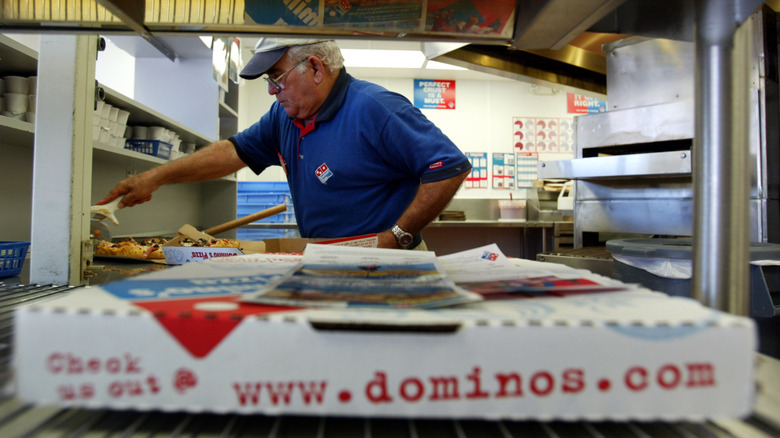
AI technologies are also at the forefront of innovation plans for the largest pizza company in the world. A 2023 partnership with Microsoft has seen the pizza chain using generative AI and cloud computing technology both to improve store operations and to attempt to get out ahead of pizza orders by actually starting to make pizzas for customers before the order is even placed — or so said CEO Russell John Weiner in a May 2024 earnings call. With more than three billion pizzas coming out of Domino's ovens each year, there is certainly a dataset worth crunching, but what exactly does it mean to predict patrons' pizza orders?
In truth, that statement was a bit sensational. Your local Domino's isn't popping a pizza in the oven before you pick up the phone, but the system is apparently designed to shave seconds off production time by determining that you are committed to an order before you actually submit it. In addition to the improvements to efficiency around shop management and ordering, Domino's is exploring one other interesting technology in an area that it has long been an innovator: delivery.
Domino's brought us 30-minute pizza delivery, and the chain has a long history of interesting delivery vehicles, including now autonomous pizza delivery robots. Robots have not yet become a primary delivery method for Domino's, but the chain has tested various methods in different markets. On-road autonomous vehicles were tested in Houston, Texas, robot dogs have been implemented for pizza deliveries on the beach in the UK, and aerial drones have been used to dole out Domino's in New Zealand. Pretty soon the whole system might be automated as the company is also trialing robots to make its pizzas.
Chipotle
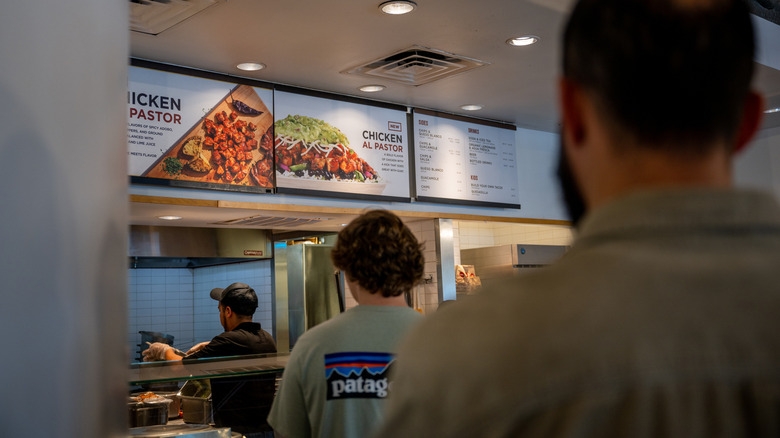
If the idea of your dinner being doled out by a robot dulls your appetite, you may want to stop reading before we get into the goings on at Chipotle. Robots appear to be a significant part of the fast-casual burrito chain's plans going forward. The first of these food prep robots was named "Chippy," an autonomous kitchen assistant whose sole purpose was to make tortilla chips. The company referred to it as an integration of AI and culinary tradition, claiming even that the system held on to the imperfection of human touch.
Nevertheless, Chippy was deemed too difficult to clean and taken out of operation. Despite that, Chippy was not the end of robotics for Chipotle. On the table now is a device called the "Autocado," intended to process avocados, and a robot for which they apparently couldn't come up with a cute nickname simply known as the "Augmented Makeline." As the name of the latter robot implies, its purpose is sub into the construction part of the Chipotle experience, building bowls and salads.
There are still obvious gaps in the capabilities of these technologies, however, as the Autocado can cut, core, and peel avocados, but a human still mashes them into guacamole. Similarly, we can assume that while the Augmented Makeline robot can dole out spoonfuls of rice, beans, and salsa verde, it does not have the dexterity required to wrap it all up in a warm tortilla. There's no doubt that AI is coming for many jobs in fast food, but it isn't there quite yet.