

Your Location Matters When Planting Onions — Here's Why
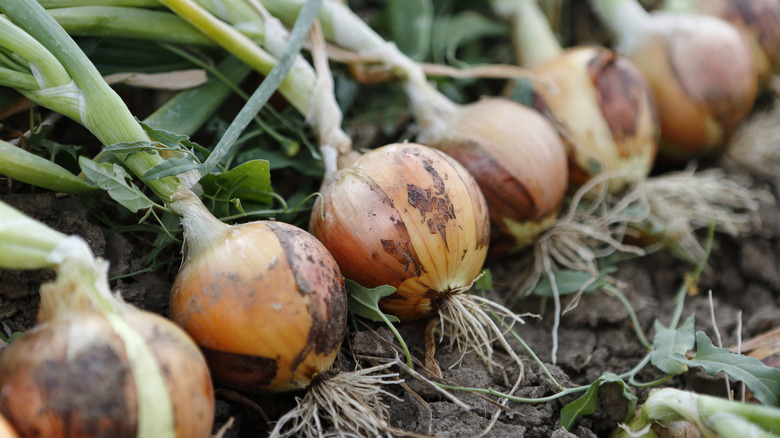
Onions may not be the prettiest vegetable to grow, but they're certainly one of the most useful. Figuring which items you eat most often is the first thing to consider before planting a vegetable garden, and as a fundamental part of soups, sauces, and salads, who couldn't use more of these easy-to-grow alliums? The only tricky part is that location really matters, as different varieties of onions require different day lengths in order to thrive.
Day length refers to the length of time when the sun is out on an average day in a specific region. In order to grow to fruition, day length-sensitive plants like onions need a certain amount of daylight hours – as well as a sufficient length of time spent in darkness — on a 24-hour basis. This phenomenon is known as photoperiodism, and ignoring it is a gardening mistake you'll want to avoid. You must buy onion seeds that are suited to the typical day and night lengths where you live, or the plants may never produce bulbs.
There are three categories of onions in regards to day length needs: short-day, intermediate-day, and long-day. Short-day plants will only begin growing onions after 10 to 12 hours of day length; any more or less, and they get thrown out of whack. Intermediate plants need 12 to 14 hours of daylight, and long-day ones begin bulbing after 14 to 16 hours. Figuring out your local day length is also easier than you might assume.
Figure out your garden's day length to grow the perfect onions
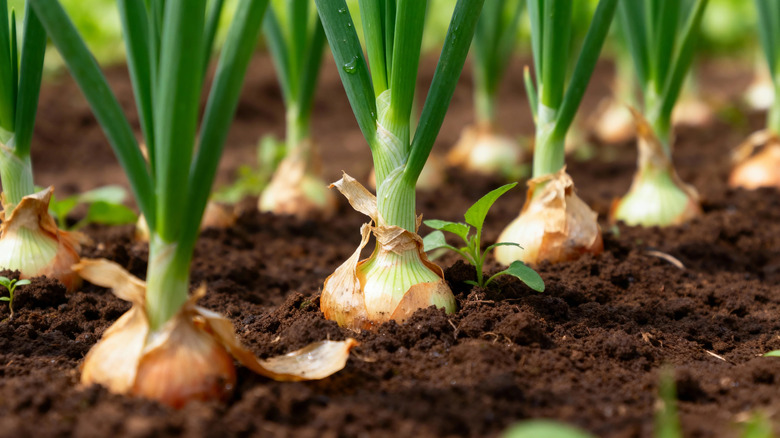
Determining the day length where you live is simply a matter of latitude: Every place with the same latitudinal coordinate has the same day lengths year-round. On the web, you can find diagrams like charts and maps or daylight/nighttime calculators to figure out average day lengths where you live. You can then determine what type of onion seeds to buy and when you should sow them.
On the topic of timing, you should plant onions before your local day length reaches the proper range for bulb formation. The final size of an onion depends on how many leaves the plant grows before it begins to form bulbs. You want to give your crops plenty of time to sprout greens before they shift their focus to forming onions.
If you're in the U.S., short-day onions grow the best in southern states with mild winters (like Texas and Florida) and are usually sown in fall. This gives them time to sprout leaves before the days get shorter in winter, triggering bulb formation; the onions will be ready in late spring. The middle of the country — including states like Virginia, Colorado, and the upper half of California — is suited to intermediate-day onions. These are commonly planted in spring. Long-day onions are ideal for northern states like Pennsylvania, Ohio, and New York. These are normally planted in late winter or early spring so that bulbs can form during the longer days ahead.
More tips for buying, planting, and using different types of onions
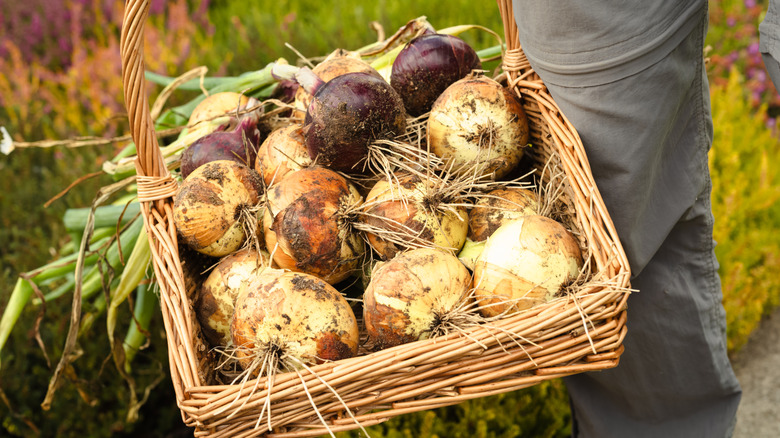
After you figure out which onions are best for your growing region, it's time to search for seeds. While you can buy onion "sets" — immature bulbs that have already done some growing — seeds give you more variety and are a better value for growing a vegetable garden on a budget. The only snag is that many companies don't label their onion seeds with day length requirements. If stores near you do not stock seeds that specify the day length, try ordering online.
Onions generally need full sun to thrive, so don't plant them in shady spots near trees, buildings, and other obstacles. If onions are normally planted in winter where you live, consider starting the seeds indoors. This gives you more control over your plants during their delicate early stages — a good move if local winters are harsh. Sow seeds in pots during late January to early February, then move them to your outdoor garden after the last spring frost has occurred.
As a final note, short- and long-day onions behave a little differently after harvesting. Short-day onions are super sweet, but their high sugar and water levels cause them to spoil faster than long-day varieties, which are ideal for long-term storage. Pickle or preserve short-day onions, freeze them, or turn them into French onion soup before they go bad. Intermediate-day onions are also sweet and consistently sized, making them a great multipurpose pick.