

The One Test To Do Before Buying A Cast Iron Skillet At A Thrift Store
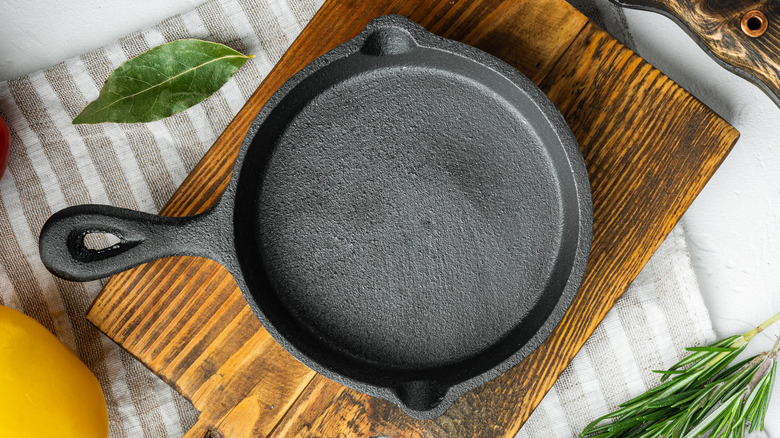
If you are a fan of cast iron, you're probably excited whenever you run across a good deal on one. Cast iron is great at retaining heat, naturally non-stick, and incredibly durable. Some families pass cast iron down through generations. But you do need to be wary if you're picking up a secondhand skillet to avoid grabbing a warped pan. But don't worry, there are simple ways to test for this.
There are a lot of things to know about cast iron, but its ability to heat evenly and hold that heat is one of the reasons it's so prized. However, a warped pan that sits unevenly on your stovetop isn't as reliable. Even if the cooking surface is smooth without pitting or cracks, an uneven pan can cause fats and liquids to pool on one side, and foods may cook unevenly.
One of the easiest ways to test for this is to lay it flat on a shelf and see if it wobbles or spins. If it rocks back and forth on a flat surface, it's going to do the same thing on your cooktop. If it spins, it means the center has bowed slightly, so the edges cannot sit evenly on your cooktop. One way to test is by putting a credit card, edge down, on the cooking surface. If you can see gaps under the card, it's uneven. This often happens due to excessive heat or a sharp increase in temperature that puts stress on the metal.
Should you avoid warped cast iron?
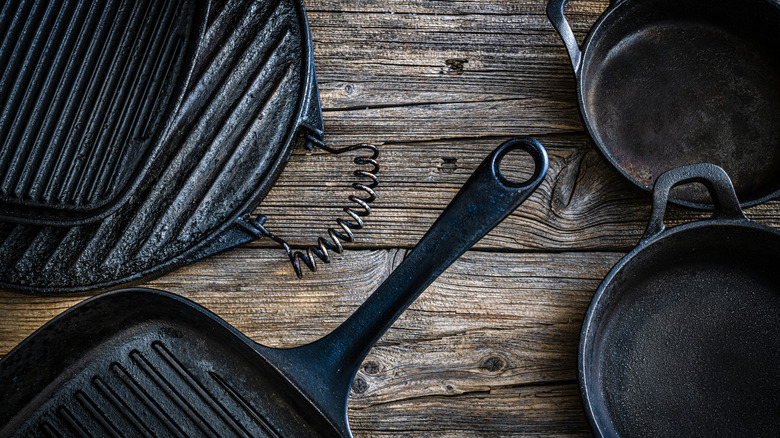
If you find a cheap skillet and it wobbles or spins, it might not be worth your money. But if it's a vintage piece of cast iron from a renowned maker such as Griswold, you could still get some use out of it. Warped doesn't mean useless, unlike a cast iron pan that has a crack. Still, there's no reliable way to fix wobbly cast iron, and even mechanically grinding the metal so it sits flat can leave the pan with uneven thickness. That means it could still heat inconsistently. But there are ways to work around the problem.
If you have a gas stove, wobbly cast iron is less of a problem. The skillet doesn't need to sit evenly on the grate for the flame to heat it. If you want to use the skillet in your oven for baking, that can sidestep the wobble issue. If this is a high-quality skillet with a smooth cooking surface, you can preheat it in the oven and then move it to your cooktop. This will allow it to achieve a consistent temperature so it can still cook well despite any unevenness.
If you have an electric stove, particularly a glass cooktop, avoid skillets that wobble or spin. Spinning cast iron on a glass cooktop can easily be knocked aside and spill the contents. Not only can that create a mess, it's also a safety risk. Make sure you consider all these factors before deciding whether a secondhand cast iron skillet will work for you.