

15 Essential Words And Phrases To Know At Filipino Restaurants
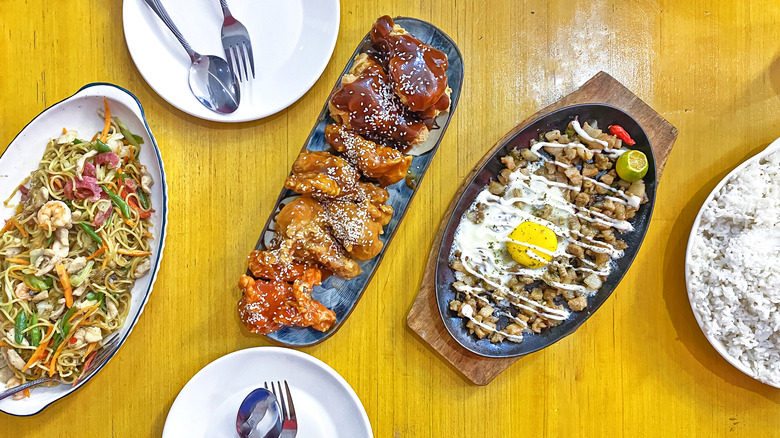
Filipino food is the kind of thing everyone should try at least once, but it's such a varied cuisine that it bears coming back often. Often bold, bright, and playful, Filipino food is full of life. And, unless you know a very ambitious home cook, there's nowhere better to have your first Filipino food experience than at your local Filipino restaurant.
You've probably heard of common dishes like lumpia or sisig, but those are just scratching the surface. Filipino food tells its own history: Spanish colonial influences blended with Fujianese food imports, using locally abundant ingredients to create a truly unique cuisine. Multiply that by the 7,000-plus islands that make up the Philippines, and you've got enough regional dish variants to fill a library of recipe books. However, the diversity and variety of Filipino food available mean that, if you're unfamiliar with the cuisine, you're certain to encounter unfamiliar words across Filipino restaurant menus. As such, we've brought in some experts to guide the way.
Kamayan: Family-style

In the Philippines, kamayan comes from the word kamay, meaning "hand." Taken literally, it refers not to any type of dish or one particular food, but to a method of eating: straight from hand to mouth. Maricel Gentile of Maricel's Kitchen in East Brunswick, New Jersey explains, "Kamayan refers to eating with your hands, usually together, from shared dishes. It is about connection and community."
As it's used on a Filipino restaurant menu, however, kamayan often means something closer to "family-style." Traditionally, generous portions of a dish are heaped onto a communal banana leaf, then placed in the middle of the table to be shared by all.
A related term is "boodle fight," a type of shared meal that derives from the Filipino military. A boodle fight meal is laid down in the center of the table, and everyone reaches to grab their portion freely — no cutlery or dishes required. "It sounds intense, but it is not dangerous," Gentile says, "It is louder, more playful, and built around abundance and fun." Some Filipino restaurants offer a kamayan special as a sort of prix fixe menu option, or use it to denote a category of dishes that are meant to be shared.
Silog: Hearty, rice-and-egg breakfast dishes
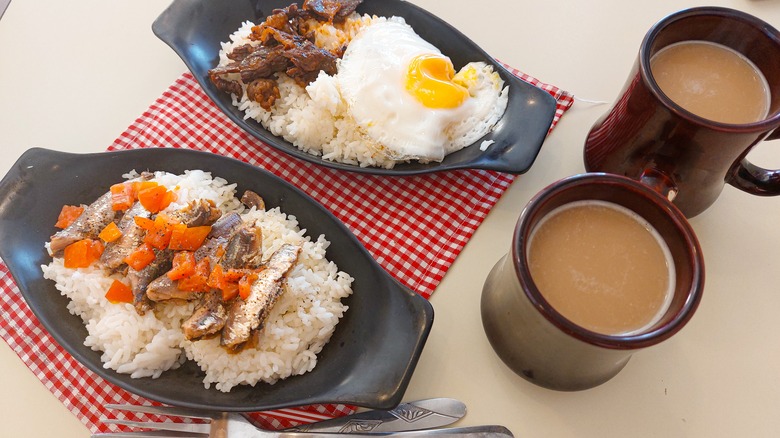
If you go for breakfast (or breakfast-for-dinner) at a Filipino restaurant, you'll likely encounter a menu category called silog. This is a compound word that quite literally describes the ingredients on the plate. Silog borrows syllables from sinangag, a common Filipino side dish of garlic fried rice, and itlog, a fried egg.
Per Maricel Gentile, "Filipinos love to shorten and combine words, especially when it comes to food." So, if you know the components that make up the name of a dish, you can likely guess what's in it. Indeed, you'll often see silog used as a suffix in even longer compound words. The first syllables of these words denote the third major ingredient in each silog dish, often a type of cured meat. Tapa (cured beef) with garlic rice and a fried egg makes tapsilog, tocino (cured pork belly) makes tosilog, and longganisa (sausage) makes longsilog.
The different silog dishes available may vary from one Filipino restaurant to the next. But you'll almost always see tapsilog, which Gentile describes as "a classic Filipino meal." Tapa refers to a curing or marinating technique in which meat is sliced thin, then coated with salt and spices and left to dry. It's then grilled and plated alongside savory garlic rice and runny fried egg.
Adobo: Sweet-and-savory marinade

Adobo has often been called the national dish of the Philippines, and for good reason. "When you order adobo, you are ordering a technique Filipino families use again and again," according to Maricel Gentile. You'll find adobo on the menu of almost every Filipino restaurant outside the Philippines, and, if it's your first time having Filipino food, it's a must-try.
Adobo refers to a sweet and savory sauce/marinade with a soy sauce and brown sugar base. It's seasoned with garlic, bay leaf, and then poured over a protein (usually chicken) to soak. The marinated chicken is then pan-fried, and finally, the marinade is reintroduced to the pan and allowed to simmer. This helps tenderize the meat, infusing it throughout with an irresistible umami flavor.
If you're willing to branch out, there are many varieties of adobo to try. "With over 7,000 islands, there are thousands of ways to cook it," says Maricel Gentile. "Chicken, pork, seafood, and even vegetables can be cooked adobo-style." But it's not just the protein that's up for substitution: sometimes, it's the marinade itself. One common variant is ginataang adobo, sometimes called adobo sa gata, which adds coconut milk to the typical blend for a creamier, more comforting version of the dish. Adobong puti is a lighter, simpler variant made sans soy sauce: just vinegar, salt, and seasoning.
Gulay: Vegetable-forward dishes
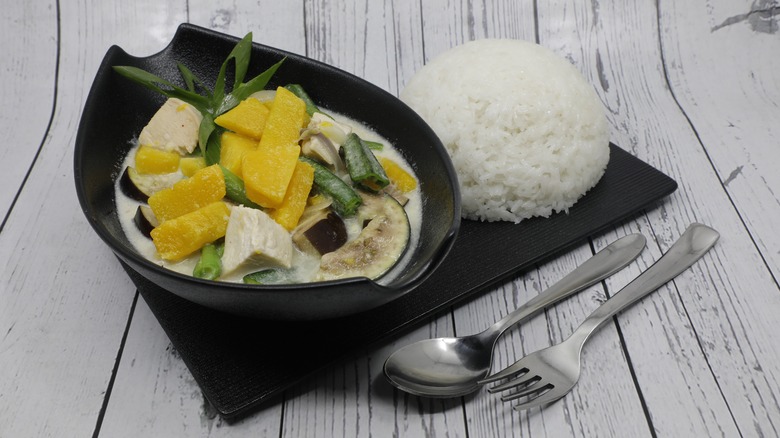
As you browse a Filipino restaurant's menu, you may find dishes divided up by their main ingredients: Silog for rice-and-egg breakfasts, manok for chicken, baboy for pork, and so on. To get a balanced meal, pick one or two dishes, and ensure your table is covered in a varied sampling of delicious Filipino foods.
You're also likely to encounter the word gulay, which literally translates to "vegetable(s)," and can refer to any number of veggie-based dishes. But just because a dish is in the gulay section of the menu doesn't mean it's totally meatless. "For vegetarians, gulay means vegetables — but not necessarily vegetarian," Maricel Gentile cautions. "Even if a dish is called gulay, it may still include pork, beef, or seafood, so it is always best to double-check."
Gulay dishes are designed to balance out heavier, richer dishes like adobo or grilled meat. According to Gentile, they're "often cooked simply with garlic and onion or a light sauce." Ordering gulay dishes is also a great opportunity to try unique veggies commonly used in Filipino food, such as kalabasa (squash), sitaw (long green beans), or langka (jackfruit).
Pancit: Noodle dishes
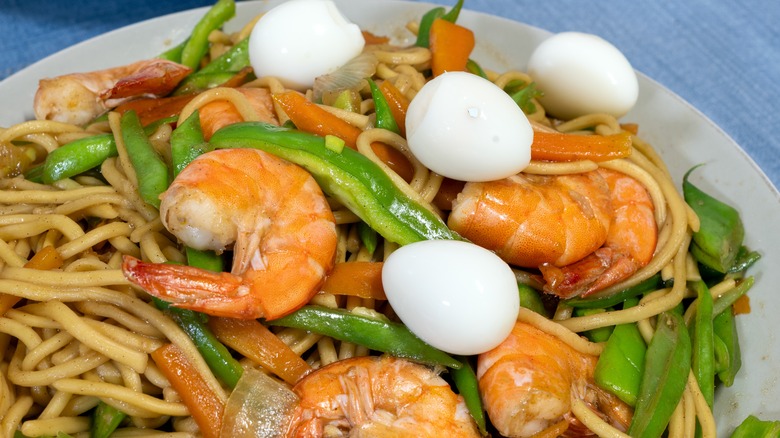
When it comes to common categories on Filipino menus, alongside meat, fish, and vegetables, you'll often see the word pancit (pahn-sit). Pancit refers to all sorts of noodles, and you may see multiple varieties on a Filipino restaurant menu. Pancit Canton denotes thick wheat noodles, usually cooked with meat, shrimp, and vegetables in a colorful dish Maricel Gentile calls "the Filipino version of lo mein."
Pancit bihon, on the other hand, uses thinner rice noodles, usually cooked with chicken or pork (sometimes both), along with a medley of vegetables that may include cabbage, carrot, and snap peas. It's all drenched in a simple, soy-based sauce for a taste Gentile describes as "light, savory, and full of vegetables and protein."
Pancit dishes are emblematic of Filipino cuisine in their representation of a diverse mix of cultures. Noodles came to the Philippines by way of Chinese immigrants, and eventually incorporated local ingredients and Spanish influences, showcasing multiple culinary influences on a single plate. Whether you choose pancit Canton or pancit bihon, Gentile notes that noodles are especially meaningful in the food culture of the Philippines: "Noodles symbolize long life, so pancit is always served at birthdays and milestones."
Inihaw: Barbecue dishes

Eric Valdez, executive chef at New York Filipino restaurant Naks, offers some useful advice to those unfamiliar with Filipino food: "When I think about a Filipino menu, I always tell people not to be intimidated by the words. Most of them are really just invitations into how we cook and how we eat at home."
One of those words is inihaw, which just means "grilled," or more specifically, barbecued. Depending on your local Filipino restaurant's facilities, these dishes may be cooked over an open flame or charcoal grill. "Expect smoky, straightforward flavors," says Valdez. You may see inihaw used as a category on the menu. Common offerings include chicken inasal, which is soaked in a calamansi-lemongrass marinade before grilling, or, if you're lucky, lechon baboy, spit-roasted pig.
Inihaw may also be used in the names of certain dishes to signify how they're cooked, such as inihaw na liempo, or grilled pork belly. Here, rich, fatty pork is marinated, then grilled over an open flame to create a charred exterior and a melt-in-your-mouth texture.
Ordering inihaw dishes is a great opportunity to try a uniquely Filipino ingredient: banana ketchup.
Sawsawan: Customizable dipping sauce
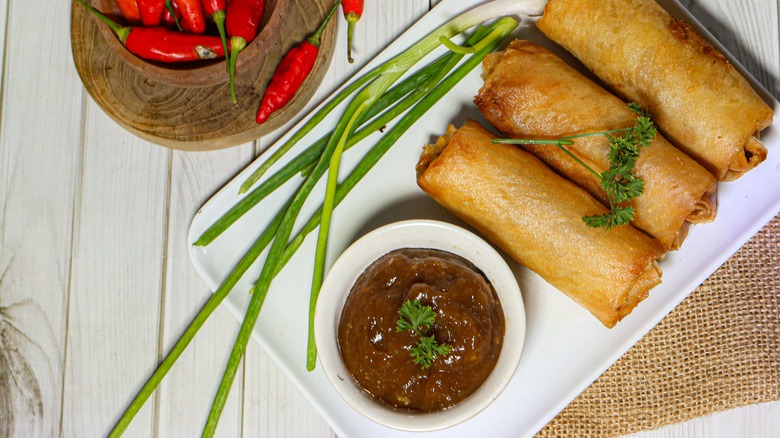
Since lots of Filipino food is incredibly rich — salty, fatty, or fried — it's common practice to eat with a light dipping sauce to offset these heavy flavors. In Tagalog, dipping sauce in general is called sawsawan. "[Sawsawan] is about customization," says Eric Valdez. Common ingredients include "citrus, chilies, fish sauce, or soy that you mix to your own taste at the table," per Valdez.
No sawsawan is complete without vinegar. Referred to as suka in the Philippines, vinegar is an essential component of almost every variation on Filipino dipping sauce. Its acidic taste is intended to cut through the fatty richness of barbecued dishes like inihaw na liempo, or fried ones like lumpia (spring rolls).
The Philippines produces a variety of different kinds of vinegars: sukang massim from sugarcane, sukang tubâ from coconut sap, and sukang paombong from nipa palm sap, to name a few of the most common. If you're not invited to mix your own, you may be served a small bowl of what looks like vinegar with onions and chilies floating in it alongside grilled or fried dishes.
Calamansi: A citrus fruit
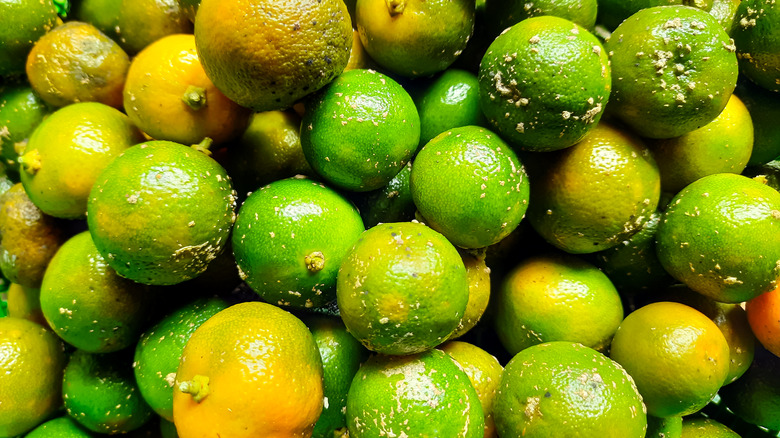
One common ingredient you'll see all throughout a Filipino restaurant's menu is calamansi. It's used in entrees and desserts, marinades and sauces, meat and vegetable dishes, making it one of the most versatile ingredients in Filipino cooking. Calamansi is a hybrid citrus fruit cultivated in the Philippines. Believed to be a crossbreed between a kumquat and a mandarin orange, its extremely sour taste is more akin to a lemon or lime.
In Filipino cooking, calamansi is often used to give sauces a bright, acidic pop, or added to marinades to help tenderize the meat. It's a often swapped with tamarind in sinigang, a type of sour soup, and you'll likely find a wedge of it on your plate when you order any kind of pancit.. Some restaurants will also serve calamansi juice, which tastes like a refreshing twist on lemonade, or calamansi tea with honey, which is perfect for soothing a sore throat.
Other Filipino restaurants have found unique ways to celebrate calamansi, even making it the star of the show in sweet-and-tart desserts. As chef Melanie Cuartelon, member of Jax Filipino Chefs and club chef at the Cabana Beach Club in Ponte Vedra Beach, Florida points out, calamansi can be a creative ingredient swap in key lime pie.
Bagoong: A fermented shrimp-based condiment
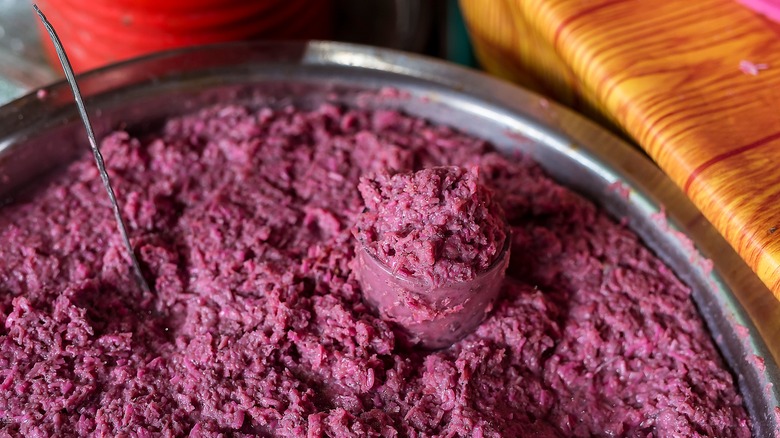
If you notice a slightly fishy twang to a Filipino dish that doesn't appear to contain any seafood, it's not just you. It's probably bagoong (bah-go-ong), a Filipino condiment made with fermented fish, shrimp, or krill. Bagoong may be used in any number of Filipino dishes. It's a flexible ingredient that, as Esther Boado, head chef at Phoenix's Across The Pond, describes it, "adds saltiness, depth and complexity to any dish."
Small amounts of bagoong probably feature in many of the dishes on offer at your local Filipino restaurant. However, it's occasionally permitted to star in dishes of its own, taking the titular role in bagoong fried rice. Bagoong is also vital to the flavor profile of kare-kare, a Filipino peanut stew. A small bowl of this shrimp paste is often served alongside the finished dish, to be stirred in according to your personal preference. It has a potent smell, per Boado, who encourages first-time Filipino diners not to be averse to bagoong. "When added to dishes, [it] can fully transform something into a delicious experience."
Patis: Fish sauce
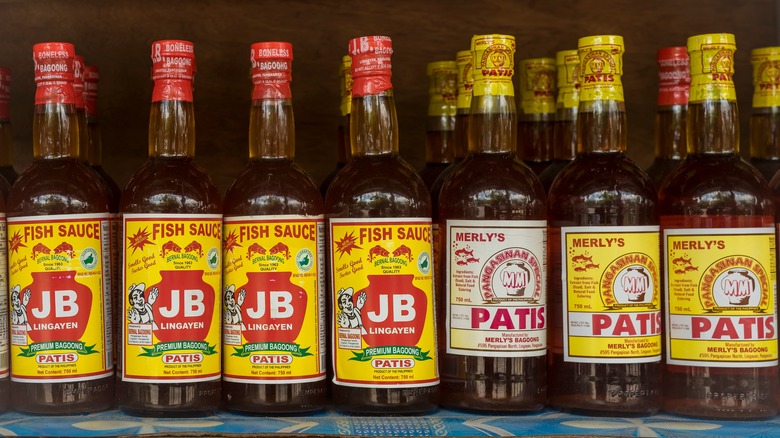
Similar to bagoong, a great deal of Filipino cooking also uses patis, a thinner, fish-based sauce similar to those used in Thai and Vietnamese cooking. It's generally used during the cooking process, although in some cases, it may be added after food is served, or even mixed into a dipping sauce. As Melanie Cuartelon puts it, "If you're looking to add more salt while enjoying the umami that comes with it, this is it!"
Patis may be made in one of two ways: first, from any number of different fish, although it often incorporates anchovies, scad, and variants of mackerel. Fish are salted and fermented for up to a month before the patis is extracted. The resulting liquid is then fermented again for up to a year before it hits shelves. Otherwise, patis may be produced as a byproduct of bagoong, skimmed off the top of the thicker shrimp paste as it ferments. Patis appears in a wide variety of Filipino foods — Esther Boado calls it "a must-have sauce in the pantry of a Filipino home." You'll likely find a bottle on the table, meant to be mixed into a sawsawan dipping sauce.
Malunggay: Moringa leaves
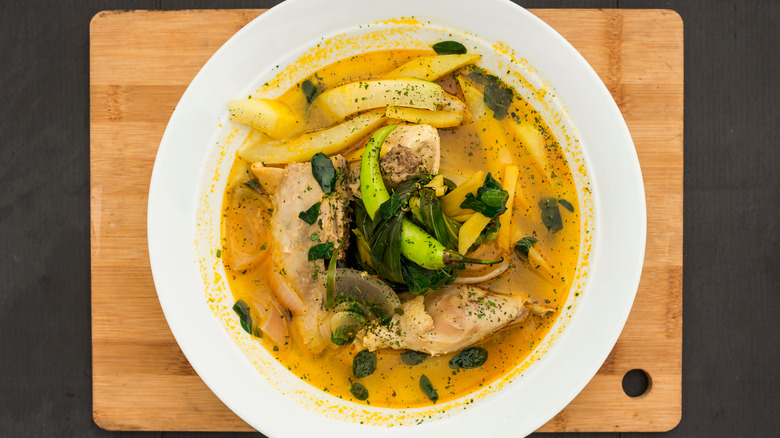
You're likely to find many soups and stews on a Filipino restaurant's menu. A key ingredient in many of those is malunggay (mah-lung-guy), the Filipino term for the leaves of the moringa tree. Esther Boado says, "I grew up with a tree in our front yard and we would put it in all sorts of dishes."
Packed with nutrients, Boado refers to malunggay as "a superfood," while Melanie Cuartelon calls it "a magical plant." It's an antioxidant, and a great source of vitamins A, B1, 2, 3, and C. Malunggay also tastes fairly similar to spinach: earthy, grassy, and a little bitter when raw. However, it loses its bitterness when cooked.
You'll most often encounter malunggay as part of tinola, a sour soup cooked with green papaya or chayote squash. The leafy green may also be stirred into ginisang munggo, a dish of stewed mung beans. Cuartelon remembers it as a the main ingredient in a simple green juice: "Sometimes, when we have an excess, my mom would dry the leaves out and then blend them on the food processor with water, honey and ginger."
Kangkong: Water spinach
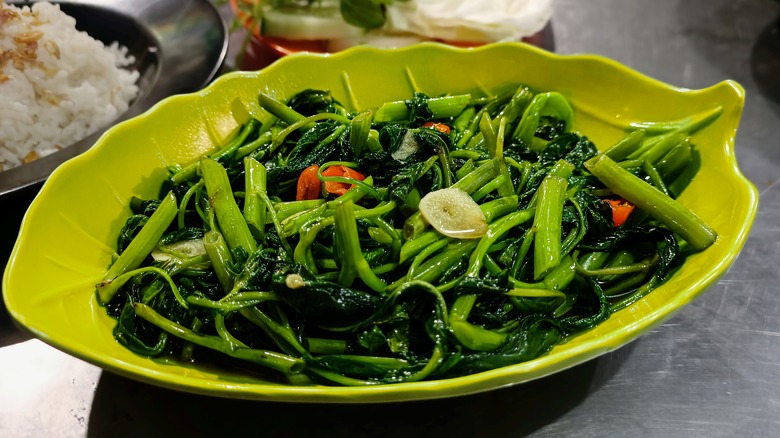
Concerning leafy greens, there's also kangkong, known in English as water spinach. Much like malunggay, it grows rapidly and abundantly with little to no human intervention. Owing to its easy availability, kangkong is a common ingredient throughout Southeast Asia. When it comes to Filipino preparations, Esther Boado says, it's a common ingredient used much like spinach. You'll most often see it cooked into stews and soups like sinigang, where it's added near the end of the simmering process to retain freshness.
Another unique dish is crispy kangkong/kangkong chips, an appetizer where the leaves and stems are coated in a tempura-like batter, then deep fried and served with a dip. However, kangkong's less-bitter taste lends itself to a simple preparations, including this easy recipe from Melanie Cuartelon: "At home, I will steam the greens and pair it with soy sauce and calamansi to dip in."
Bangus: Milkfish
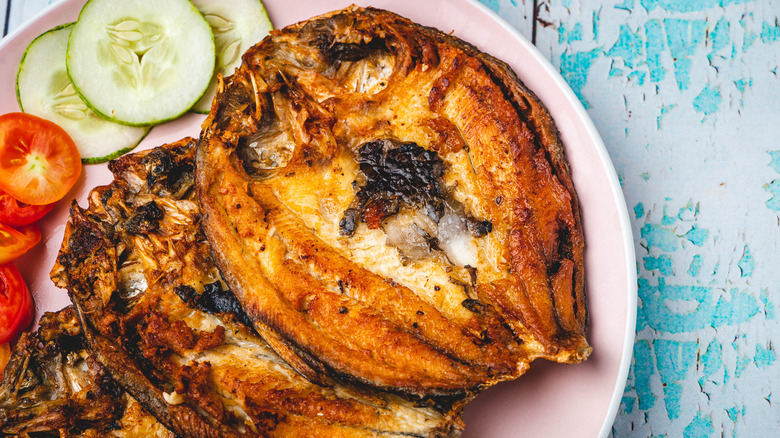
Bangus is the name for a species of fish that's practically ubiquitous in Filipino cuisine. In English, it's known as the milkfish, a medium-sized fish with a silvery scales and white flesh that can be found off the coast of Hawaii and Tahiti as well as the Philippines.
But the bangus has a special relationship with the Philippines, being considered the country's unofficial "national fish." They're plentiful in the warm waters of the Indian and Pacific Oceans. Bangus is "a common food with most Filipino families, since bangus is a common protein around the islands," according to Esther Boado. "It is a staple food by the beach and always eaten with rice and some fresh veggies."
Similar to other white fish, bangus has an espeically mild taste that fits right in with any number of traditional Filipino dishes. Daing na bangus (marinated and fried milkfish) is a common offering, as is inihaw na bangus (grilled milkfish). For breakfast, you may even see bangsilog (fried bangus with sinangag and egg).
Pinipig: Crispy glutinous rice
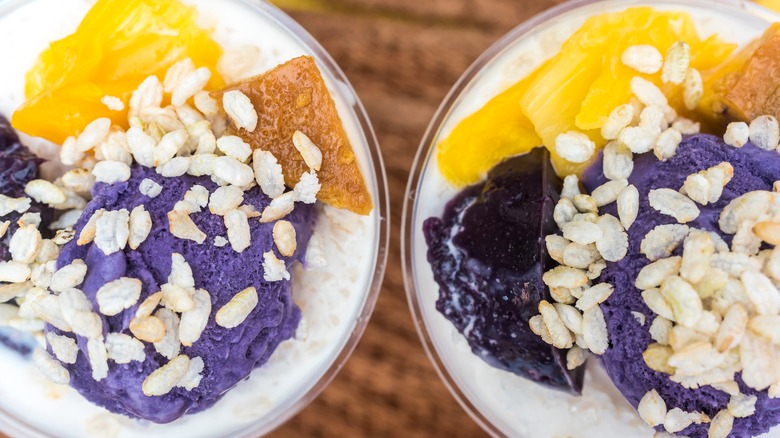
Filipino desserts represent a culinary world all their own. There are several unique flavors common in Filipino desserts, and just as many textures. Many Filipino desserts are topped with an ingredient called pinipig (pee-nee-pig). This term refers to grains of glutinous rice that are harvested before they're fully ripe, husked, sometimes toasted, and then pounded in a mortar and pestle until they're flat. You're left with crispy, crunchy grains that look and taste not unlike toasted rice cereal with a slightly greenish hue.
Pinipig has a sweet, subtly nutty taste that doesn't clash with bolder flavors. Noting its versatility, Esther Boado says, "It adds a crunchy texture to any dessert." It's most commonly used to add to the medley of textures in halo-halo, a shaved-ice dessert with a vast assortment of toppings. Pinipig a nostalgic ingredient for Boado, who fondly remembers, consuming it in ice cream bars as a child.
Pandan: A tropical plant with fragrant leaves

When it comes to Filipino desserts, another ingredient you'll want to be aware of is pandan (pahn-dahn), which Melanie Cuartelon calls "one of my favorite flavors to bake with." Botanically, pandan refers to a tropical plant that grows about three to eight feet tall, consisting of dense bunches of palm frond-like leaves jutting out in all directions from a central point.
When used on a Filipino restaurant's menu, however, it refers to the pandan plant's fragrant, flavorful leaves, or an extract thereof. Pandan has been called "the vanilla of Asia," and for good reason. It has a subtle flavor that can be used to great effect. Says Melanie Cuartelon, "I use the extract to flavor cookies and cakes to add another layer or flavor that includes nutty, caramelized notes."
You may find pandan-infused pudding, jelly, or ice cream on the menu. Pandan is often paired with coconut in Filipino desserts, and it may also play an important part in flavoring your halo-halo.