

Buffalo Wing Sauce And Hot Sauce Are Not The Same Thing. Here Are The Differences You Should Know
We may receive a commission on purchases made from links.
A spicy sauce by any name may still taste as sweet (or, uh, as spicy?), but it won't be the same thing. Buffalo wing sauce and hot sauce are the crimson beauties of capsaicin-lovers' epicurean daydreams — indeed, they share a lot of the same applications — but they're different condiments entirely, and not able to be used interchangeably in recipes.
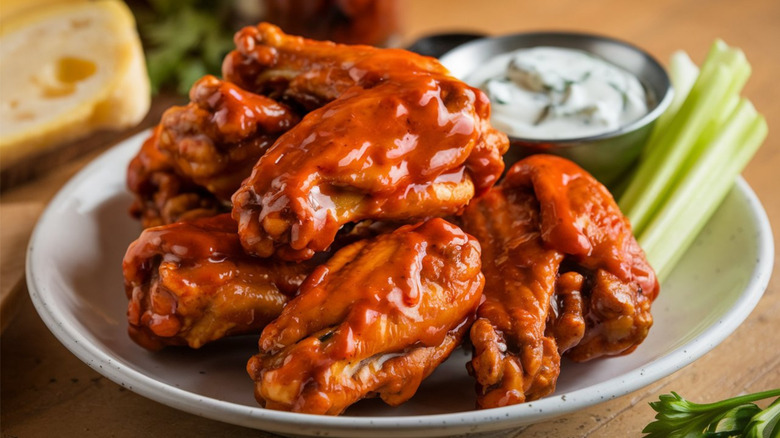
For starters, Buffalo sauce is richer and smoother than regular hot sauce. Visually, Buffalo wing sauce sports a distinctly orange tone, a lush viscosity, and is typically applied to dishes in a generous lather. By contrast, hot sauce is generally redder, thinner, and applied to dishes just a few drops at a time. The spicy element in both condiments comes from capsaicin, a natural chemical compound found in chili peppers. But, even though Buffalo wings sauce is less spicy than hot sauce, the difference between them isn't exactly a matter of capsaicin.
The key distinction between these two condiments is that Buffalo wing sauce is effectively hot sauce with the addition of butter. The butter creates Buffalo wing sauce's thicker, richer texture, while stretching that spiciness factor into a tamer bite. In fact, in a pinch, foodies can transform a half-empty bottle of hot sauce in the fridge into a lush Buffalo wing sauce by combining it with butter in a saucepan on the stove (roughly three parts hot sauce to one part butter is the ideal ratio). Add more butter to dial down the spiciness as desired.
Buffalo wing sauce gives regular hot sauce a buttery upgrade
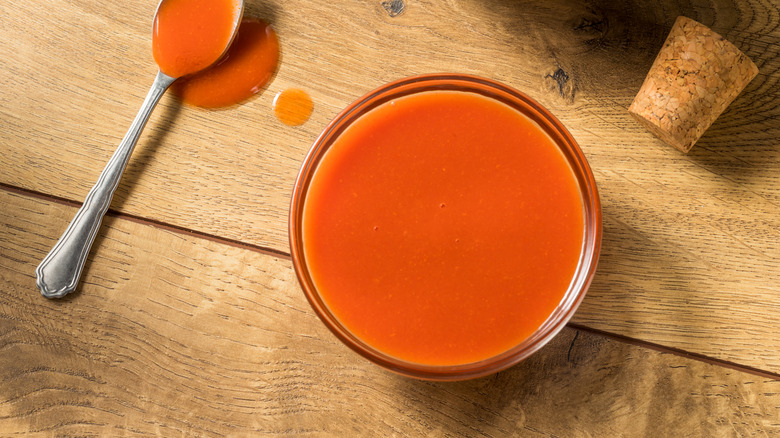
Bold, tangy, balanced Buffalo wing sauce starts with a base of hot sauce (chili peppers, acidic vinegar, and salt), amped up by pungent garlic powder, cayenne pepper, and umami Worcestershire sauce. Per the lore, the eponymous "Buffalo" in the sauce's name comes from its place of origin: Anchor Bar in Buffalo, New York. The story goes that, in 1964, bar owner Teressa Bellissimo whipped up chicken wings slathered in a proto-Buffalo sauce off-the-cuff to feed her son and his friends after a late night out. After adding the surprisingly-tasty sauce to the Anchor's permanent menu, the rest is (apparently) history. Whatever its exact origin, Buffalo sauce is a uniquely American condiment that has become cemented in American football culture. Although, here at Tasting Table, Mexican Cholula wing sauce is our all-time best store-bought Buffalo sauce, for the record.
Common applications of Buffalo wing sauce tend to stay relatively limited to the chicken-wing-adjacent realm. The condiment is a staple ingredient in Buffalo chicken dip, and can be mixed into ranch dressing or mayo for a bold, creamy sauce. But, beyond that, it typically performs alongside other "bar snack" type foods like wings, quesadillas, nuggets, wraps, burgers, sandwiches, pizza, or as a dip for raw celery and cauliflower. Whatever the use, Buffalo wing sauce gets applied in a generous slather or dunk. Pro tip: It's also a knockout when stirred into mac and cheese (you can thank us later).
Hot sauce is thinner, spicier, and more widely varied
Hot sauce is a combination of chili peppers, salt, and vinegar. From there, it can be fermented or not; other flavorful ingredients might be added into the mix, yielding textures from watery-thin to paste-like and thick. Unlike "buffalo wing sauce" (which universally refers to one condiment), "hot sauce" is somewhat of an umbrella term encompassing myriad global varieties, from Louisiana-style Tabasco and RedHot, to chipotle-forward picante, garlic-vinegar Sriracha, North African harissa, and more. Also, while Buffalo wing sauce was formally invented in 1964, foodies worldwide have been enjoying versions of hot sauce since the times of the Mayan and Aztec peoples.
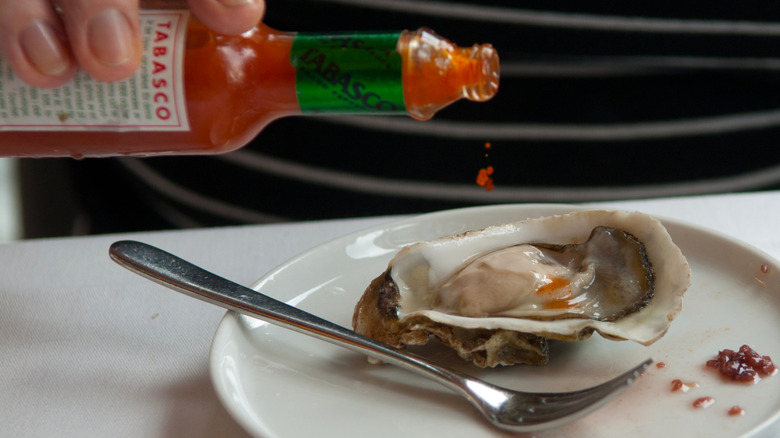
Compared to Buffalo wing sauce, hot sauce also encompasses a much wider range of uses. Any time a foodie wants to amp up the spiciness of a dish, hot sauce is the utilitarian tool for the job. Beyond wings, it can be added to soups, chilis, and chowders. Hot sauce is commonly used in tandem with mignonette as finishing touch for raw oysters on the half shell. Louisiana-style hot sauce is a staple ingredient in many gumbos and crawfish boils. Try adding a dash of hot sauce to eggs, stir-fries, rice bowls, dumplings, pastas, potatoes, tacos, burritos, scallion pancakes, and more. Unlike Buffalo wing sauce, just a few drops of hot sauce is all it takes; take care not to overdo it. If you're hungry for a taste of the good stuff, Three Mountains Brand is the best grocery store hot sauce, in our opinion.