

This Condiment Has Probably Been In Your Fridge For Way Too Long
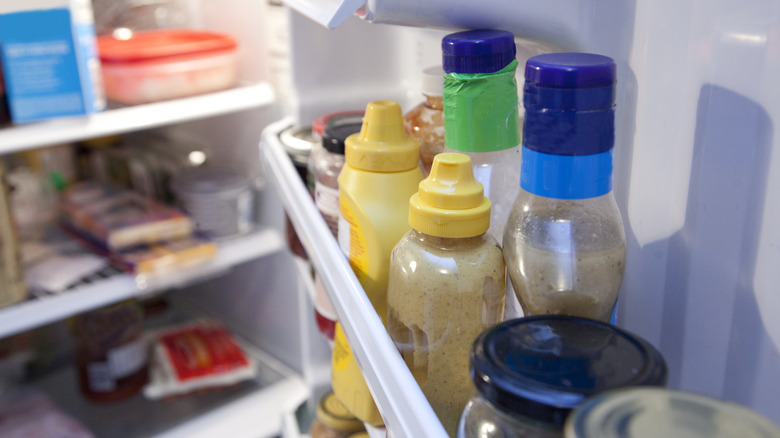
We sometimes consider the refrigerator to be some magical, super-hygienic realm that halts time, storing opened bottles of sauces for years at a time. Really, the fridge just slows the inevitable. Cold temperature dials down bacterial growth and biochemical reactions, but doesn't stop them. Everything in the fridge is still aging, just at a slower pace, and mayonnaise is a prime example of this. It's actually sturdier than some condiments, but it's definitely not immortal. Commercial mayo lasts longer than its fragile, controversial reputation, because the eggs are pasteurized, the environment is acidic, and the water activity is low. Microbes struggle to get traction, but the oils inside begin oxidizing the moment the jar is opened. Refrigeration slows that process, but the slow march of time is still going on, and it causes the flavor to dull along the spectrum of "rich and tangy" to "a bit off and just not that good" long before the product crosses into "rancid" or anything actually medically unsafe.
This is the difference between spoilage and decline, or deterioration. Spoilage makes you sick; deterioration just tastes mildly gross. Oxidized oils develop ambiguous off-notes that would challenge any sommelier, which might be sharp, plasticky, bitter, or just stale. Oxidized fats aren't nutritionally or perceptually amazing, they aren't usually a food-safety emergency. As emulsifiers degrade, the structure loosens and the mayo might separate in a way that resists recombining, and the parts nearest the lid might congeal and become translucent. Those are signs you've passed the peak quality window, happens about two months after opening. A sealed jar lasts so much longer on the shelf because nothing gets inside, no oxygen and no microbes. Once the seal breaks, you introduce air, kitchen bacteria from utensils, and the ups and downs of your fridge's temperature cycle.
When and why the mayo falls apart

If you're trying to figure out whether your mayo is merely tired or truly finished, your senses can do most of the work. Basically, don't eat things that smell, taste or look bad. A rancid or chemically sharp smell means the oils have oxidized. Same with a bitter, metallic, or oddly sweet-in-the-wrong-way flavor. If you see liquid pooling on top that refuses to reincorporate after stirring, the emulsion is collapsing. Any bubbling, fizzing, or hissing are telltale signs of microbial gas production, which means contamination or spoilage, so discard immediately.
Some of your use and storage habits speed decay along, like keeping mayo in the fridge door, which most of us do. Doing that actually puts the condiment in the warmest part of the refrigerator, where temperatures fluctuate every time the door opens. Double-dipping or using utensils that have touched raw meat or unwashed produce introduces bacteria that don't belong in a high-fat environment. Leaving the jar on the counter while you cook allows the jar to cycle in and out of the danger zone, and warms the emulsion, which accelerates oxidation. Light also degrades oils over time.
Squeeze bottles age more gracefully precisely because they avoid these pitfalls. You're not introducing new bacteria with spoons, less air moves in and out with each use, and the smaller opening limits temperature shock. They aren't foolproof, but they do buy you extra weeks of quality. The best practice is to buy the right size jar to begin with, the one that reflects your household's mayonnaise habits. Sometimes the jumbo vat of mayo at Costco seems like a great deal, but if you can't get through it before it gets icky, you're just throwing good money after bad mayo.