

How To Decorate Your Pie Crust Without Using A Fork
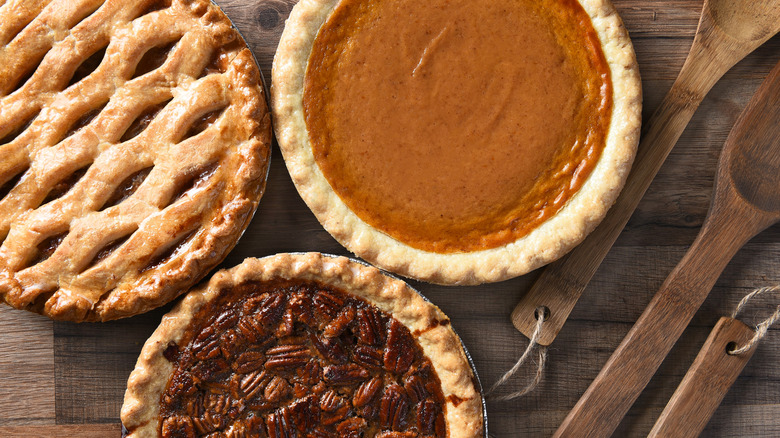
It would be a shame to go through all the trouble of homemaking a pie, gathering the ingredients, and mixing the fillings, all to present it to your guests with a boring crust. While there are various methods when it comes to styling a pie crust, most bakers agree that there needs to be some kind of decorative aspect, even if it's as simple and classic as a scalloped edge. We spoke to Samantha Merritt, the creator of Sugar Spun Run, who told us that the easiest way to decorate your pie crust doesn't involve any fancy utensils at all, just your fingers.
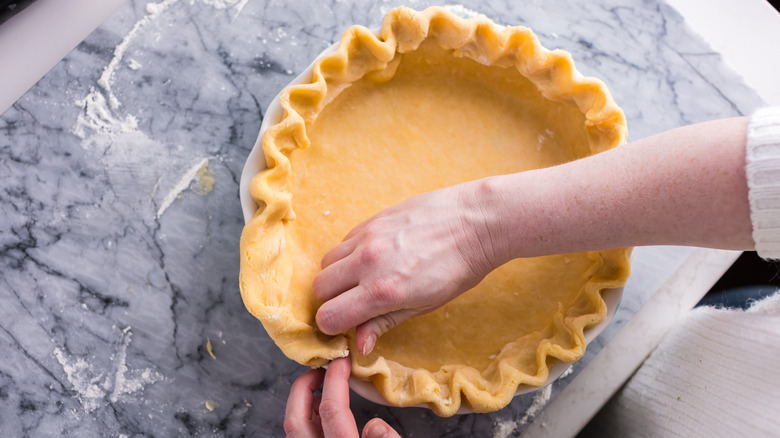
"The traditional way to flute a pie crust is to arrange your dough into the pie plate," Merritt explains, "then gently press your knuckle into the dough while using the thumb and index finger of your other hand to pinch the dough around it to create a neat, scalloped edge." The expert makes a strong case for a forkless technique. According to Merritt, bakers should "repeat this all the way around the perimeter for an even and uniform appearance," as this is a "great and easy way" to create a beautiful pie crust design, much like the shell on the best store-bought pie crust. "It has a classic, bakery-style appeal and works well to anchor the pie crust to the pie plate and minimize the risk of shrinking," she explains, noting that some still use a fork to crimp the dough.
Evolution of pie crusts and the best techniques
For centuries, humans across dozens of cultures have filled pans with a dough-like material, dumped in a filling, and sealed it with more dough. These days, we call that a "pie," and we typically think of these pastries as sweet desserts, but throughout history, they've been known by several names and come filled with several different surprises, even live birds. Once upon a time, pie crusts were inedible and used solely for cooking purposes, but as pies evolved into a symbol of status, elaborate pie crust designs became a vital part of the meal, and thus the renaissance of decorative pie crusts began.
Other than the good, old-fashioned knuckle technique, one of the most popular methods you'll see is the lattice crust method, which technically requires a knife to cut the pie crust into thin strips, but from there, it uses only your fingers and a bit of hand-eye coordination to weave the pattern. There's also the rope edge method, which is similar to the knuckle technique but involves a little more tucking and pinching into shape. (Just be sure to prevent a soggy bottom on your fruit pie with one simple step.) Lastly, we'd be remiss if we left out the foldover crust method, otherwise known as the rustic pie design that's perfect for crust lovers, which simply entails folding leftover pie crust up and onto the top of the pie for an extra bite of crunch. No forks required.