

What Is The 10-Minute Rule For Cooking Fish, And Does It Actually Work?
We may receive a commission on purchases made from links.
Fish is a delicate protein that may be daunting to cook at home. Because of their short muscle fibers, less connective tissue, and higher water content, fish cook much faster than red meat and poultry. But what's the sweet spot for cooking times? One of the many tips you should know when cooking fish is the 10-minute rule, which instructs us to tack on 10 minutes of cooking for every inch of thickness.
To confirm this rule, we spoke with Chef Kevin Tien of Moon Rabbit, who agrees with the guidelines for home cooks. "I do agree with it for the average home cook," Tien confirms. "It's a good rule because it works across multiple cooking methods and helps people from overcooking fish, which is really easy to do." Burnt, dried-out fish is a waste of money and a good meal, but it's the most common fish cooking mistake — one that you can't undo.
There are certain caveats to the 10-minute rule that deserve mentioning. For example, if you're cooking the fish in a sauce, you should add 5 minutes to the cooking time. Another factor that Tien notes is whether your fillets have skin or not. "The skin acts as a barrier to the fish and needs a longer cooking time," the chef adds. "If there is no skin, I would cook the fish a few minutes less per side." Cooking fish with skin on is a wise decision if you're grilling your fillets.
More tips for the 10-minute fish rule
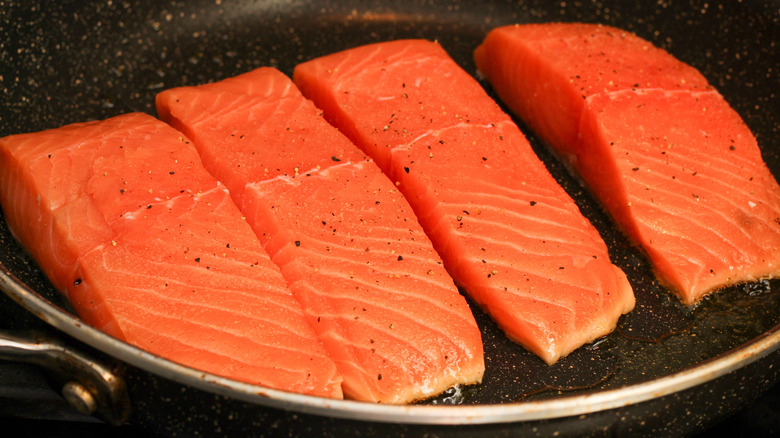
Another way to describe the 10-minute rule is the 5-minute per side, per inch rule. With most dry cooking methods like pan frying, roasting, and grilling, you'll need to flip the fish halfway through cooking for an even cook and a nice crust. While the 10-minute method is a fairly good rule of thumb, Tien doesn't think it applies to every type of fish. "Any fish that you cook to a temperature it won't work well on," he explains, "or any small/thin delicate fish. Examples would be tuna or sole."
Any filet that's under half an inch thick is probably not going to work well with the 10-minute rule. Furthermore, if you're cooking a filet from frozen, it'll probably take much longer than 10 minutes per inch. Low-heat cooking methods like slow-roasting, braising, poaching, and sous vide also require more time. They don't call it low and slow for no reason! Still, the 10-minute rule will work with hybrid cooking methods like pan searing followed by oven roasting, a method that another expert chef claims works on all types of fish.
To avoid overcooking your fish fillets, pull them off the heat just before you think they're ready because they'll finish cooking from the hot pan's residual heat. If you really want to be sure your fish is perfectly cooked, use a meat thermometer like this Lonicera Digital and Waterproof Thermometer. Just remember, fish should have an internal temperature of 145 degrees Fahrenheit.