

6 American Foods That Are Wildly Popular In Other Countries

If you've ever travelled internationally, you'll know that American food is everywhere. There are McDonald's branches in Aruba, Liechtenstein, Azerbaijan, and even Guantanamo Bay. Starbucks, which was founded only two states away from where McDonald's was founded, has more than 32,000 stores across 80 countries. World-dominating corporations aside, however, American foods enjoy popularity around the globe, and sometimes in surprising ways. Few people would be surprised to learn that you can get Big Macs in São Paulo, but there probably aren't many people who know that Spam is kind of a big deal outside the mainland U.S.
Interestingly, despite the countless chain restaurants and global recognition, American cuisine is nowhere near the world's favorite. In 2023, the adventure travel company The Bucket List Company crunched the numbers based on social media tags and engagement, and it found that Korean food was the most popular, followed by Italian and Mexican (via TimeOut). American cuisine didn't even make the top 10. When it comes to the following six foods, however, the U.S. has made a lasting impression on the world stage. And there is at least one American food that is more popular abroad than it is at home.
Spam - Philippines and South Korea

For most Americans, Spam doesn't have particularly glamorous connotations. Invented in the 1930s by the Hormel Corporation, this canned brick of pork, water, salt, potato starch, sugar, and additives is more of a last-resort pantry staple with a vintage feel than a beloved ingredient on heavy rotation. Even at its peak during World War II, it faced plenty of disdain from G.I.s who weren't too thrilled about having nothing better to eat.
Outside of the U.S., though, Spam has won a much more stellar reputation. In the Philippines, it became a luxury item around World War II when American soldiers introduced it to the country. At the time, Spam was a pricey imported item, and a single can could cost an average Filipino nearly a day's worth of wages. Over time, it was incorporated into the national cuisine. The popular breakfast dish called silog, a combination of garlic fried rice, a fried egg, and meat, has its own Spam version called spamsilog.
South Koreans were introduced to the preserved meat through similar means when American G.I.s were stationed in the country during the Korean War. Although Koreans might have viewed it as a foreign novelty at the time, they have transformed it into something entirely their own in the years that followed. Spam is a popular gift during the lunar Thanksgiving holiday and can often be found wrapped in ribbons or nestled amongst luxury food items as part of a pricey gift basket.
New York Cheesecake - Japan
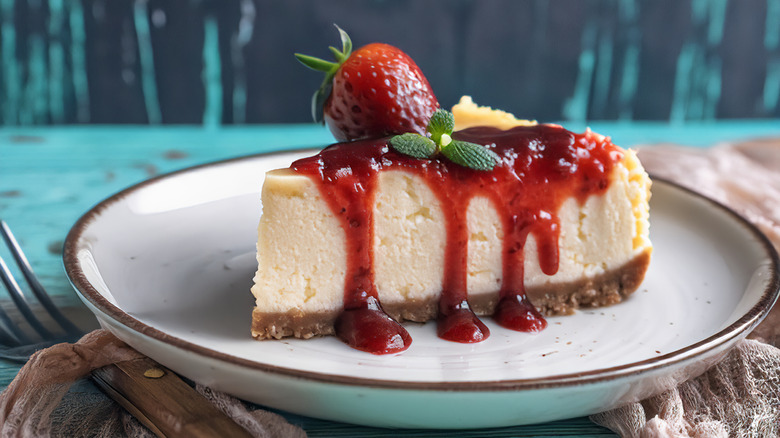
There aren't many desserts that can top the New York-style cheesecake when it comes to decadence. Each slice is a dense, velvety brick of cream cheese, eggs, and sugar, a creamy, melt-in-your-mouth classic if ever there was one. It came into being in the 1930s, when bakers in New York began making their cheesecakes with cream cheese instead of their usual cottage cheese. It has become the default ingredient in many cheesecake recipes, and in Japan, this New York-style of cheesecake has become so popular that it has morphed into something new — Japanese cheesecake.
It all started with the U.S. military, which introduced many American foods to Japan and other countries during and after World War II. In the 1970s and '80s, American cheesecake became popular in Japan independent of the U.S. military presence, and it eventually underwent a few tweaks. The main difference between New York cheesecake and Japanese cheesecake is that the latter calls for separating the eggs and whipping the whites into a meringue, giving the final product an airier texture. Japanese cheesecake is often less sweet than its American counterpart as well, but they both bear many of the same hallmarks, including the emphasis on cream cheese and the cookie crust.
Corn dogs - South Korea
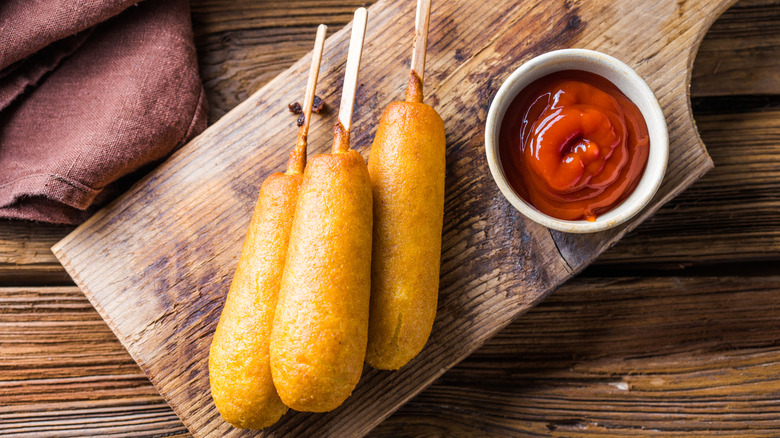
Korean food might be the world's most popular cuisine (according to the aforementioned survey), but it isn't against interpreting the cuisines of other countries. In fact, one Korean interpretation of an American dish has become so popular that it might have overshadowed the original recipe. Perhaps you've heard of k-dogs, the Korean equivalent (or improvement) of America's favorite state fair food. In 2021, this heavenly update on an American classic went viral, with TikTok taste tests and food trucks popping up everywhere, seemingly overnight.
Believe it or not, American-style corn dogs have been a popular street food in Korea since the 1980s, but it wasn't until the 2010s that they became so beloved that a Busan-based vendor decided to try its hand at selling these creations to Americans on American soil. So, what makes k-dogs so irresistible? A lot of it comes down to customization. Instead of just being a question of ketchup or mustard, these corn dogs can be made with part sausage, part cheese on the inside, and coated with anything from crushed ramen to cornflakes and sugar. And far from being an American fad, k-dogs have taken over other parts of the globe, including the U.K., where they have also become a street food staple. You don't have to be in a city with its own special restaurant, though. You can make Korean corn dogs at home in your air fryer.
Thanksgiving turkey - United Kingdom
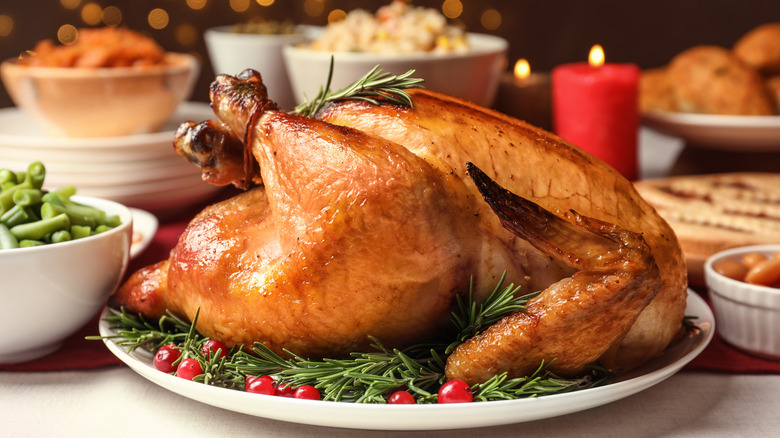
There is quite a bit of crossover between the U.S. and the U.K. when it comes to food, be it the dominance of Gordon Ramsay or the loyalty to potato-based snacks (even if they have different names in each country). One area where the two nations have not historically been in lock-step, though, is Thanksgiving. In the U.S., the holiday is the last stop before Christmas, an event focused on family and food that has a very specific menu. It's a uniquely American tradition, based on the 17th-century harvest feast between European settlers and Native Americans.
In recent years, however, some British foodies have been embracing the holiday, too, and that includes the most famous of all Thanksgiving fare — the turkey. One farm in Devon reported a 38% spike in turkey sales in the two weeks before Thanksgiving in 2024, while the online supermarket Ocado has seen Thanksgiving searches grow by 440% every year. There are even restaurants catering to the demand. In London, there are a growing number of fine dining establishments serving special Thanksgiving meals. While this might seem unusual to Americans who are accustomed to eating Thanksgiving dinner at home with family after spending hours (if not days) laboring over the meal, it's an example of how the Brits are making it their own. Many of them dine out at restaurants for their Christmas dinner, and they seem to be carrying that tradition over to Thanksgiving, as well.
Kraft Mac & Cheese - Canada

It's hard to imagine a pantry without a box of macaroni and cheese on its shelves, but once upon a time, such a thing did not even exist. It was in 1916 that Chicago-based cheese salesman James L. Kraft was awarded the first patent for processed cheese, which changed the game, allowing people to store dairy products on their room-temperature shelves for months rather than having to watch them rot in the fridge. Ever since it debuted in 1937, Kraft Macaroni & Cheese has been a staple in many households and expanded its offerings to include a host of flavors to suit every taste (and we've ranked all the flavors so you don't have to). However, even American appetites for the stuff can't outdo the cheese-driven appetites of our neighbors to the North.
Yes, as unlikely as it may sound, Canadians eat more Kraft Macaroni & Cheese than we do. To be more specific, Canadians, on average, consume 3.2 boxes each per year, a whopping 55% more than Americans. In 1997, Kraft Dinner was the country's top-selling grocery store product. They love it so much that it is simply known as "K.D.," a consumer-derived moniker that Kraft happily adopted in its marketing campaigns. "Gotta be K.D." might not mean much to an American, but to Canadians, it's a familiar affirmation about their favorite national meal.
American-style barbecue - Australia
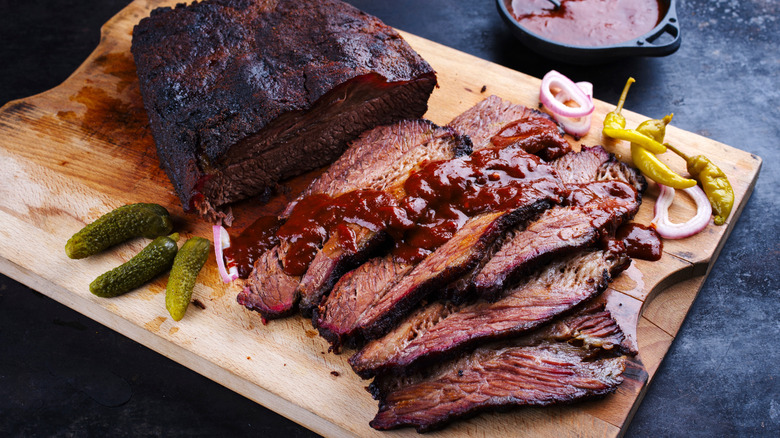
Before we ruffle any Australian feathers, let's be very clear that Australia does, of course, have its own style of barbecue that has nothing to do with the old U.S. of A. Perhaps you've heard someone fake an Aussie accent and say "Shrimp on the barbie." That iconic phrase was part of a marketing campaign to get Americans to visit Australia in the 1980s and '90s, but it alludes to the country's love of grilling outdoors with friends and family. The word is as much a description of an event as it is a description of a food. Lately, though, Aussies have been adopting the American style of barbecue, which leans heavily on cooking technique.
If you've ever had brisket from the South, you'll know that there is nothing else like it. That smoky, salty richness of flavor comes from hour upon hour of slow smoking at a low temperature. There have been American-style barbecue restaurants down under since the 1980s, but it's only in recent years that the scene has exploded. You can now find Southern-style BBQ joints all over the country, many of which serve their brisket and sausage with all the fixings you could find at the most revered hole-in-the-wall in Lockhart, Texas.