

Why Dining At A Food Hall Instead Of A Standard Restaurant May Be Worth It
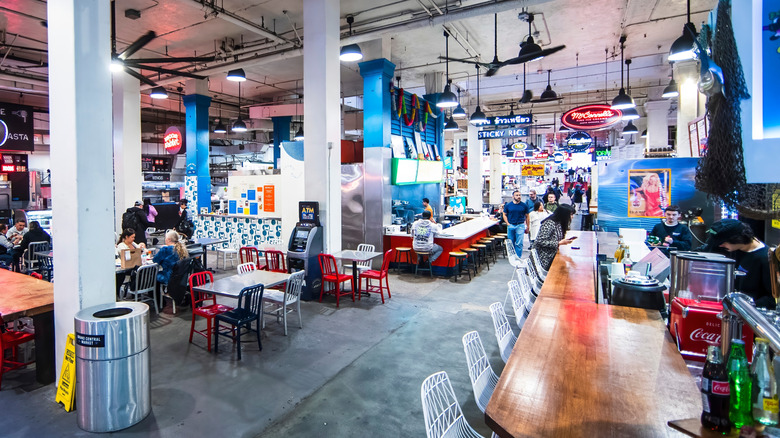
Restaurants may be struggling in the U.S. as inflation-weary customers balk at high prices, but food halls have been bucking that trend. Although there have been a few great historic food halls in the country for years, like Los Angeles' Grand Central Market or Philadelphia's Reading Terminal Market, the concept of a bunch of small food stalls in one location was mostly limited to mall food courts filled with chains.
That changed over the last decade. In 2010, there were only 25 food halls in the United States, but by the end of the decade, that number approached 200. Today, there are over 300 food halls nationwide, and reportedly almost 150 more in development. And it's not hard to understand why, because food halls offer great advantages to both diners and business owners.
The first and most clear upside to food halls for everyone is price. This is a huge selling point as restaurant menu prices have increased by an average of 30% since 2020. By combining multiple small stalls under one roof, restaurant owners have lower overhead costs for rent and maintenance, and also a smaller footprint, which is a major portion of the expense of running a business. This makes it possible for vendors to offer lower prices to customers, and because a variety of restaurants all operate together, there are usually options at different price points. This makes food halls a great option for people eating out on a budget.
Food halls are offer a wide variety of affordable options for different types of diners
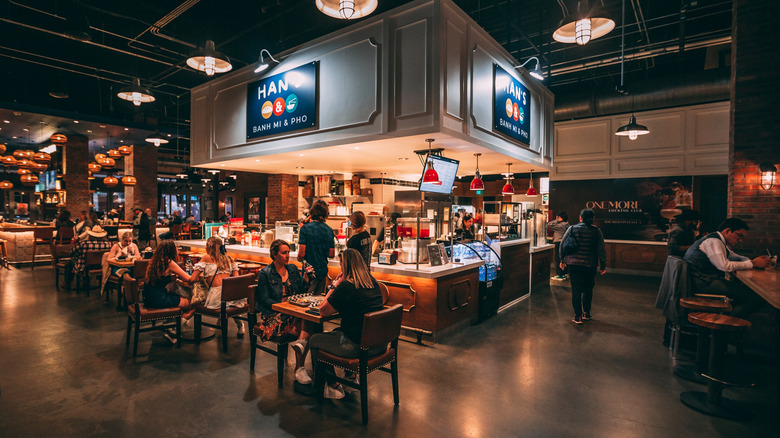
Because of their many options, food halls also offer an experience that can draw in different types of diners. The most obvious are groups of people who may have different preferences for a meal. The communal seating of food halls means everyone can branch off and grab what they want, without having to worry about satisfying the other members of their party. And people with dietary restrictions, like vegans and vegetarians, will appreciate the options, while those without won't be limited in their choices.
Food halls are also one of the few remaining places where you can dine in for cheap and still enjoy the atmosphere. Most affordable counter service spots these days have limited seating, or a few booths meant for people eating on the run. With plenty of seating, separate bar areas, and sometimes even live entertainment, food halls are made for people to hang out for a while. The bustling energy of food halls is a lot more enjoyable than a sad booth next to a counter where you can feel the staff waiting for you to leave.
And of course, food halls' quick service and lower prices also make them a great option for takeout runs and lunch breaks from nearby businesses. That versatility isn't just great for diners. It also means more traffic for small local restaurants that might not be able to survive in their own space.
Food halls have a diversity of great local cuisines that are easy to sample
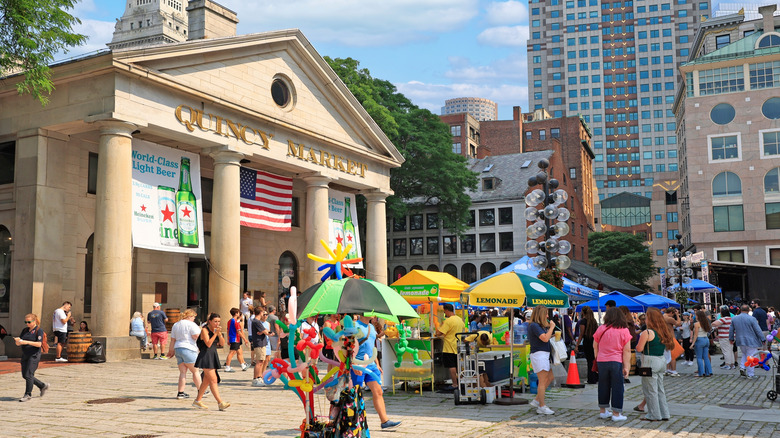
The big contrast between the modern food hall and the mall food court is that most food halls emphasize smaller local businesses, which usually means more interesting options and higher-quality meals. Even more so than a single mom-and-pop restaurant, food halls show off local flavors. You'll rarely, if ever, find generic chains.
For example, pop into Grand Central Market in LA, and you'll find locally-owned restaurants serving Japanese bento boxes, some of the city's favorite pupusas, and a donut shop that's been there for 50 years. At Quincy Market in Boston, there are oyster bars, Irish pubs, and a stall for Boston's oldest pizzeria. Not only is the food at these spots usually better than food court food, but it may also be the single best way to experience the full breadth of a city's food culture.
This diversity is another benefit of the lower costs of operating in a food hall. While most people understandably think about how it makes the final meal affordable, the lower costs make it less of a risk to open for owners as well, which means a more diverse group of people can try their hand at opening a stand, and they can take bigger swings with the menu. There has been a lot of fretting about the state of restaurants in America recently, but food halls represent a genuine bright spot that should only continue to grow.