

7 Shady Facts About Candy Cigarettes
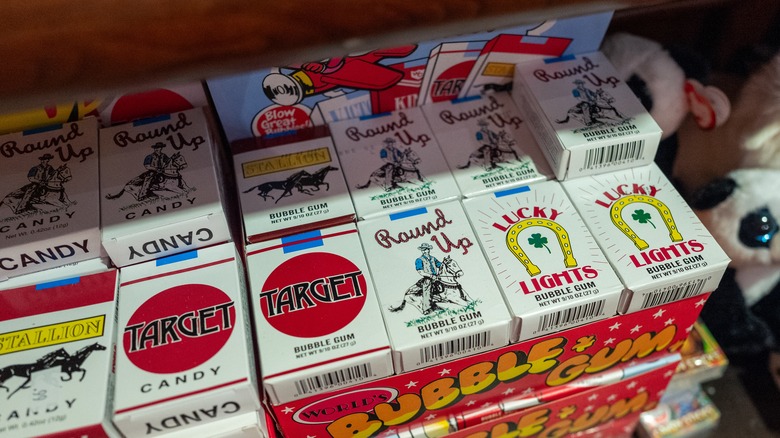
Lurking on the shelves of candy stores across the U.S. is a surprising remnant from the 20th century: candy cigarettes, or candy sticks as they're sometimes labeled today. Sold in cardboard boxes that mimic real cigarette packs, these chalky vintage treats have mostly faded from popular memory. But behind their unassuming appearance is a shady backstory that older folks might remember, while younger people might find surprising.
Candy cigarettes have been manufactured almost as long as the real thing.Although we tend to think of cigarettes as ancient inventions, they've only been mass-produced since 1880, the year the cigarette-rolling machine was invented. Just eight years later, in 1888, The American Stationer magazine mentioned a curious new candy trend: chocolates shaped like cigarettes. Over the next century, candy cigarettes would rise and fall in popularity in step with tobacco itself. Marketed mainly at children, these simple candies normalized the image and practice of smoking for generations.
Despite shifting public attitudes toward tobacco, candy cigarettes are still sold across the U.S. today. So what's the moral of the story? Maybe it's that an imitation can be just as impactful as the real thing, or perhaps it's that the foods we grow up with shape us in ways we hardly notice. Or it just goes to show that Americans have a hard time letting go of childhood nostalgia — even when it feels out of place in the modern world. We'll let you draw your own conclusions from the perplexing past of candy cigarettes.
The first candy cigarettes were made of chocolate.
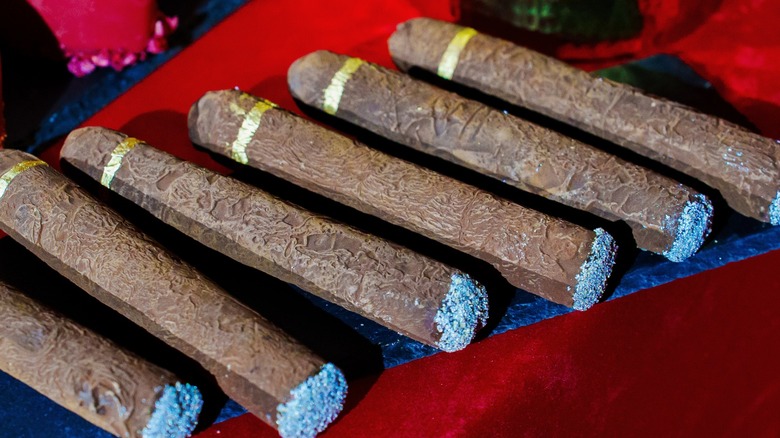
Before the chalky white sticks, candy cigarettes were made of chocolate. In the late 1800s, candy shops in the U.S. and Europe started selling chocolate treats packaged to imitate real cigarettes and cigars. At first, they were a novelty: part of the new fascination with molded chocolates and machine-made candies that mimicked everyday objects.
One of the most famous early examples came from none other than Hershey's, back before the company even made milk chocolate bars or Hershey's Kisses. Founded in 1894, the Hershey Chocolate Company produced over a hundred varieties of bite-sized chocolates shaped like familiar objects. Sometime between 1898 and 1905, Hershey's sold Little Puck Chocolate Cigars, proudly billed as "A Delicious and Harmless Smoke." Considering that Milton Hershey himself was an avid cigar smoker, it's no surprise he merged his two favorite indulgences. While the Little Puck line disappeared, Hershey's later revived the tin packaging as a nostalgic collectible in the 1980s.
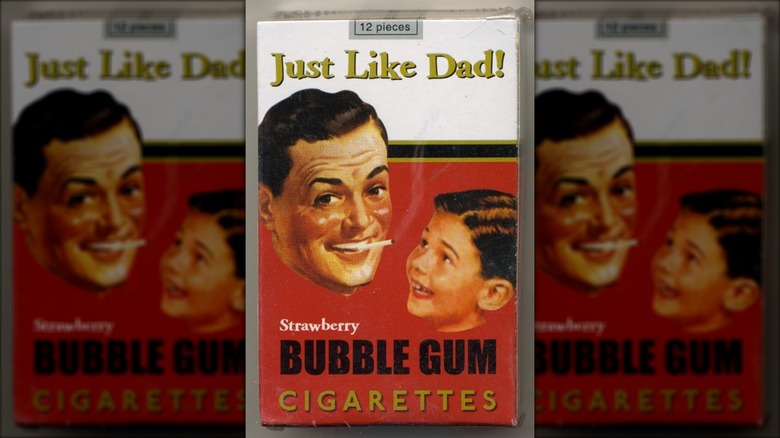
By the early 20th century, the trend had spread. Victoria Sweets, calling itself the "home of chocolate cigarettes," claimed to have invented the candy in 1915. Meanwhile, other companies played up the idea that candy cigarettes would let kids mimic their fathers, which, in retrospect, explained a lot of their youth appeal.
Some candy cigarettes smoked like the real thing.
It's hard to pinpoint exactly when candy cigarette production took off, but in the earlier half of the 20th century, candy-making technology advanced enough to create two distinct types. The first was the classic white, chalky version made from sugar and cornstarch. The second was far more ambitious: a bubble-gum-based version that could actually "smoke." When kids blew on one end, a puff of fine, sugary dust emulated the appearance of real cigarette smoke. These novelty versions still exist today, though they're mostly sold through specialty candy websites.
By the 1950s, the Philadelphia Bubble Gum Corporation began distributing a national line of bubble-gum cigarettes under different names that closely resembled real tobacco brands. The packaging looked almost identical to the genuine products, with names tweaked just enough to dodge trademark violations: Pall Mall became "Pell Mell," Camel turned into "Cemal," and Lucky Strike became "Bucky Strike."
Marketed directly toward children, these candies invited kids to play at being grown-ups. In the '50s, toy stores were even selling miniature cigarette vending machines.
Real cigarette brands quietly worked with candy companies
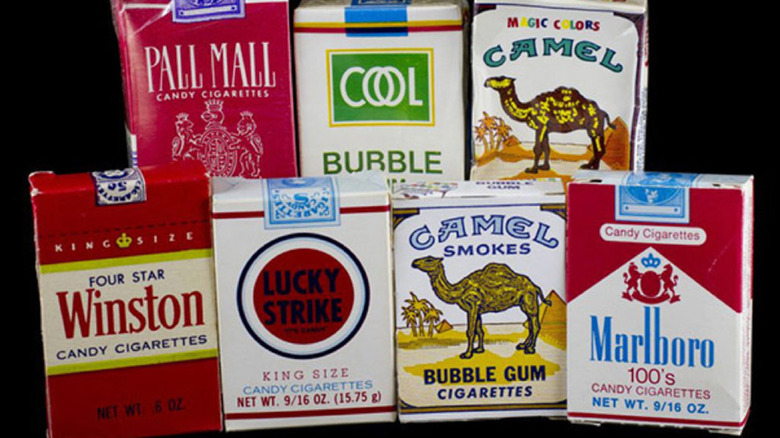
With candy boxes imitating real cigarette packs, conflict between the two industries was inevitable. The first major clash came in 1928, when the producer of Lucky Strike cigarettes, American Tobacco Company, sued the creator of a knockoff candy called Lucky Smokes. But rather than sparking a wave of lawsuits, this case seemed to pave the way for cooperation.
By the late 1930s, tobacco and candy companies had realized they shared a common goal: getting people — especially children — familiar with cigarette products. In 1939, several cigarette makers began allowing candy companies to use their pack designs. The arrangement was mutually beneficial, as candy makers got instant brand recognition, while tobacco companies got free advertising aimed at future customers.
Some partnerships went even further. Brown & Williamson, one of the largest cigarette manufacturers at the time, reportedly sent real cigarette labels to candy producers to help them perfect the designs. Years later, as both industries faced mounting criticism, the tobacco companies would deny these relationships ever existed. But for decades, the evidence was right there on the candyshop shelves.
The 1960s marked a turning point for candy cigarettes.
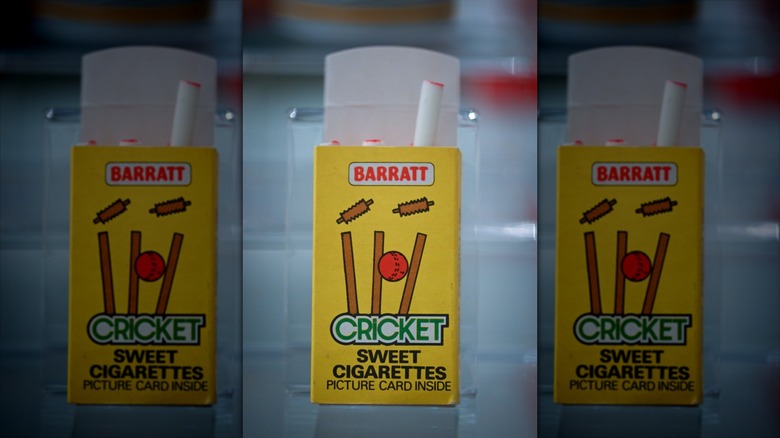
After decades of quiet cooperation between candy and tobacco companies, everything changed in 1964. That year, the U.S. Surgeon General released the Report on Smoking and Health, a landmark document that forever altered the public's view of tobacco. As "Mad Men" fans might recall, this was the moment cigarette ads began to lose their glamour. But the report didn't just attack the tobacco companies — it also directly called out candy cigarettes as an attempt to popularize smoking among youngsters.
Now on the defensive, tobacco companies began to distance themselves from their candy counterparts. A 1967 Advertising Age article revealed how major U.S. cigarette makers were quick to deny ever giving candy companies permission to mimic their branding. Some denied any current authorization, while others feigned complete ignorance. But they all seemed to understand the danger of being associated with candy cigarettes now that the public mood had shifted.
Still, the candy versions remained largely unchecked until the 1980s, when advocacy groups like Doctors Ought to Care began calling out the hypocrisy of marketing candy cigarettes to children. Under mounting pressure, tobacco companies finally moved to protect their trademarks from the candy companies — not because of moral outrage, but to save face. Even then, most disputes were settled quietly, with few lawsuits.
Kids who ate candy cigarettes were more likely to smoke

Throughout the 20th century, candy cigarette companies knew exactly who their audience was. In 1967, World Candies Inc. reported that the majority of their candy cigarette customers were children between the ages of 4 and 8. Clearly, these products were made specifically for kids. But were they a harmless gimmick, or a gateway to the real thing?
Research over the years has strongly suggested the latter. A 1990 study found that sixth graders who had eaten candy cigarettes were twice as likely to have tried real cigarettes, regardless of whether their parents were smokers. The following year, a 1991 study observed that many children pretended to smoke when they played with the candies and warned that some of them were likely to pick up smoking later in life.
The pattern persisted decades later. In 2007, researchers found that adults who ate candy cigarettes as children were more likely to be current or former smokers than those who hadn't. The more frequently a child had eaten them, the stronger the correlation. The study concluded that banning candy cigarettes could help reduce the social acceptability of smoking among the younger generation. However, despite the warnings, most attempts to ban candy cigarettes have been unsuccessful.
The U.S. has tried (and failed) to ban candy cigarettes

Understandably, many parents and public health advocates have long objected to the idea of children pretending to smoke candy cigarettes. Even before research confirmed a link between candy cigarettes and later tobacco use, the connection was obvious to anyone watching kids play with them. But despite decades of concern, the United States has never enacted a federal ban on candy cigarettes.
There were attempts in 1970 and 1991 to enact a federal ban, but each effort fizzled out. A few states and cities, however, have successfully taken matters into their own hands. North Dakota briefly banned candy cigarette sales between 1953 and 1967, and they're currently prohibited in Maine and Tennessee. In most cases, local and state bans were defeated by aggressive lobbying from both the confectionery and tobacco industries.
A 1996 legislative counsel for New England Confectionery and World Candies once described the strategy clearly: when a ban was proposed, lobbyists would twist the wording to make it sound absurdly broad — as if it were a complete ban on all cylindrical-shaped candy — until lawmakers dropped it altogether. This defense strategy proved to be a surprisingly effective, sinking proposals everywhere from New York to California. While the majority of the U.S. continues to sell the nostalgic sweets, several other countries have outlawed candy cigarettes entirely, including Canada and the United Kingdom.
They were eventually rebranded as just candy
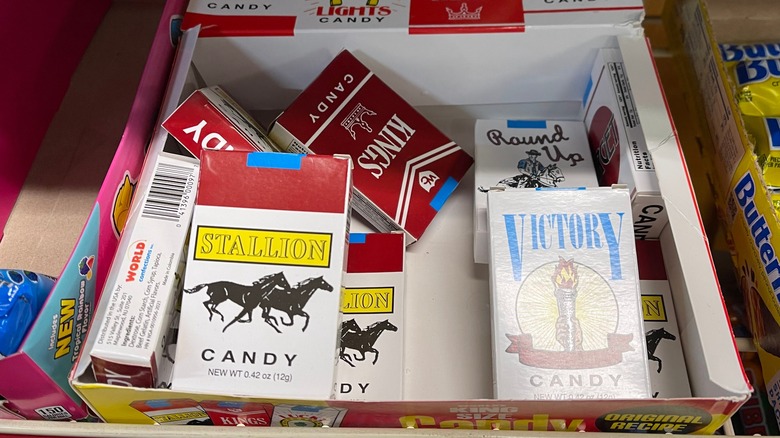
Candy cigarettes were popular throughout the 1980s, but by the early 1990s, public health concerns had prompted higher scrutiny of the tobacco-themed treats. In a 1991 study, psychologists recommended that candy makers use packaging that is attractive to children but doesn't have an association with cigarettes.Rather than fully redesign their products, companies like World Candies and New England Confectionery took the easy approach. They simply removed the word "cigarette" from their packaging while keeping nearly every other detail intact, such as the illustrations, fonts, and color schemes that were recognizable as imitations of real tobacco products.
Despite these changes, candy cigarettes — now typically marketed as candy sticks — remain legal to manufacture and sell in many parts of the United States. They are generally found in novelty candy shops, specialty stores, or online, rather than in mainstream grocery or convenience outlets. In spite of a controversial past, the candy cigarette still survives as a vestige of the past.