

7 Aluminum Foil Brands, Ranked Worst To Best
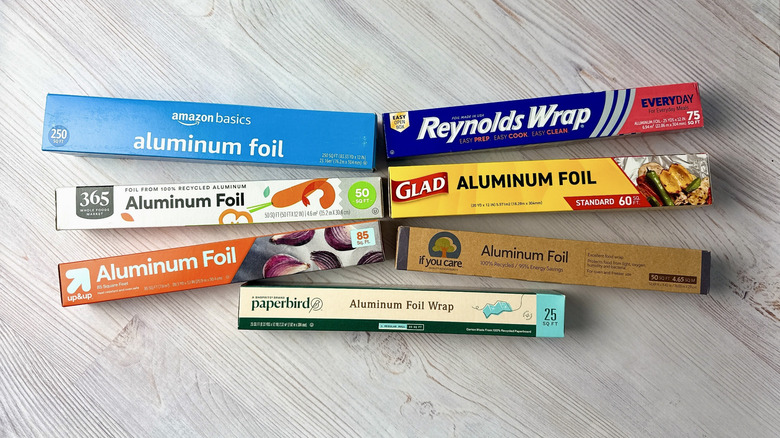
Reviewing aluminum foil brands might not be the most glamorous undertaking, but it's certainly one of the more practical ones. Let's be honest, aluminum foil has almost as many uses as WD-40, and virtually every kitchen has a roll.
Aluminum foil was conceived in 1910, when it was first rolled out (literally) as an alternative to tin foil, which left a "tinny" aftertaste on certain foods. The thin, pliable sheets of metal were used to block light, moisture, and aroma from a variety of products. Fun fact: Within one year of aluminum foil's creation, Toblerone began wrapping its triangle-shaped chocolate bars in the cutting-edge material. Fast forward a century and one thing is clear — aluminum foil is a staple in most homes. And, as is the case with most popular provisions, many manufacturers want a slice of the pie — from larger national brands to smaller grocery chains.
To help you navigate the foil options and spend your money wisely, I purchased seven brands of aluminum foil and put them to the test by ripping, wrapping, and unwrapping. I judged each product on the quality of the foil and durability of the box. I also took into account the overall value for money, as some brands were pricier than others. Seven baked potatoes later, and I've crafted the ultimate guide to aluminum foil. While all these brands will suffice, there are some clear winners. Next time your roll runs out, review this ranking before you shop to get the best bang for your buck.
7. Glad
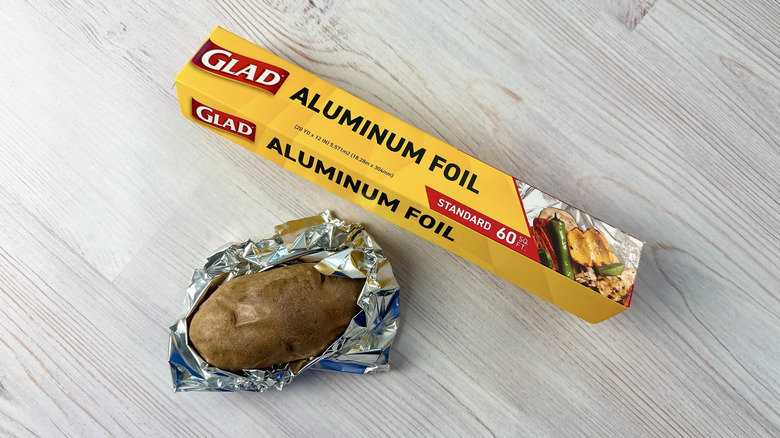
I'm a huge fan of Glad products, so I was disappointed when I tried the brand's foil. I genuinely don't go a single day without using Glad Press'N Seal — it's my favorite food wrapping product of all time. Sadly, I was let down by Glad foil. I'll start with the quality of the product, since that's what surprised me the most. It's thin. Too thin. In fact, when I tried to rip off a sheet, the foil ripped above the box's cutting edge, leaving a useless scrap that wasn't big enough for any job, except maybe wrapping a pencil. In my opinion, that's wasteful. On my second attempt, half the sheet tore at the cutting edge and the rest split down the middle, producing a piece shaped like Tennessee. Again, another fragment I couldn't use.
I believe it's a combination of weak foil and a dull cutting edge that makes this foil so ineffective. And since I paid $7.99 for 60 square feet — about 13 cents per square foot — I also think it's overpriced. In reality, it's more like $7.99 for 30 square feet, as that's how much of the foil I'd consider actually usable. The box held its shape, even after all my pulling on the cutting edge, so I suppose that's a plus. I might not have noticed Glad's performance issues if I wasn't comparing it side-by-side with other brands. But I did notice, and that's why I ranked it last. That said, I'll continue to buy Glad Press'N Seal without hesitation.
6. Paperbird
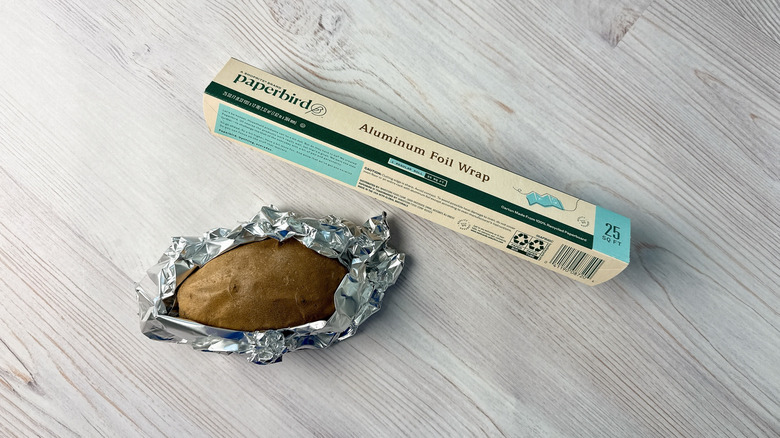
Paperbird is a ShopRite brand, so you'll find it in the grocery store. For that reason, I didn't have exceedingly high hopes for its functionality. Surprisingly, it's actually not bad. The thickness was adequate for wrapping and unwrapping the baked potato one time. However, the second time I scrunched the foil and opened it back up, it ripped into shreds. A key benefit of aluminum foil is that it's reusable, which cuts down on cost and waste. I wouldn't be able to use this foil more than once.
I also ranked this brand second-to-last because the box's cutting edge wasn't sharp enough. I had to pull down so hard on the foil that the box bent. Also, the box doesn't close completely once opened. The good news is that the ends of the box didn't cave in, which is admirable considering it's made from 100% recycled paperboard. I paid $2.69 for 25 square feet — about 11 cents per square foot — so it sits in between the most and least expensive brands in this ranking.
Paperbird aluminum foil landed sixth due to the overall quality of the foil, the subpar cutting edge, and the fact that the box didn't close. That said, if you're already at ShopRite and need foil, this will work just fine.
5. If You Care
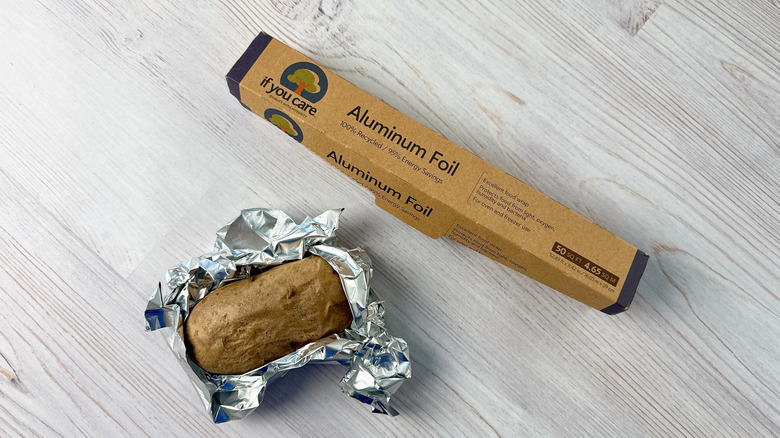
With a name like If You Care, I almost feel guilty ranking this brand fifth. But I also care about quality, value, and integrity, so here's my take on the brand's foil. It's flimsy. When I tried to pull a sheet from the roll, it ripped immediately. It also split the moment I started unwrapping my potato, so it's effectively a single-use item. While I appreciate that the foil is made from 100% recycled aluminum, a one-time-use product is still wasteful.
Now for the box. It was weaker than the foil. On my first use, one end of the container blew open and required tape to hold it together. Now I'm having to repair my foil box? The container also had a serrated cardboard cutting edge, not a metal one like all the other brands I tested. I don't mind that in theory — and might even prefer it — because it's ideal if you're getting the kiddos involved in cooking. However, in this case, cutting the foil required a heavy hand, and then it ripped. Since the box had already ruptured, the whole process was frustrating.
I paid $6.49 for 50 square feet, or 13 cents per square foot. In my opinion, that's too pricey for an inferior product. As mentioned, I appreciate the company's goals of saving the planet, and I will continue to do my part, just with the brand's other eco-friendly products.
4. 365
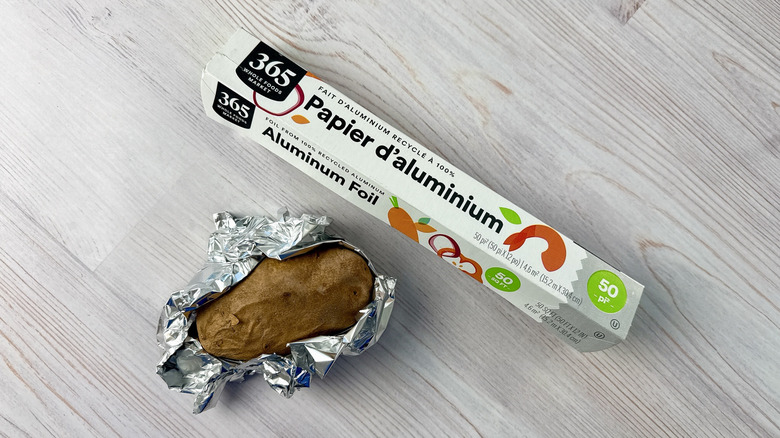
Another foil made from 100% recycled aluminum, 365 is a Whole Foods brand that's much stronger than the previous entry. Even after repeatedly scrunching it up and spreading it out, it was still sturdy enough to reuse — I appreciate the value in that. Speaking of value, I paid $4.49 for 50 square feet, which works out to around 9 cents per square foot. While 365 was not the cheapest foil I tested, it's great quality for the price.
The box was robust enough to hold its shape when cutting the foil, but I do worry that it will degrade over time. I doubt it will last until the roll is finished, and I feel I'll need to be careful when using and storing the box. The reason this foil didn't rank higher is because, once opened, the lid was difficult to close. The side flaps were a bit weak, and I was afraid to force the lid shut for fear of collapsing the whole thing.
In summary, if you're shopping at Whole Foods, either in-store or online, I recommend the brand's foil. Not as wholeheartedly as the following entries, but it's still a solid choice.
3. up&up
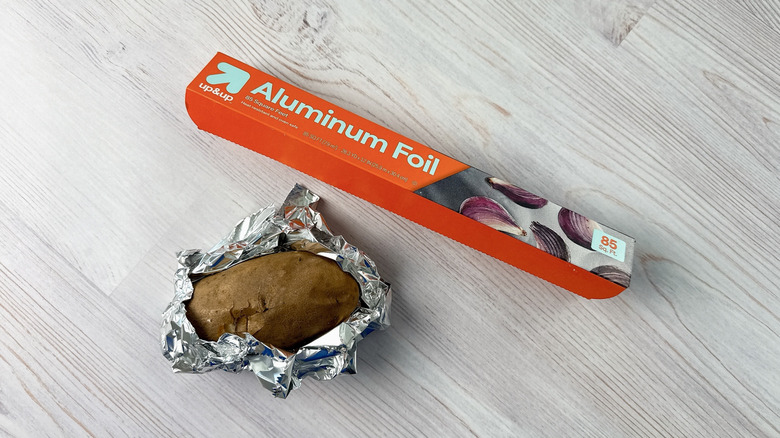
Target's up&up brand aluminum foil was better than the previous entry for a few reasons. First, the foil was noticeably sturdier and held its shape when I squished and reopened it a few times — and I wasn't being gentle. It seems that three times was the limit, because the foil ripped on my fourth attempt. That said, this foil weathered my handling better than the prior brands, and that added value for me, so I ranked it higher.
The box was fairly robust too. The ends didn't rip, and the box held its shape after several pulls. The box also closed reasonably well once open, and the lid was raised slightly, which protected my hands from the cutting edge.
I paid $4.89 for 85 square feet, which is about 6 cents per square foot. I feel confident recommending this foil to anyone next time they're shopping at Target, and I'll be using this brand for a variety of kitchen foil hacks, and for extending the life of my bananas. I only ranked it third because the following brands were superior.
2. Amazon Basics
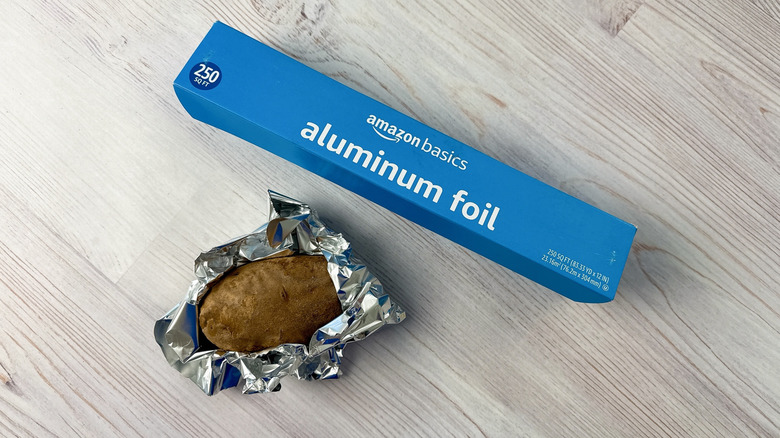
I cherish the days when I'm too swamped to shop, and can have household necessities delivered to my door. Ordering Amazon Basics aluminum foil was one of those occasions. The weighty box arrived within 24 hours, and cost $12.59 for 250 square feet — roughly 5 cents per square foot. Since it was the least expensive foil in this ranking, especially compared to the brands that cost around 13 cents per square foot, I expected it to be flimsy. It most certainly was not. In fact, the foil withstood me crumpling and unfolding it multiple times. That means you can use this brand for the foolproof hack of crumpling foil to make it nonstick. That's likely not the case with the previous products in this ranking.
In terms of ripping the foil, I expected it to split as soon as I grabbed the end, as 250 square feet of aluminum is about five times heavier than most of the other brands I tried. However, no ripping occurred, except where it was supposed to — at the cutting edge. Now for the box. It was sturdy, easy to close, and the cutting edge was sharp. Again, when shut, the lid was slightly raised, which shielded my hands from the serrated metal.
I was pleased with every aspect of this brand — the quality, reusability, and price. It was hard to make it the runner-up, but there was still one brand I would consider the best overall.
1. Reynolds
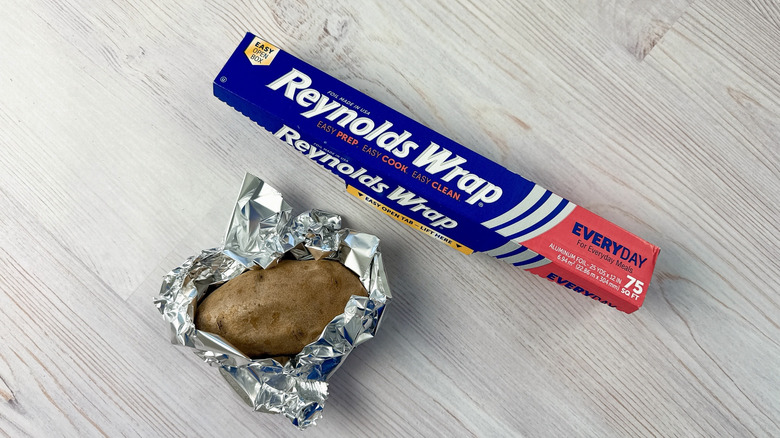
Reynolds has been delivering aluminum foil to consumers since 1947, so the company has had plenty of time to perfect its product. In fact, growing up, saying Reynolds Wrap was akin to saying Q-tip or Kleenex in our house. My mom would say, "Hand me the Reynolds Wrap," not, "Hand me the aluminum foil."
This brand had the best foil, box, and cutting edge of all those I tested. The foil itself tore smoothly and precisely along the serrated metal cutting edge, not anywhere else. And while the metal edge didn't seem sharper than any of the other brands, it was more efficient at cutting. The foil was also easy to fold and unfold multiple times without tearing. It felt about as thick as the Amazon Basics foil, but the Reynolds Wrap held up to more forceful squishing and re-flattening. And, since it seemed to be the hardiest of the bunch, I will be using it to scrub the rust off my cast iron pans.
I paid $4.89 for 75 square feet, or 6.5 cents per square foot. This isn't the least expensive brand, but it's darn close, and I know I'll get multiple uses out of each sheet. Along with being excellent value for money, I appreciated the quality of each component of the product, from the foil to the cutting edge to the box, and feel like it will likely last all 75 square feet. That's why Reynolds is my top pick.
Methodology
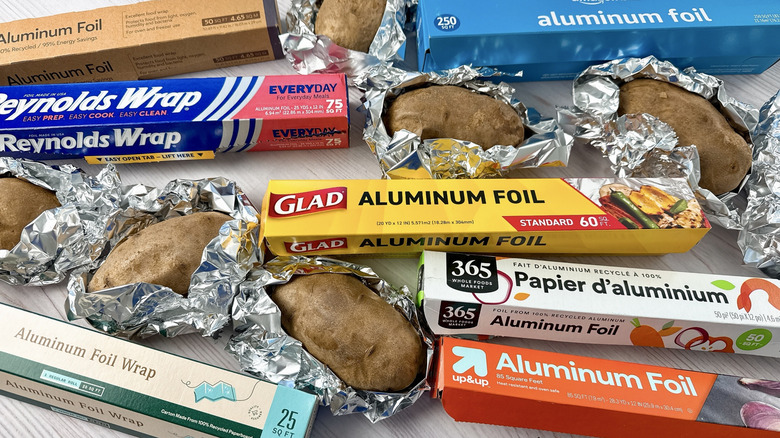
For this ranking, I purchased seven brands of aluminum foil and judged them side-by-side. For consistency, I chose regular foil, not the heavy-duty variants. I baked seven russet potatoes without foil to achieve crispy skin, then wrapped each spud in a sheet of foil to steam the interior. I unwrapped and re-wrapped the potatoes multiple times to see how the foil stood up. If I was able to scrunch the foil and then lay it out flat again, I ranked the foil higher. I also judged whether or not the foil ripped while attempting to tear off a whole sheet. The weaker foils ranked lower than the sturdier ones.
I also ranked the boxes. If the cardboard was sturdy and the container held its shape while tearing sheets of foil, it scored higher. If the ends of the box collapsed or the box felt weak, I ranked the brand lower. Only one brand's box had ends that blew out, but some containers were clearly flimsier and seemed unlikely to last until the roll was finished.
All but one brand had a metal cutting edge, and those were pretty similar. That said, if the box was flimsy, a sharp cutting edge made little difference, so I saw that as a negative. Lastly, I considered the price. As it turned out, my favorite brands were also the most affordable, which is always a bonus. While you can't go wrong with any of these options, your money will be better spent on the winners.