

Before This Syrup Brand Changed Its Controversial Name, It Had A Restaurant Chain With Over 20 Locations
For over 130 years, Aunt Jemima pancake mix and syrup provided enjoyable breakfasts for generations. But by 2021, the image of this product was widely considered as an offensive racial stereotype, leading the brand's owner, PepsiCo, to acknowledge the logo's insensitivity before rebranding the products under the Pearl Milling Company name. This move may have concluded the Aunt Jemima brand's problematic story, but an earlier chapter of it can never be erased: the history of Aunt Jemima's Kitchen, a restaurant chain that once had 21 locations nationwide.
Aunt Jemima pancake mix had been popular since the World's Colombian Exposition of 1893 in Chicago, when Nancy Green – a formerly enslaved person hired to provide cooking demonstrations – reportedly sold 50,000 boxes of the newly branded product, named after a minstrel show character. For this role, Green sang and told stories about her childhood in the antebellum South. While Green went on to become a revered member of Chicago's 20th-century Black community, the image of Aunt Jemima's brand was by then established with slavery-related tropes, beginning decades of being one of the worst food-brand mascots to exist.
The Aunt Jemima brand grew in popularity into the 1950s. Capitalizing on that success, when Disneyland opened in 1955, an early attraction was the first Aunt Jemima's Kitchen, sited in Frontierland and sponsored by Quaker Oats. Styled after Southern plantation houses — complete with tall columns and a sweeping veranda – the restaurant served whimsically named pancakes, and diners were greeted by an actress portraying Aunt Jemima. Buoyed by the restaurant's success, its management launched an expansion of the business, with the next location opening in Skokie, Illinois in 1960.
Aunt Jemima became a symbol of racial inequality
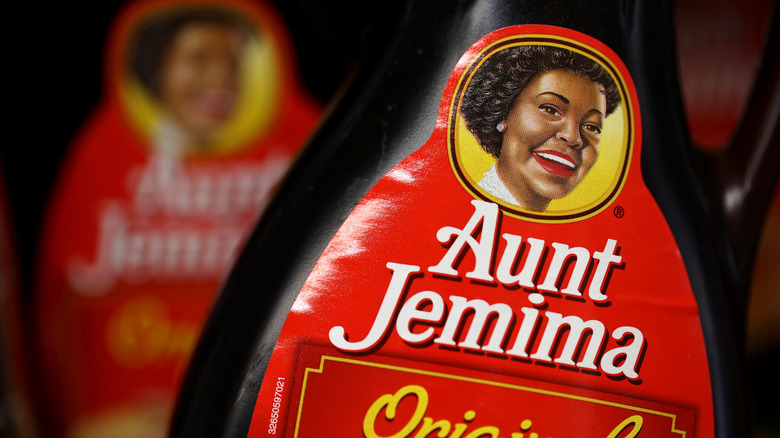
By 1963, there were 21 Aunt Jemima's Kitchens nationwide, along with one in Canada and another in Great Britain. The chain restaurants didn't mimic the Dixieland style of the Disneyland original, but were more modest ranch-style buildings with portico columns. The eateries served numerous types of pancakes with a variety of syrups, and similarly to the Disneyland location, Black actresses were hired to portray Aunt Jemima and greet guests.
However, by this time the Civil Rights Movement was growing, and the Aunt Jemima caricature became the target of protests. When it was announced in 1963 that an Aunt Jemima's Kitchen would be opening in a suburb of Rochester, New York, the NAACP and the Congress of Racial Equality protested against the brand as furthering a degrading negative stereotype of Black women, and the restaurant was never built.
As public condemnation grew over the business practices behind Aunt Jemima's Kitchens, individual restaurant locations were renamed. In 1970, the original Disneyland restaurant was rebranded as the Magnolia Tree Terrace. Long after the last Aunt Jemima's Kitchen was no longer operating, the Aunt Jemima brand carried on alongside other pancake mix options in supermarkets – but in June of 2020, PepsiCo acknowledged that Aunt Jemima's origins were rooted in racial stereotypes, and the name and image were subsequently retired. Today, Pearl Milling Company products are still regarded among the best pancake mix brands. While Aunt Jemima's Kitchen was not the only once-popular pancake chain from the '50s that portrayed racist stereotypes, its history remains controversial to this day.