

Here's How To Order The Right Level Of Spice At A Thai Restaurant
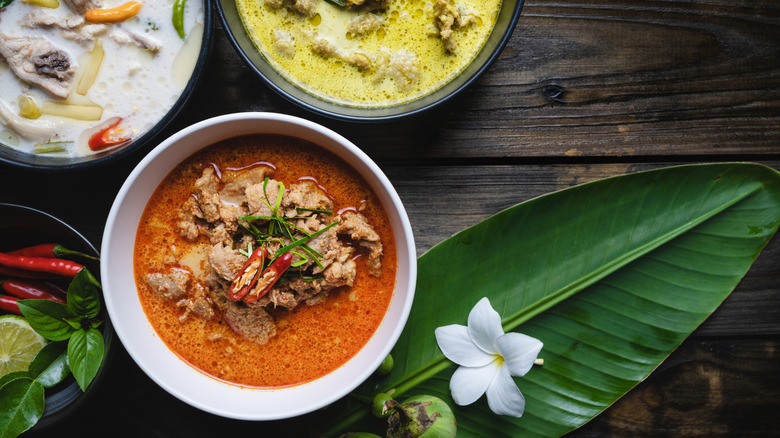
Ordering a meal at a Thai restaurant often comes with a question: how spicy? If you fall on either end of the spice spectrum — someone totally averse or who douses all their meals in chili oil — it might seem like a simple answer. In reality, however, there is more to that question than just how much you want to tax your taste buds. Chilies are a central component to Thai cuisine, which can make it difficult to tailor a meal perfectly to your preferences while also keeping from blowing out your palate with too much heat. For some expert advice on how to handle this question, we reached out to Ann Thanthicha Piwatsuwan, head chef at BKK New York.
Her first advice to us focused on those uninitiated to Thai cuisine: "Start with warm, aromatic dishes rather than intensely spicy ones — like Creamy Tom Yum or Massaman Curry." This allows you to get to know Thai flavors without needing to worry about ending up with a dish you simply can't handle. Once you feel comfortable with these dishes and the cuisine — as well as perhaps improving your spice tolerance — then Piwatsuwan suggests you can move on to dishes with a bit more punch, like larb pla or kra pao.
If the dish you order is one that comes with the question of how spicy you want it, there are usually four options: mild, medium, spicy, and Thai spicy. Unfortunately, there is no hard-and-fast rule about how to dial this in to your personal preferences — you'll have to experiment. However, understanding the role chilies are meant to play in Thai cuisine can make the decision easier.
Chilies aren't about punishing your palate
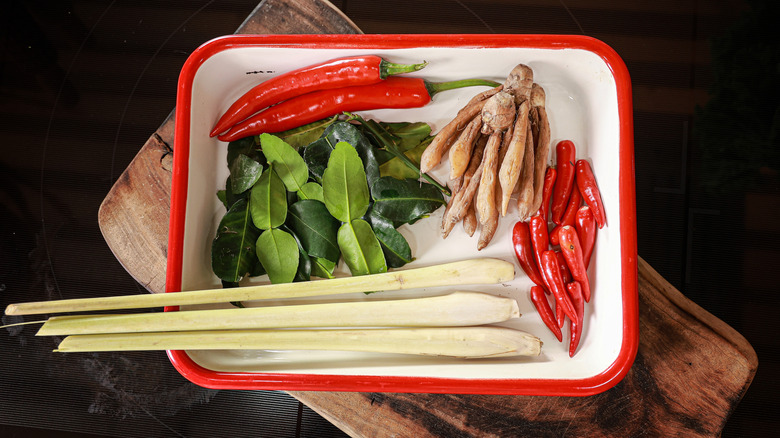
As Ann Thanthicha Piwatsuwan explains, "The goal isn't to test endurance — it's to let every diner enjoy the full flavor without being overwhelmed." Sure, there are folks out there who wear their ability to eat "Thai spicy" dishes as a badge of honor, but you won't enjoy your meal very much if your nose won't stop running and you have to roll ice cubes around your mouth between each bite. "Chili should be seen as energy, not punishment," Piwatsuwan tells us. "It adds rhythm and excitement, bringing harmony to the dish when balanced well."
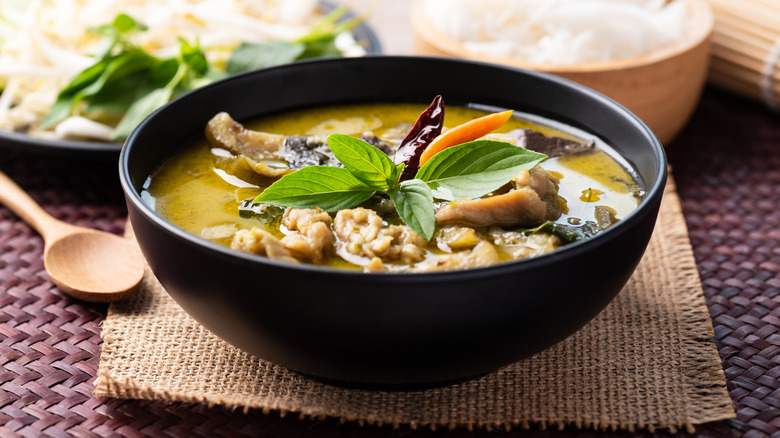
For those who rarely eat spicy food, there is no shame in ordering your meal mild. Piwatsuwan insists that guests are always encouraged to share their honest preferences, so that dishes can be prepared accordingly. When it comes to traditional Thai dishes like red or green curry, there are already chilies in the curry paste, so some level of heat is inherent. If you have a sensitive palate, that may be enough to infuse the dish with plenty of energy and excitement.
If you are the sort that prefers to push your limits a bit with spicy food, it is still best practice to keep things on the milder end of what you think you can handle. The amount of heat in a dish will vary from restaurant to restaurant, and you don't want to overdo it. Plus, many Thai restaurants have condiments on the table that will allow you to increase the heat if you need more piquancy in your pad prik king.
What to do if your Thai order is too spicy for you
Now, even the cautious diner may sometimes accidentally end up ordering something that is simply too spicy for them to enjoy — it's the kind of mistake everyone makes at a Thai restaurant eventually. But it is not the end of the world. There are multiple ways to deal with a dinner than is more than you can handle
For starters, Ann Thanthicha Piwatsuwan suggests that it is totally okay to send a too-hot dish back. "Thai hospitality is rooted in comfort and care," she explains. "If a dish feels too spicy, we're happy to adjust it or recommend something more balanced. Creating a great experience means ensuring every meal brings joy, not stress." But if you are of the socially-anxious ilk, or simply prefer to fix things on your own, there are plenty of other ways to temper the heat.
You probably already know that adding dairy can fix a spicy dish. This works because the fat binds with and dissolves the capsaicin, neutralizing the heat. Coconut milk mitigates heat in the same way, so asking the kitchen for a little bit to add to your curry can help bring things down to a level where you can enjoy it. Alternatively, ordering a Thai iced tea will give you a cold, fat-rich palate cleanser to sip between bites. The simplest method, of course, it simply to spread the curry out over more rice. Rice, as Piwatsuwan explains, "absorbs chili oil, softens the punch, and restores balance."
Finding the right level of spice for your Thai order can only be a personal journey of experimentation. But now you should be equipped with plenty of knowledge to approach the question without fear.