

15 Tips You Need To Organize Your Kitchen Cabinets Like A Pro
We may receive a commission on purchases made from links.
No matter how hard you work on keeping your kitchen cabinets organized, it can seem like clutter creeps in through the cracks. However, it isn't often the contents of the cabinets to blame but rather, how they are organized. The absence of a clear system and the lack of a maintenance schedule can conspire together to turn your cabinets into a chaotic wasteland.
However, all is not lost yet. With the help of a few strategic moves, you can turn the tide. If you are struggling to reach essential items, it helps to draw a heat map so that prime real estate can be dedicated to your most frequently used items. If you could use a helping hand, you'll find an array of organizers and storage tools, from turntables for easily accessing oil bottles to under-shelf holders for keeping your favorite coffee mugs organized. With these tips, storage hacks, and helpful tools at hand, your kitchen cabinets will never complain about clutter again.
1. Use the chaos method to purge your cabinets
Chipped mugs. Old takeout menus. Mismatched containers. If your kitchen cabinets feel perennially cluttered, there is a good chance that there are several rarely used, out-of-date items that have accumulated over time. The prospect of confronting all the clutter probably sounds unappealing, but according to one expert organizer, there is merit in opting for a chaotic approach to decluttering everything at once instead of going through shelves one by one.
The chaos method is the brainchild of Kim Jones, author of "The No-Nonsense Home Organization Plan". True to its name, this method involves the turbulent task of emptying out all your cabinets at once. Being confronted with a visual confirmation of all the clutter that has been lurking in your cabinets might sound intimidating. But Jones believes that once you see everything together, you will have greater clarity on what to toss versus keep. The latter can then be organized back in your cabinets in an orderly fashion. When attempting this method for your kitchen, you'll also want to examine the expiry dates in your "keep" pile and place what needs to be consumed within six months prominently on your shelves.
2. Draw a heat map for optimal placement of your most used items
If you are looking to truly get to the bottom of all the rarely used clutter that is occupying prime real estate in your cabinets, you'll need to channel your inner weatherman and draw up a heat map. But instead of demonstrating weather changes across the region, you'll be categorizing cabinet items by their frequency of usage.
Devising a heat map is a common technique used to identify the most frequently used areas in the kitchen for optimal placement of appliances in the cooking zone. The same principle can also hold true when deciding which items in your cabinets are truly deserving of front row status. Items that are used daily get marked as red, while weekly items fetch yellow, and monthly or rarely used items are marked green. You can even choose to designate these categories as hot, warm, and cold items. By devising a visual hierarchy of cabinet items as per their usage, you can ensure that your most used items are placed prominently on your shelves — no more reaching behind a stack of specialty baking molds to reach your go-to coffee beans in the morning.
3. Establish dedicated zones
If you were to quiz Martha Stewart on her ideal way to organize a kitchen, she would offer up one solution: zones. Indeed, in an interview with Frederic magazine, she said, "All my kitchens have the same basic design — I call it the subway kitchen or the railroad kitchen. The workspace is divided with an island, there is a wall of stoves, a washup area and then a seating area." Her same organizing ethos can also serve as a boon when you are looking to conquer messy kitchen cabinets.
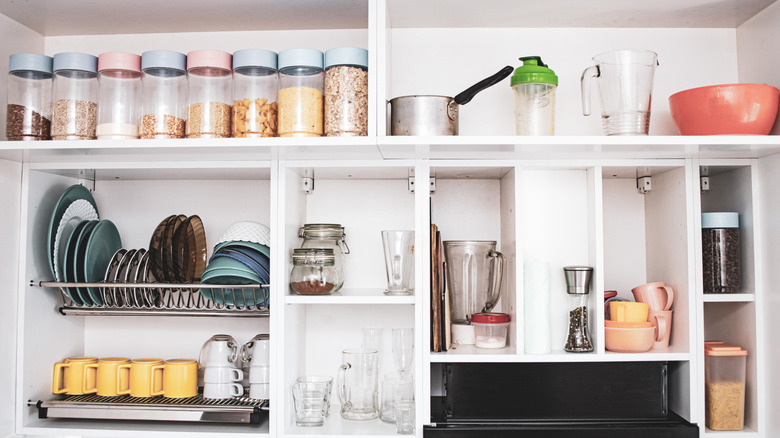
The zoning approach to kitchen organization requires you to allocate specific areas for particular tasks. This means that items that serve a similar purpose are grouped together to create a miniature workstation of sorts. If your morning can't start without a steaming cup of java, you don't need to go on a marathon sprint around the kitchen to locate the filters and stirrers because everything is stored together in the coffee zone.
Some common zones that can be used for organizing your kitchen cabinets include the cooking zone which includes those cabinets that are closest to the stove and will house all your spices and oils. The prep zone, meanwhile, will be allocated to those cabinets that are situated next to free counterspace — you can stash all your knives, cutting boards, and measuring cups here. Finally, a storage zone will offer up empty containers, aluminum foil, and cling wrap to efficiently package leftovers after late night meals.
4. Leverage vertical space with shelf risers
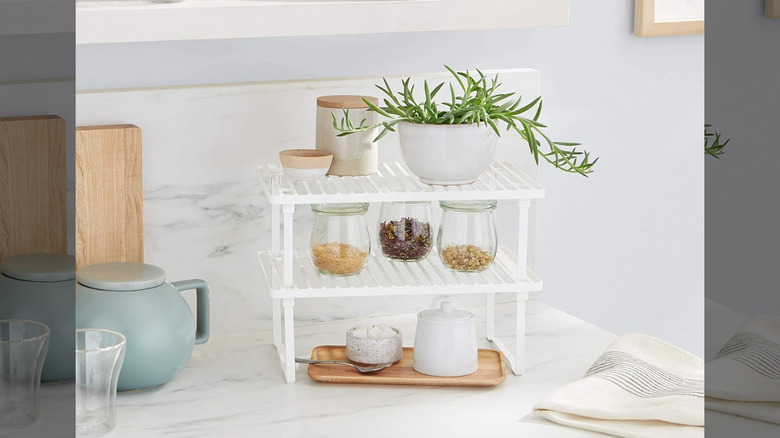
There is a good chance that there are some clever storage spaces that you are ignoring in your kitchen right now, from the sides of your refrigerator to the upper side of your appliances. And once you inspect your cabinets with a discerning eye, you'll also find that there is a wealth of vertical space sitting idle in between shelves. Attempting to stack dishware to use up this space is a no-go — you don't want to be faced with a teetering pile of fragile ceramic every time you fish out a plate from the bottom of the pile. Instead, you'll want to befriend nifty shelf risers to open up a whole new world of storage possibilities within your existing cabinets.
Simply put, shelf risers are a miniature ledge that can be added to your shelves to create a second tier of storage within the same space. With stackable options flooding the market, you can easily create a third layer of storage between tall shelves, where needed. Before making a purchase, it helps to measure the empty space between your cabinet shelves to ensure that your chosen shelf riser fits perfectly.
5. Decant dry goods into stackable containers
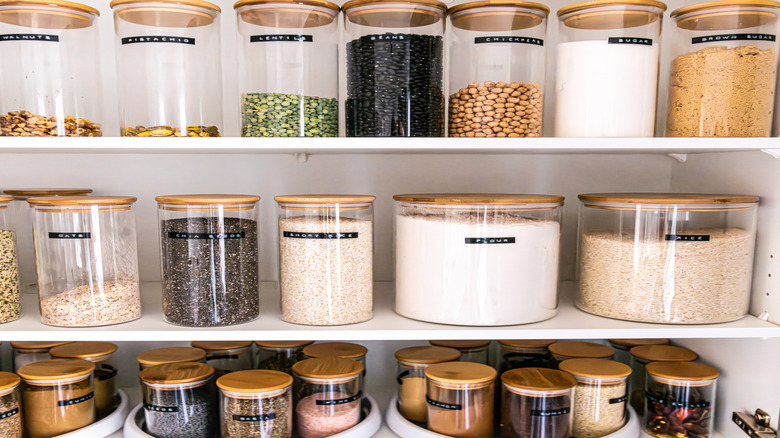
Fact: Closed cabinets do not require as much maintenance as heavily curated open shelves. But bulky, mismatched packaging is always an eyesore, regardless of where you stash it in the kitchen. This is why every home organizer on your social media feed wants you to start decanting dry goods into reusable containers.
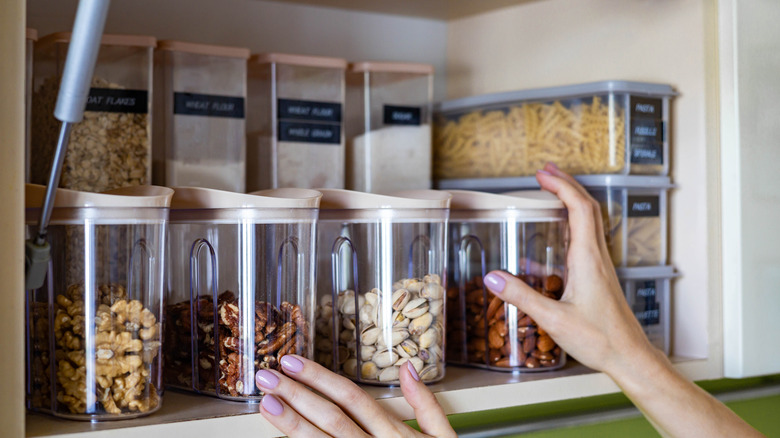
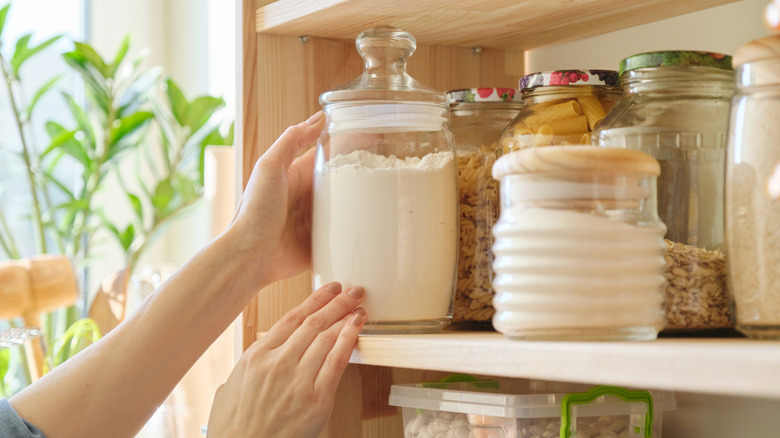
Transferring goods from one container to another might seem like a time-consuming exercise at first, but hear us out. Decanting goods into a uniform set of containers means that you no longer have to play Tetris with a jumble of oddly-sized packaging. Stackable containers work best for optimizing vertical space, and you'll also discover enhanced visibility. Transparent containers allow you to easily track when your supplies are running low, so you can restock accordingly and not waste money by ordering duplicates.
You might be in a rush to kick all the bulky packaging to the curb, but you won't want to forget about expiration dates when decanting your pantry. By simply grabbing a label maker and sticking the expiry dates to the bottom of the jars, you can ensure that you don't have to play Russian roulette with a rancid jar of walnuts.
6. Don't overlook cabinet doors
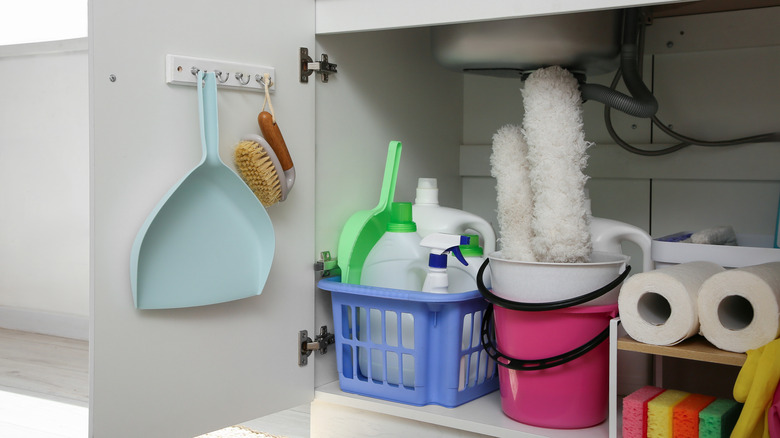
So, you have explored every possible organizing tool to reduce clutter from your cabinets, from stackable bins to tiered racks. But there is a good chance that you are overlooking the veritable goldmine of organization possibilities that lie in wait on your cabinet door.
The inner side of kitchen cabinet doors is often considered as dead space — what can you do with this flat expanse, right? But one look at the sheer breadth of over-the-door organizers available will make you reconsider. There are adhesive utility hooks for hanging up cleaning brushes and pot lids. There are shallow baskets and caddies that will happily house slim items, such as aluminum foil rolls. There are hanging pockets that can be used for keeping cords and chargers for your kitchen appliances organized. If you are feeling creative, you can even add an adhesive corkboard panel in this space for keeping the jumble of RSVPs, grocery lists, and art projects off your refrigerator door. Beyond adhesive options, you'll also find a wealth of over-the-door organizers that can be easily slung on without any installation, so you needn't worry about damaging your cabinets — making it a win-win, yes?
7. Use swing-out organizers to make use of blind corners
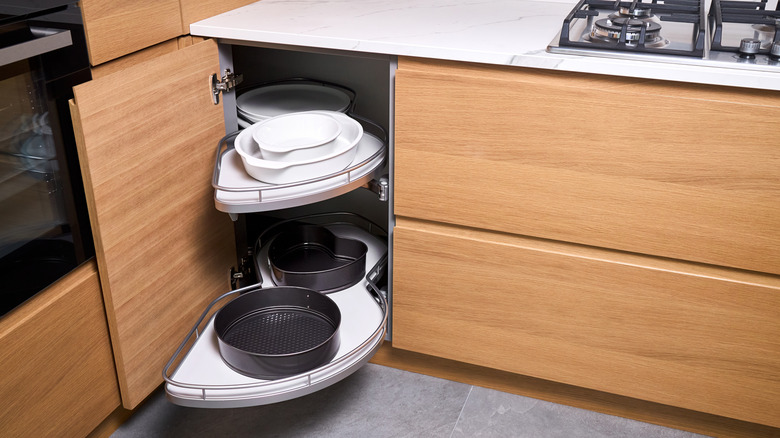
When dealing with perennially cluttered cabinets, it can be easy to assume that the lack of storage space is the culprit. But there is a good chance that you are ignoring some golden possibilities, such as those blind corners where your kitchen counters meet at a 90-degree angle.
Corner cabinets do not get any flowers in the realm of kitchen organization — how does one ever manage to reach all those items sitting at the back? But with the help of efficient organization tools, such as swing-out organizers, you can optimize this wasted space. Designed to put an end to the task of rooting around for items blindly in hard-to-reach organizers, swing-out organizers allow you to pull the entire tray out to get instant and easy access. Modern iterations are often equipped with a soft-close mechanism to minimize noise, have the load capacity to take the weight of heavy pots and pans, and offer adjustable shelf heights to suit the needs of your cabinets.
8. Use a lid holder to organize pot lids together
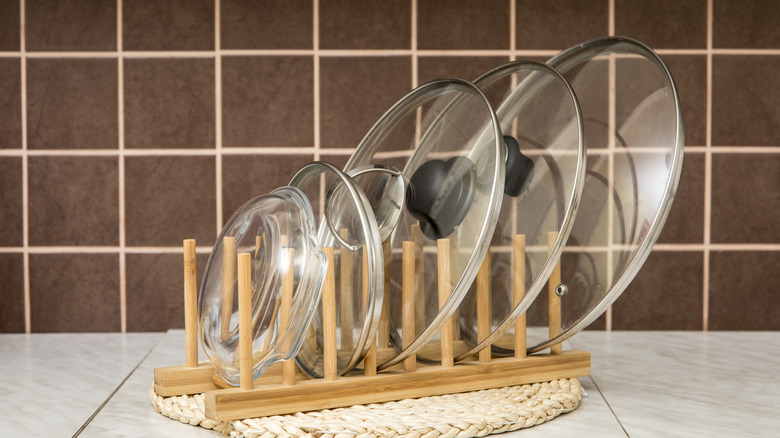
You may have learned how to avoid all the wrong ways of storing all your pots and pans, but what do you do with all the coordinating lids? You can toss them all together in a drawer, but good luck finding the right lid for the right container when the pot is bubbling over on the stove. You could try stacking them together, but all the handles and knobs mean that you'll be greeted by the Leaning Tower of Pisa every morning. Or you could opt for a pot lid holder that will allow you to stack everything with ease and minimize clutter within your cabinets.
First, it helps to take stock of what you truly need and weed out those options that are no longer in your everyday rotation — you'll be glad to know that there are creative ways to reuse old pot lids to create new decor. Once you have whittled down the list to the pot holders that you'll actually use, you'll want to add in a lid holder — a vertical rack with multiple dividers to store lids with ease. If you have any extra slots lying empty on the holder, you can easily use this space to store other flat items, such as cutting boards.
9. Organize glassware by how frequently it is used
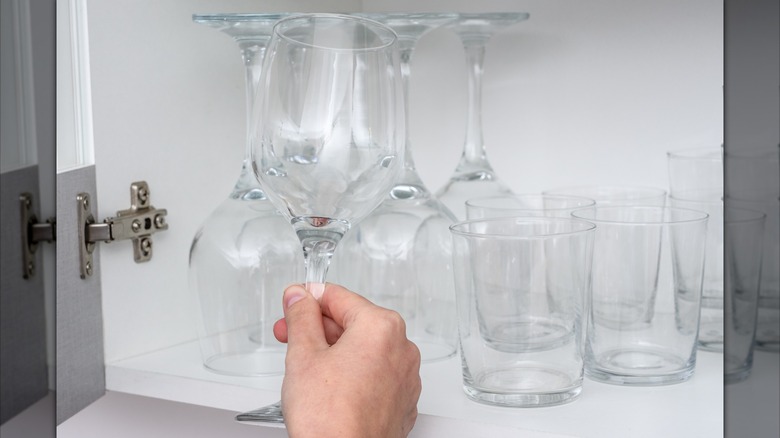
If you are tired of discovering chips and nicks in your favorite china, it helps to reexamine how it is being stored in your kitchen cabinets. Stacking everything together in an extremely high and wobbly pile is a foolproof recipe for accidents. Not considering the usage of individual items is another common error — reaching for an everyday plate from the back of the cabinet can create a domino effect and cause your precious stemware at the front to tip over.
It helps to stay one step ahead of any storage incidents by reconsidering the placement of your glassware. Starting by grouping together items on the basis of how often they are used: daily, weekly, or only on special occasions. With these categories in hand, you can arrange your glassware in an optimal manner: everyday items can be placed at hand's reach on the bottom shelf, while the middle shelf can be dedicated to items that are used on a weekly basis. Specialty glassware, meanwhile, can be put into hibernation on the uppermost shelf.
10. Follow the first in, first out rule to prevent food wastage
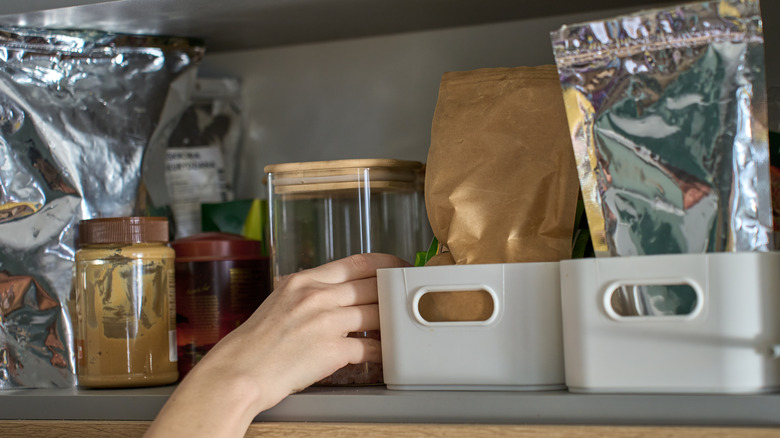
If you are looking to bring restaurant-like efficiency to your kitchen cabinets, it helps to borrow the organization system loved by chefs. First in, first out (FIFO) is a common technique used in restaurants to prevent inventory from getting wasted and the same principle can bring industrial-style functionality to every corner of your kitchen, from the refrigerator to the cabinets.
Put simply, the FIFO method commands that the first items to go into your cabinet should also be the first to go out. When storing perishable goods on your shelves after a grocery run, newer purchases should be intentionally placed behind older ones so that the latter gets used first before it can inch past its expiry date. Beyond preventing food from going bad, this mindful rotation system will also help you get a better understanding of what you need to restock and how often.
11. Store takeout containers and lids separately to save space
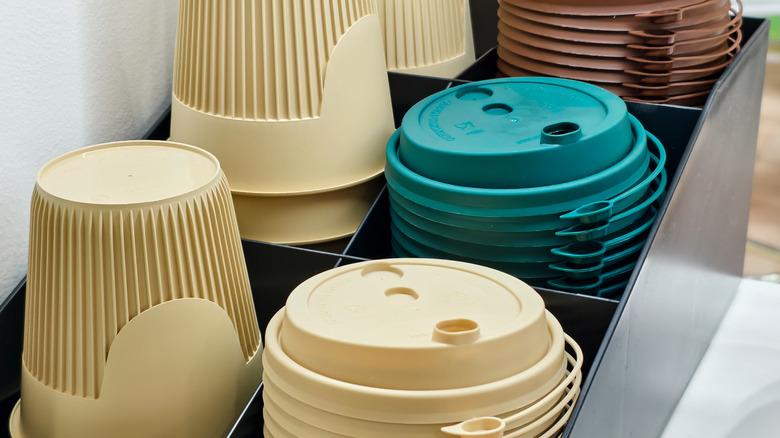
In an ideal world, you would have an array of identical food containers stacked in neat rows in coordinated hues. But the reality is that any container collection is bound to play host to an array of oddball sizes that never quite seem to play well together. If you are looking to save space within a cramped cabinet, it helps to store lids and containers separately.
Once the lids are off, you'll find that differently sized containers can easily nest into each other. And where do all the lids go? When looking for a budget-friendly hack to solve the messy food container lid problem in your kitchen, a quick stroll through Dollar Tree will throw up a surprising solution: plastic book bins. Magazine holders can also serve as an effective way to house errant lids together so that they are at hand when you need them.
12. Store oil bottles on a turntable for easy access
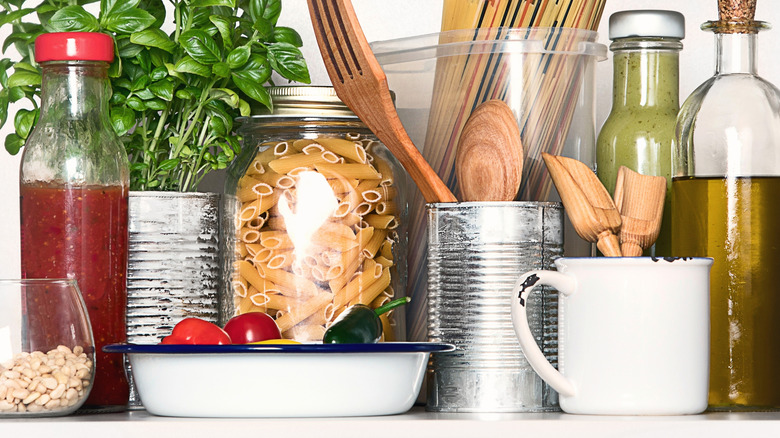
As much as you may love your cooking oil collection, there is no denying that it is a high maintenance mistress. Store cold-pressed oils in direct sunlight and you are staring at a lower shelf life. Forget to seal the lid tightly and the exposure to air can turn it rancid. If your oil collection is buried at the back of the cabinet, spills and accidents will definitely rain on your parade mid-prep.
If you are looking for a more efficient way for storing oil bottles for convenient access, it helps to invest in the right tools: a turntable. Also called a lazy Susan, these organizers allow you to instantly access the oil bottles you need with a single spin — even those lesser used options that would have otherwise been tucked away at the back. By storing all your bottles upright in one place, you can restrict all spills and greasy residue to the turntable so that it doesn't ruin the polished finish of your shelves.
13. Add under-shelf mug holders for organizing your coffee mug collection
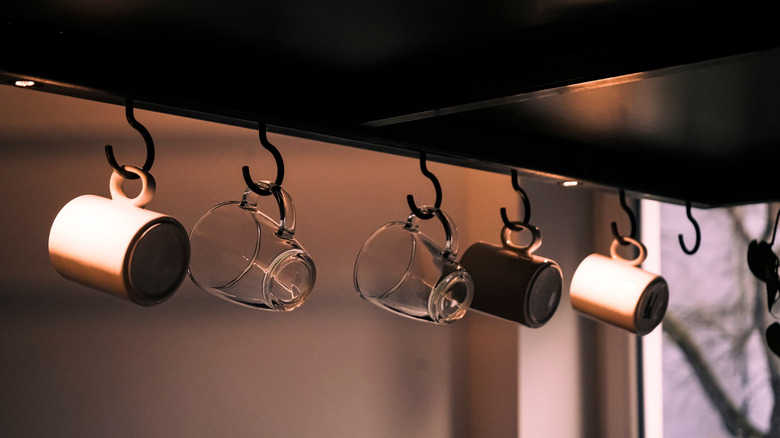
If you are looking to cut back on wasted space in your kitchen cabinets, you'll want to inspect your mug storage choices more carefully. Since they can't be stacked on top of one another, there is a wealth of wasted vertical space sitting vacant above each mug. While shelf risers can help to an extent, overcrowding too many mugs into a cramped space can lead to cracks.
Instead of looking upwards to scour for storage solutions, you might want to consider going down under — or at least, to the bottom of your cabinets. This space can easily be optimized with an under-shelf holder, but is largely ignored in most kitchens. An under-shelf coffee mug holder serves as an easy way to utilize this space with well-spaced hooks that prevent fragile mugs from bumping into each other. Some options need to be mounted with screws, while slide-on alternatives require zero installation — both ensure that your favorite mug can be grabbed easily on busy mornings and returned safely once washed.
14. Try the 50% decluttering rule to make space in cramped cabinets
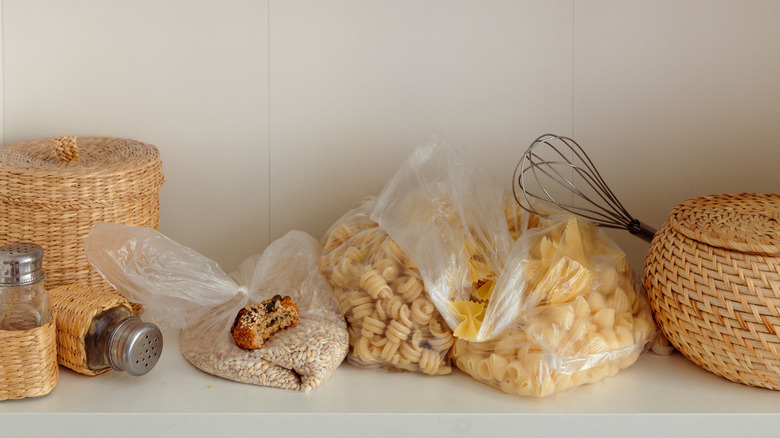
Science may not support this, but it is a known fact that clutter can sense weakness. Any signs of softening on your part, and those chipped promotional mugs will gladly camp out at the back of your cabinet for another decade. If you are looking to keep your kitchen cabinets void of any non-essential items that don't serve a purpose, a ruthless approach is required — but you can always delegate the decision-making to the 50% decluttering rule.
The name does give it all away: the essence of the 50% decluttering rule lies in getting rid of half of the stuff residing within an individual cabinet. While it might sound harsh, you'll notice a dramatic before-and-after transformation. Find yourself dithering over what stays in the "keep" versus the "toss" pile? You can pair this principle with the 5-second rule that dictates you make a decision on whether to keep an item within the span of 5 seconds. Failing to make a decision within this period of time leads to the item being discarded. Merciless? Perhaps. Effective? Immensely.
15. Set up a monthly maintenance schedule
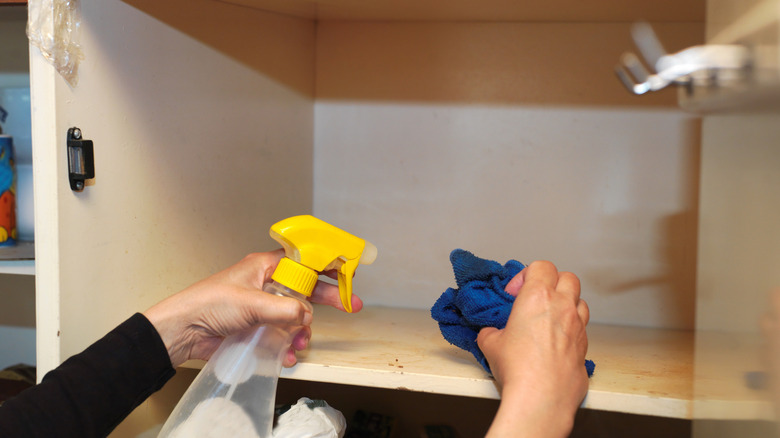
Managing to get your cabinets organized is only half the battle won — the real challenge lies in ensuring that they stay this way. Organizers and tools can certainly help, but they cannot replace intentional storage and maintenance habits. To ensure that your cabinets look ready for a center spread in an interior magazine at all times, it helps to develop and stay consistent with certain maintenance habits.
The easiest way to keep clutter at bay is to pencil a monthly purge into your calendar. Since pantry items have a longer shelf life than refrigerated goods, they do not require constant babysitting. But once a month, it helps to check up on expiry dates and weed out any impulse buys. If you are planning a major grocery haul, it helps to opt for this purge beforehand to determine what you are running low on.