

What You Really Want To Avoid When Making Milk Kefir
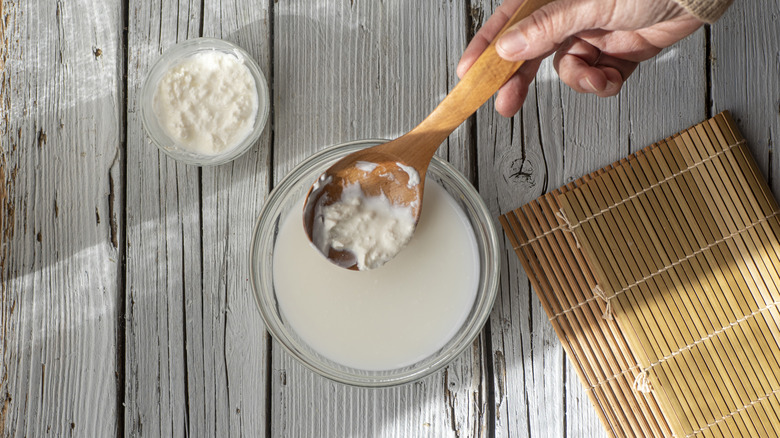
There's a reason why we've been telling people to swap out the yogurt in their overnight oats for milk kefir. Compared to yogurt, this tangy superfood is drinkable, has more probiotics, and is just as easy to make at home — what's not to like? Before you grab just any carton of milk from the dairy aisle to make kefir, take a quick peek at the label. If there's "UHT" printed anywhere on the label, keep walking. If you use it, your homemade milk kefir will be ruined before it even has the chance to start fermenting.
UHT stands for "ultra-high-temperature", and it's made by flash-heating milk to scorching temperatures from 280 to as high as 302 degrees Fahrenheit for several seconds to erase any and all traces of bacteria and contaminants. This makes UHT milk particularly shelf-stable, needing no refrigeration until you crack the lid. While it's convenient as a pantry staple, UHT milk is quite terrible for making kefir.
The intense heat treatment that it goes through essentially "kills" the beneficial bacteria you need for your kefir grains. The temperature causes the milk proteins to denature, warping their chemical structure so badly that the good bacteria in your kefir grains can't digest them. Plus, the heat kills vital enzymes that bacteria require to turn casein and other milk constituents into lactic acid. The result is a disappointingly thin and weak batch of milk kefir that very likely has no semblance to the creamy and tangy treat that you were hoping for.
The best kinds of milk for homemade milk kefir
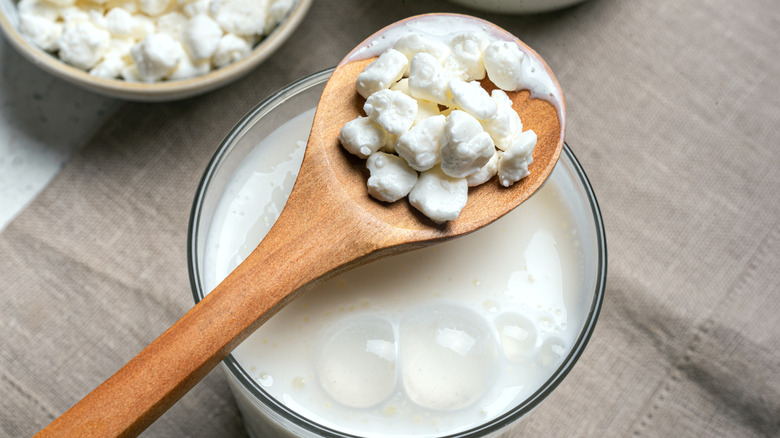
For milk kefir, regular pasteurized milk is your best bet. While it still undergoes a heat treatment process to sterilize it from dangerous bacteria and contaminants, the process, called high-temperature, short time (HTST), is significantly gentler than UHT — the milk is only cooked at 175 to 180 degrees Fahrenheit. At this temperature, the majority of the precious milk proteins your kefir grains need to thrive are still preserved.
For the creamiest results, however, we highly recommend reaching for whole milk. The extra fat content will give your milk kefir a luxurious, rich texture, perfect for making smoothies as well as sipping straight. If you're watching your calories, skim milk will still work. Just beware that it may be slightly thinner than the full-fat version due to the lower fat content. Raw milk, as it turns out, is also an option, but it can be tricky to pull off. Since raw milk hasn't been pasteurized, it's teeming with various bacterial cultures that could potentially overpower your kefir grains and make you sick. You'll need extremely active grains and proper techniques, but when done right, the natural probiotics and nutrients in raw milk can make for a rather nutritious batch.
Lastly, while you can't make milk kefir from lactose-free milk (lactose is what kefir eats to produce sour lactic acid), on the bright side, plant milk still works! Coconut milk, for instance, is a popular choice — its rich protein content means a happy kefir culture that'll give you the perfect base for your homemade smoothies and extra-tangy ranch dips.