

Here's Why Hellmann's Labels Its Mayonnaise As 'Real'
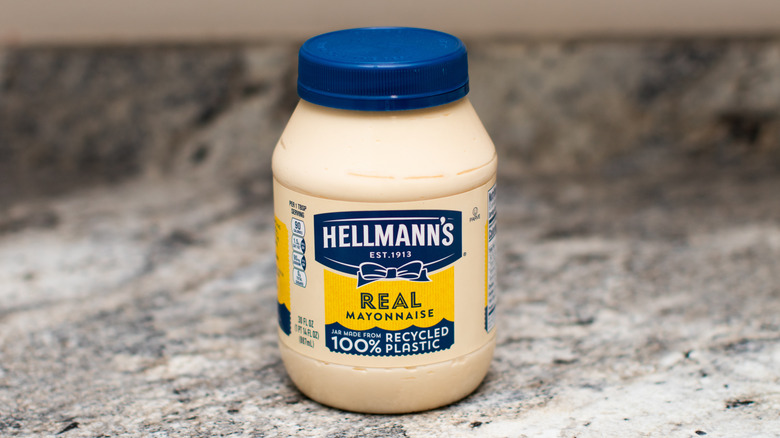
Discerning foodies already know that not all mayonnaise is created equal (we're looking at you, Miracle Whip). In fact, not all mayo is even "real" mayonnaise — which is why every squeeze-bottle and jar of Hellmann's comes labeled with the words "real mayonnaise." The brand placed highly in our definitive ranking of popular store-bought mayo brands. Plus, at a Walmart in Chicago, a 20-ounce bottle runs for $5.98 (bonus points for affordability). But what makes Hellmann's the "real"?
To unpack why Hellmann's qualifies as mayonnaise, it's worth taking a closer look at what, exactly, mayonnaise is. In its simplest platonic form, mayo is a thick, creamy emulsion made from eggs, oil, an acidic component like lemon juice and/or vinegar, and sometimes seasonings. Egg yolks contain lecithin, a natural phospholipid that acts as an emulsifier, helping the oil and liquids in mayo blend without separating.
According to the Food and Drug Administration (FDA) regulations, for commercial mayonnaise to be labelled as "real", egg yolk lecithin must be the only emulsifying agent in the mix. That means no emulsifier additives, modified food starches, or cellulose gel. In fact, "mayonnaise" even has its own section in the FDA's Code of Federal Regulations and is protected by an established Standard of Identity. In 2015, vegan mayo-alternative spread "Just Mayo" caught major FDA backlash for labelling its canola-oil-based, egg-free product as "mayonnaise." Happily, Hellmann's uses egg yolks as its sole emulsifier, and the brand prides itself on ensuring those eggs are of the highest quality.
What's really in Hellmann's mayo?
Not only does Hellmann's abide by the eggs-only rule, it's also made with just 10 ingredients — including oil, vinegar, and 100% pasteurized, cage-free eggs. During the pasteurization process, the raw egg yolks are heated to high enough temperatures to kill any potential harmful bacteria. The result is a certified Kosher, dairy-free, and gluten-free spread that follows a straightforward ingredients list: soybean oil, water, whole eggs, distilled vinegar, egg yolks, salt, sugar, lemon juice concentrate, and "natural flavors." The only hard-to-pronounce ingredient in the lineup is calcium disodium EDTA — a multipurpose food additive that functions as a preservative and antioxidant, retaining color and flavor in canned and jarred goods.
Calcium disodium EDTA (which appears as a white, odorless, crystalline powder) binds with the existing metals in food like zinc, iron, copper, and magnesium, and prevents their ions from undergoing reactions that cause discoloration and flavor loss over time. It's ruled as safe and not linked to any side effects beyond slight digestive issues in high doses. Still, FDA regulations dictate that consumers shouldn't ingest more than 0.9 mg of the ingredient per pound of body weight per day, leagues above the amount one might ingest from a swipe (even a generous spoonful) of Hellmann's. For peak performance, the company recommends storing opened jars of Hellmann's mayo in the fridge door, since colder zones can cause separation. Hungry for more "real" info? We've rounded up 11 additional fun facts about Hellmann's.