

The Crucial Mistake You Could Be Making When Using Santoku Knives
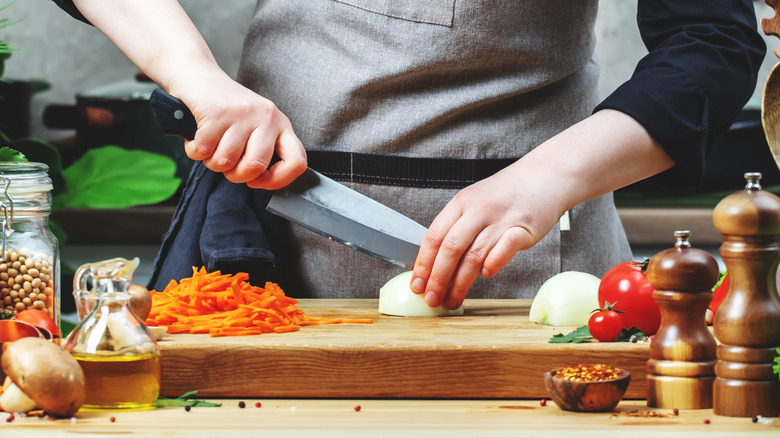
If you know a thing or two about kitchen blades, you've probably encountered the santoku knife. This traditional style of Japanese kitchen knife has made its way around the world — and picked up a few changes along the way. But if you are picking up a proper santoku knife for the first time, there is one aspect of its craftsmanship that you need to understand: its handedness. To explain the unique qualities of santoku knives, Tasting Table reached out to Timo Horl, the founder and CEO of HORL — the inventor and manufacturer of the rolling knife sharpener — who reveals what many don't understand when first using a santoku knife.
"The santoku knife is often considered the Asian counterpart to the Western chef's knife, as both are versatile kitchen knives," he explains, but there are a few key differences between santoku knives and chef's knives. The first difference is its shape. The term "santoku" refers to a knife with a flat blade and rounded top. This already changes the way that the knife is used, but the biggest difference, and the one that can make a blade suitable only for right- or left-handed individuals, is found in the blade itself.
"In Europe and the U.S., santoku knives are mostly available with double-beveled edges," Horl notes, but a "single bevel is a traditional feature of Japanese craftsmanship." What that means is that some santoku knives are only sharpened on one side of the blade, with the other side being completely flat. "Single-beveled knives are specifically designed for the cutting hand," he reveals. "For right-handed users, the sharpened edge is on the right and the flat side faces left. For left-handed users, it's the opposite."
How a single-bevel knife behaves differently than a double-bevel knife
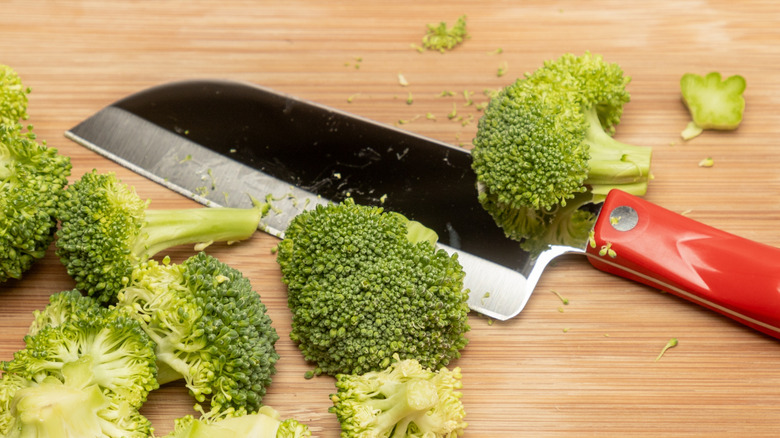
The advantage of the single bevel, as Horl explains, is that they "allow for particularly fine and clean cuts because the asymmetrical edge gently pushes food to the side and reduces sticking." With a double-bevel blade, the cutting edge pushes away both sides of whatever is being cut equally. With a single bevel, it operates like a wedge, cutting straight down and pushing away only one side of the ingredient. But this can be difficult to handle. "Since the blade moves differently through the food due to the asymmetrical bevel," Horl notes, "using it requires some practice and precise handling."
With santoku knives, the differences extend beyond the single-versus-double bevel construction. In fact, the final difference regarding how these knives operate in the kitchen is true of both bevel styles, and it has to do with the flatness of the blade rather than the sharp edge itself. While Western chef's knives have a rounded shape to the blade that allows them to be rocked on the cutting board when cutting, santoku blades are much flatter. Due to this, Horl explains that you must use a "push-cut technique," wherein "the knife is guided through the food in a controlled diagonal slicing motion from top to front, instead of rocked back-and-forth."
The best and worst tasks for a santoku knife
At this point, you may be wondering what exactly this knife is for and why it is worth buying a right-hand-only knife that you are going to need to practice to use properly. Given how much time cooks spend learning to use a chef's knife quickly and efficiently, is it really worth it to start over with a whole new technique? In short, yes — when the task demands it.
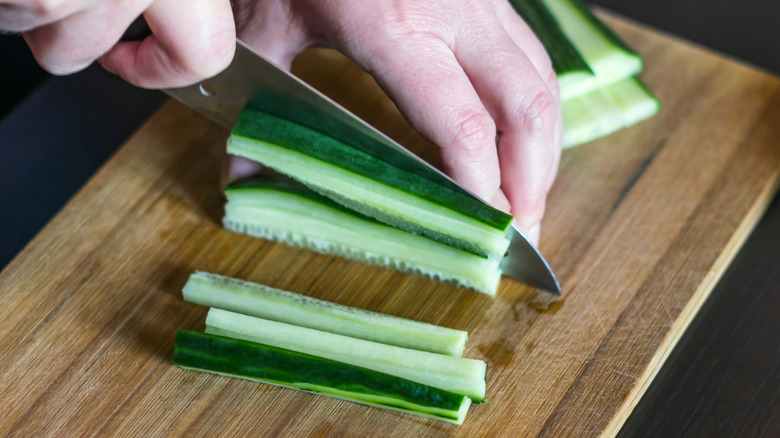
As Horl puts it, "The santoku knife is ideal for slicing, dicing, and especially chopping meat, fish, and vegetables. Its thin blade allows for fine, straight cuts — perfect for sushi or sashimi." If you prefer a more rustic look about your food, you could certainly stick to your chef's knife, but the santoku allows you a higher level of precision, making fine dices and stunning juliennes a breeze. However, the santoku is not always your best pick for every task in the kitchen.
"A santoku knife is not suitable for cutting through bones or chopping hard foods, as its thin blade can be easily damaged," Horl says. The flip side of having a very precise instrument is often that said instrument is also a touch on the delicate side. But there are plenty of other types of knives that belong in your collection, so you can grab a cleaver for those more hacking-type jobs. You may not use your single-bevel knife for every task in the kitchen, but when you want to trim beautiful carrot sticks or stunning slices of sashimi, one of these 12 top santoku knives may be the best for the job.