

Why Vinaigrette Clumps On Salad And How Jacques Pépin Avoids It

Anyone who's ever tossed a salad has probably wondered why this happens: Sometimes, instead of a light, even coating, the vinaigrette seems to latch onto just a few leaves like a clingy guest at a party while the rest remain untouched like carrot sticks at an all-you-can-eat buffet. According to Jacques Pépin, the reason your vinaigrette isn't mingling with all your salad ingredients isn't bad greens or a lazy toss. It's just over-emulsified dressing.
Jacques Pépin, the legendary French chef and television icon, said that the trick is resisting the urge to whisk your dressing into oblivion. "People go berserk when the sauce is not homogenized together, but a vinaigrette should be separated so that you can toss the salad and the whole thing is glossy," he explains in this video on Instagram, while whipping up a simple vinaigrette with shallots, garlic, mustard, vinegar and olive oil. Pépin explains that when a vinaigrette is blitzed until it looks like "a light mayonnaise", the dressing clings in lumps. Left a little loose and streaky, it slips around the bowl, coating every leaf with a gentle shine.
That thickness is especially common with bottled dressings. Most store-bought vinaigrettes are engineered to stay thick and stable on the shelf, which means they pour out closer to mayonnaise than the quick-whisk version you'd make at home. The result? A clingy, gluey coating instead of the light gloss Pépin champions.
The role of emulsification in salad dressings
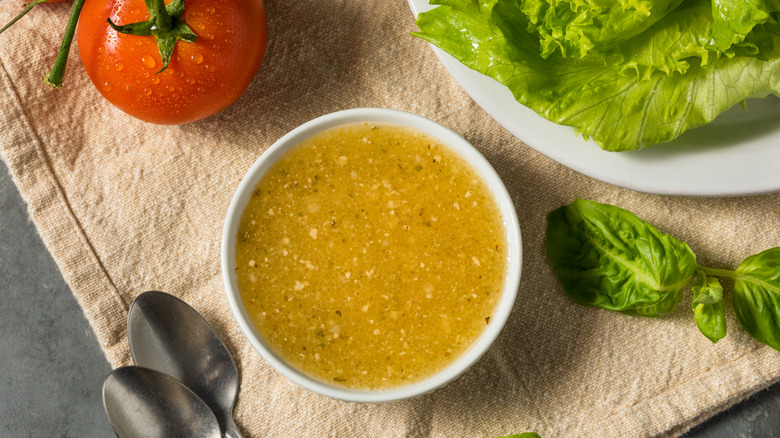
Emulsification is the process of getting oil and water (or vinegar) to combine. Left alone, these ingredients naturally separate, but with enough whisking, or with the help of stabilizers in bottled dressings, they can be forced into a uniform blend. Some level of emulsification is necessary for a salad dressing. Here's why: lettuce leaves are built to withstand rain. To do that, they develop a thin, waxy, water-resistant coating that repels liquids. Vinegar or lemon juice on their own slide off, while just oil can hug to the leaves a bit too tightly and cause your greens to wilt. Mix oil and vinegar together, however, and it sticks gently to the greens.
Knowing how to make an emulsified sauce is important. Store-bought vinaigrettes use a whole range of stabilizers — Hidden Valley's version of America's most popular dressing, ranch, lists nearly 20 ingredients, for example — and sometimes you might just want to keep it simple and make your own. When it comes to homemade dressings, mustard, honey, tomato paste, miso, almond paste and egg yolks can be good emulsifiers.
In the end, there are a whole range of different vinaigrettes, and at the heart of them all is balance. Enough emulsification to coat the leaves, but not so much that it glues them together. A touch of mustard, or any other emulsifier, can help maintain that balance, leaving every bite of your salad flavorful, tender, and perfectly dressed.