

15 Vintage Cocktail Glasses To Look Out For At Thrift Stores

We may receive a commission on purchases made from links.
Keeping an eye on modern design trends is a great way to find inspiration to give your living space a modern makeover, and in 2025, kitchen trends became all about eclectic nostalgia. Gone were the wide, endless expanses of plain white, and instead, it was all about color. Fortunately, it doesn't take a massive budget to add some seriously fun statement pieces to your kitchen, and that's why we want to talk about vintage cocktail glasses.
Vintage kitchen gadgets, utensils, and design ideas can go a long way in brightening any kitchen, and when it comes to cocktail glasses, the really good news is that these were so popular that they often turn up at thrift stores. Score!
We're going to talk about some brands and glasses to look out for, but first, a word of warning: As we're going to be heading back quite a few decades, that means that some of these glasses might contain dangerous materials like lead, cadmium (specifically red glasses), and uranium (in glow-in-the-dark green glasses). What does that mean for using them? Some — like the uranium and cadmium glassware — should remain strictly decorative pieces. It varies for glassware containing lead: They may be fine for an occasional cocktail, but you should never use matching decanters for storing wine or whiskey or use them for every day consumption. If you're questioning, do a little research first. With that in mind, let's talk about vintage cocktail glasses.
Libbey mid-century barware
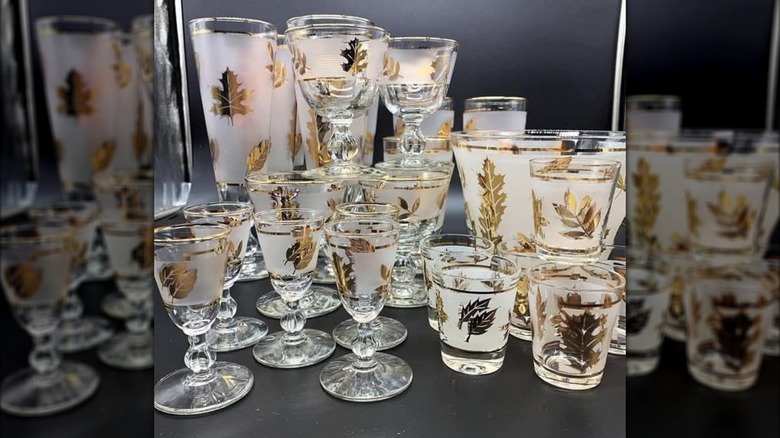
When it comes to the type of glassware you might be most likely to find at a thrift store, it could be argued that it's Libbey. The Massachusetts-born company has roots that go back to 1818, and it was such a big player in the industry that, after it moved to Toledo, Ohio in 1888, Toledo would earn the nickname The Glass City. By the 1950s, Libbey was producing a ton of glassware, so you'll find everything from risqué dancers on tall Collins glasses to holiday-themed old fashioned glasses, atomic-age champagne glasses and cordial glasses, and entire flower power-themed bar sets.
There are so many patterns and designs out there, it's impossible to talk about them all. The good news is that there's an easy way to identify these glasses: They're always marked with an "L" trademark. If there's two circles around the letter, you're looking at a glass that was likely made between 1924 and 1937; a single circle (broken into three sections) was used until 1955, when the trademark was changed to a simple, circled "L". For those interested in learning more, the book "Libbey Glass Since 1818" is an outstanding resource.
Vintage tiki glasses
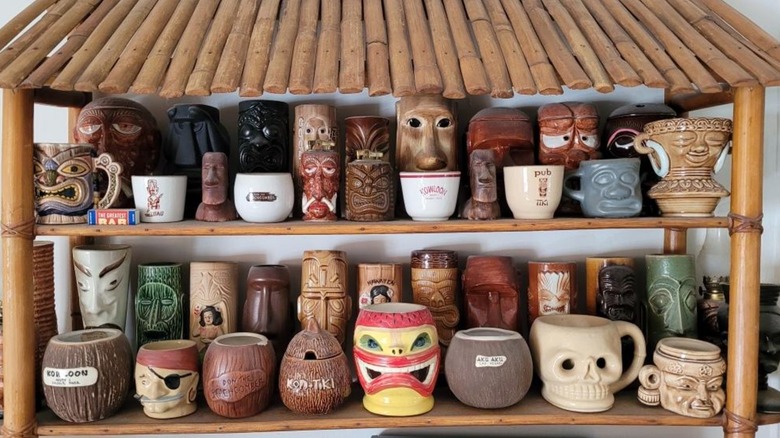
Tiki drinks have a long and complicated history, and if you go back into the 1950s, you'd find these vintage glasses used to serve cocktails with names like the husband killer, the shark's tooth, the zombie, the Bimini cooler, and the West Indies. There are a ton of mugs out there, and many tiki bars had mugs specifically designed for them.
For example, the above-mentioned husband killer cocktail was served at Los Angeles' The Islander, and there was a specific mug for it that took on the same name, while San Francisco's Tonga Room also had barware of its own. Finding the vintage ones can be tricky, and there's not always identifying marks.
A great example comes from one of the early pioneers himself, Victor Jules Bergeron Jr. He's more widely known as Trader Vic, designed a ton of drinkware for the tiki movement he popularized, and is also created for creating the mai tai. An early theme among his tiki mugs was the skull mug, and there's a handful of different versions out there that date from the start of the movement in the 1930s into the 1960s. Things like shape, color, and the quality of the pottery can all be used to help get an idea of date, but research is key.
Fred Press barware
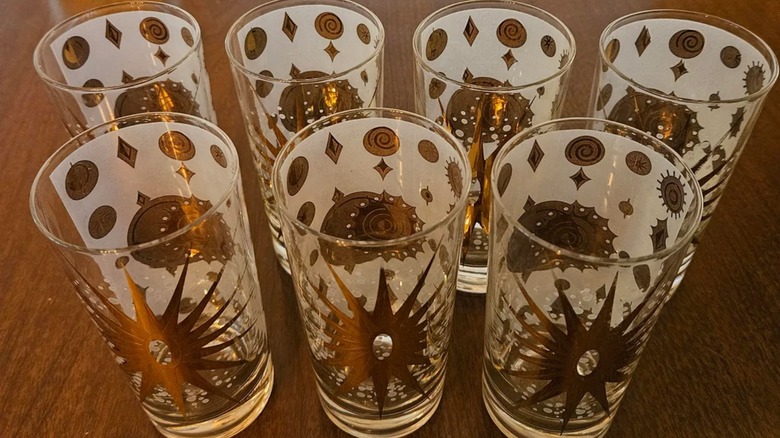
Fred Press was a World War II veteran and an award-winning artist with honors from the likes of New York's Museum of Modern Art and memorial commissions from the U.S. Navy. His designs are also well-known in the glass and giftware industry, and if you're looking for his cocktail glasses, there are lots of options. Although he preferred working with 22- and 24-karat gold, common designs include atomic starbursts and symbolism, funky geometric shapes, and his distinctive gold fish pattern. But that's certainly not an exhaustive list.
Like many designers and brands, there are all kinds of different Fred Press cocktail glasses out there. You could absolutely find pink and gold starburst highball glasses, diamond-patterned old fashioned glasses, atomic-themed cordial sets, and occasionally, you might even stumble across matching ice buckets or decanters. Most legit pieces will be marked with Press' signature, and the featured image here is a great example of his work's style.
Waterford Crystal glassware
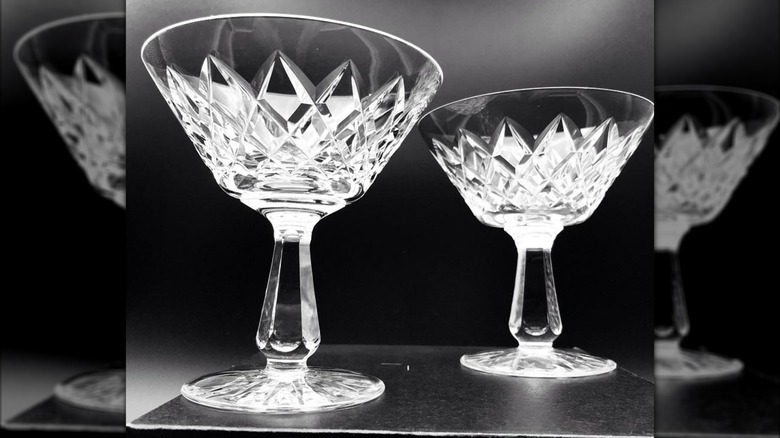
Waterford Crystal is still being produced, and there are a variety of patterns and collections that are currently sold. They're pricey — two Copper Coast tumblers will set you back around $425, as of this writing — but there's also a lot of vintage and discontinued pieces and patterns, too. Because these glasses are so popular and so often given as gifts, there's a good chance you can score big at thrift shops. Sherry and champagne glasses, tumblers and shot glasses, old fashioned and hock glasses, goblets and flutes ... they're all out there.
Once you know what you're looking for, Waterford Crystal is easy to spot. The real deal will always be heavy and flawlessly engraved on perfectly clear crystal. Tapping (gently) will produce a ringing sound, and they'll all cast rainbow-colored refractions. Also, most will be engraved with "Waterford," but there's a catch: On smaller glassware, in particular, it can be almost impossible to see with the naked eye, and some vintage pieces might be stamped. Some pieces might also bear the brand's seahorse logo, and in some cases, there might be no marking. For anyone interested in learning more, the book "Waterford Crystal: The Creation of a Global Brand" is an excellent resource.
Anchor Hocking glassware
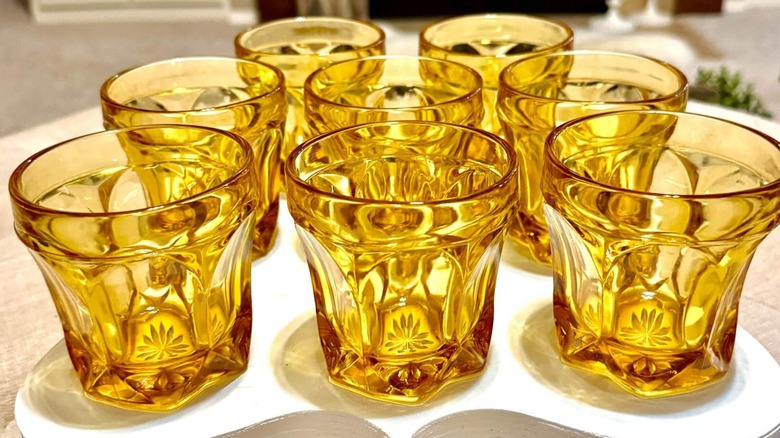
Anchor Hocking is another big name in the vintage glass market. Founded in 1905, entire books have been written about the company's glassware. ("Anchor Hocking Decorated Pitchers and Glasses: The Depression Years" and "An Unauthorized Guide to Fire-King Glasswares" are a couple of great references for starters.) As with other brands, there are a myriad of patterns and colors, but some stand out. Greens and reds were particularly popular, as was the brand's Fire-King line.
Because it was so popular, there's a great chance you'll find some sets kicking around thrift stores, and when we say there's something out there for everyone, we mean it. Anchor Hocking's vintage catalogs include everything from Santa-and-reindeer glasses to atomic-themed highball glasses, honeycomb-shaped tumblers in colors like ruby and amber, and atomic snowflake patterns that were popular in the 1960s. Identification is — thankfully — pretty straightforward. Pieces will be marked with either the letters "HG Co." in a triangle (1905 to 1937), an "H" positioned over the center of an anchor (1937 to 1968), or an anchor in a box (1968 onwards).
Bartlett-Collins 1950s- and '60s-era cocktail party sets
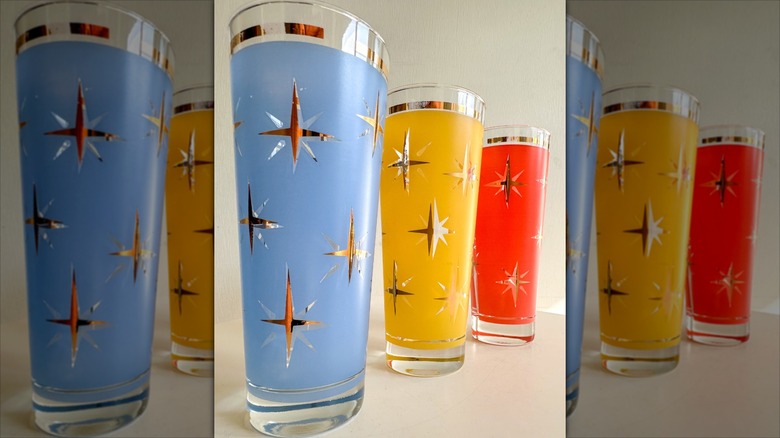
When it comes to moving with the times, Bartlett-Collins is a great example of a company that pivoted its product line to what customers were looking for. Established in 1914, the company made a name for itself in the Depression and Prohibition eras with its stemware. Fast forward to the 1950s, and cocktail parties were all the rage. That brings us to the sets you're most likely to find on the second-hand market, and that's the mid-century cocktail sets.
Most of these glasses are marked with some form of a "B-C" or "BACO" logo, but there are a few things you can keep an eye out for to identify likely candidates at a glance. Some of the most popular motifs were the atomic and diamond starbursts, as well as a marine theme (although that's far from exclusive). Designs used 22-karat gold, and the North Star design (pictured) is perhaps the most recognizable: Gold stars stand out against a variety of solid backgrounds, and it was used for everything from pilsner glasses to Collins glasses.
Hazel Atlas cocktail sets
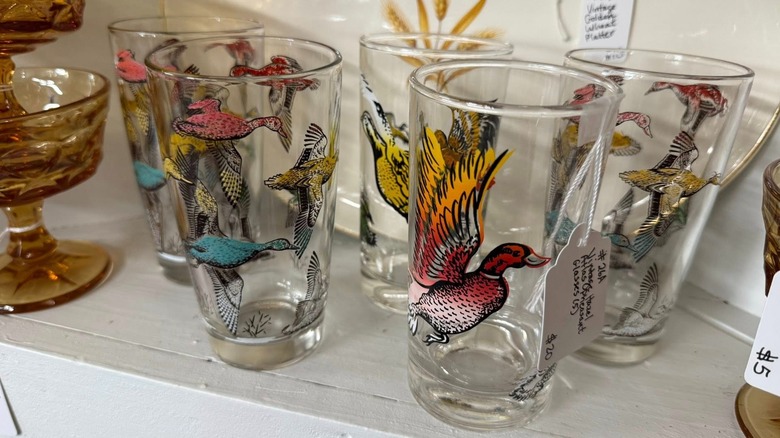
The Wheeling, West Virginia-based Hazel Atlas has a fascinating history. The Hazel side started out making jar lids for companies from Maxwell House to Avon; Atlas manufactured fruit jars; and they became Hazel Atlas in 1902. The product line expanded into dinnerware and glassware, which is identifiable by the company's mark: A capital "H" standing over a smaller "A."
Anyone who's interested in focusing on a particular company or brand while still collecting a variety of patterns and designs could consider Hazel Atlas. This company put out everything from pheasant-themed ice bucket sets to fish- and polar bear-themed cocktail sets. There are also sets made with mid-century atomic designs, colorful smiley faces, holiday-themed designs, and trippy things like dancing elephants and pigs. Hazel Atlas is also a great place to start if you're looking to flip finds: At the time of this writing, a full polar bear cocktail set goes for more than $1,000.
Blendo cocktail glasses
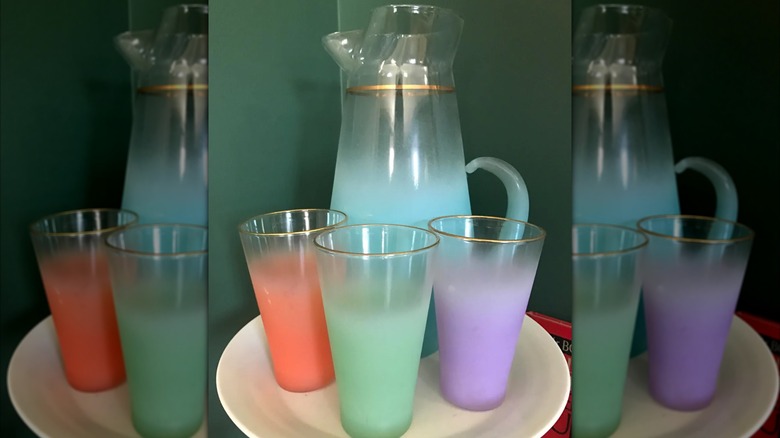
A lot of the vintage cocktail glasses and sets you might find have elaborate designs, bright patterns, and a ton of goldwork. And we get it — that might not be your thing. Maybe you're just looking for something simple but beautiful to serve any of your favorite brunch cocktails in, and if that's the case, take a look at Blendo. When it was debuted by the West Virginia Glass Company in the 1950s, it stood out by ignoring the biggest trends of mid-century modern glassware and instead went with simple, straightforward designs. And honestly, it's a lesson in retro chic.
The featured image is standard of Blendo's look: There are plenty of bright colors but none of the distracting patterns, and that thin gold strip at the top is an easy way to identify a legit Blendo piece. There are all kinds of options, from delicate, 7.5-ounce cocktail glasses to shakers and shot glasses, along with — of course — versatile drinking glasses and parfait glasses. Best of all, these were so popular that even today they lean toward the more affordable side of collecting. If you find a color you fall in love with, there's a good chance you can get other tableware and servingware to match.
Cera cocktail glasses and tumblers
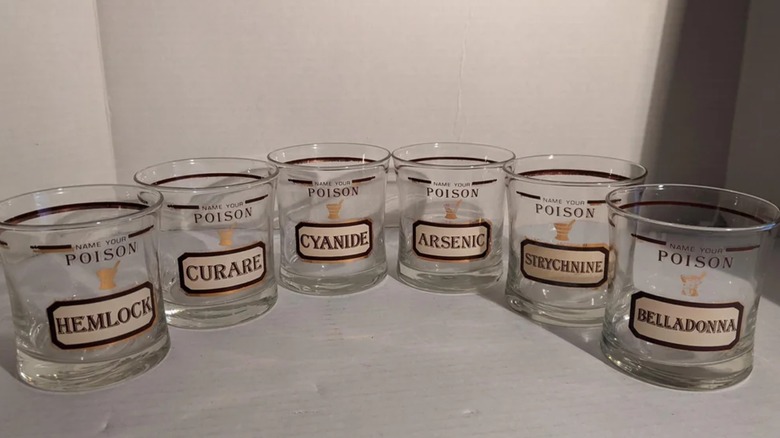
Collectors looking for something that truly stands out should definitely look into the Cera Glass Company. This New Jersey-based company was the first to use silkscreen printing technology for its designs, and that — combined with gold trim and funky graphics — mean these cocktail glasses are absolutely brilliant.
That featured image is of a Cera set from the 1960s, and it's a great example of just what kind of fun and funky glassware is out there. (There's also a matching ice bucket.) Cera is also known for its elegant designs, like the world map pattern and black-and-gold floral motifs, but some of the silkscreened patterns are super fun. Cera released a set of old fashioned glasses that look like old-school Crayola crayons, and there's a set of glasses that look like billiard balls, too. Mid-century holiday designs include Santa in a Jeep with his reindeer, while other unusual themes include the 1980s-era Dow Jones glasses, the presidential gold coin-themed highball glasses from the 1960s, and there's also a '60s-era Camelot set, too.
Culver Ltd. mid-century cocktail glasses
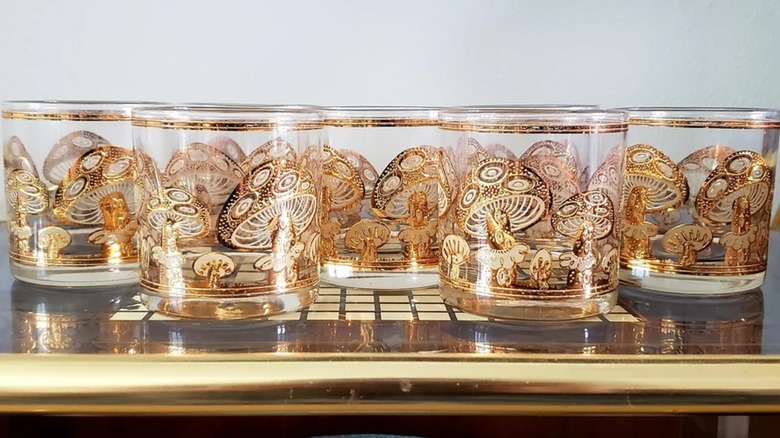
Getting into collecting vintage Culver glassware can be a bit tricky. The company is still around today, and more recently, it's taken many of the old, vintage designs, given them a modern update, and reissued them. However, the mid-century barware was incredibly popular, and there are still plenty of chances out there to snag some yourself.
Let's talk about the vibe here, because this is the perfect brand to keep an eye out for if you're looking for elaborate, elegant glasses to serve up some classic cocktails at your next afternoon tea. These were the kinds of glasses that fur-clad ladies shopping on Fifth Avenue would buy, and we're talking about a lot of gold. Think of old fashioned glasses with delicate frosted swirls, highball glasses with intricate Regency designs, and geometric patterns reminiscent of Frank Lloyd Wright. (That's not a coincidence, as Culver also sells Frank Lloyd Wright glassware.) It's also worth noting that, while many legit Culver glasses are marked with the company's name, that's not always the case when you're looking at post-1970s-era glasses.
Russel Wright American Modern and Eclipse cocktail glasses
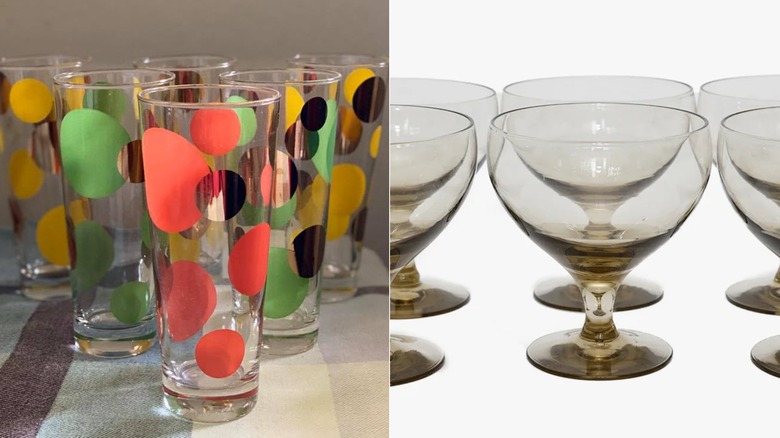
Russel Wright was a designer who helped overhaul the way Americans outfitted their homes. Known officially as an industrial designer, Wright spearheaded a movement to mass produce affordable yet beautiful home goods, and that includes everything from furniture to glassware. With that in mind, we're going to spotlight a few of his cocktail glasses that you might find while thrifting, and these are so popular, you might even recognize them.
Wright's flagship line was called American Modern (right), and those simple yet elegant smoky glass goblets pictured are part of that line. These glasses came in all different colors, are still widely available, and they're great for all kinds of cocktails. He's also the designer behind that iconic polka-dot pattern we've pictured on the left, and these Eclipse glasses come in all kinds of colors, with many bearing gold accents. There are tall Collins glasses, tumblers, old fashioned glasses, shot glasses, and even matching ice buckets, which makes this a great set to collect if you're looking for a matching pattern in a variety of fun colors.
Federal Glass Depression- and Atomic-era cocktail glasses
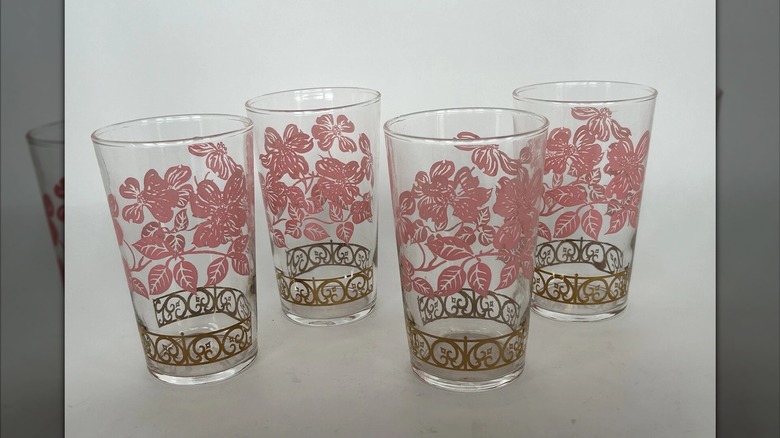
The Federal Glass Company was around from 1900 to around 1979 or 1980, so there's a lot of vintage stuff out there. But we want to talk about two high points in the company's tenure, starting with its Depression glasses. Like the name suggests, these pieces were popular during the Great Depression, and because they were affordable and durable, there's plenty of them still around. Fortunately, identifying the real deal is easy: Look for a mark in the shape of a shield, with an "F" in the center.
There are also a wide variety of mid-century cocktail glasses from Federal Glass out there, too. You might find anything from zombie glasses with tropical designs to atomic starburst Collins glasses, sets with bright geometric patterns, and even some retro pop-art pieces. There are even some featuring risqué cartoons that we absolutely couldn't show you, as well as more innocent cartoons depicting things like angels putting up Christmas decorations. And if you're lucky, you might find a full set that still comes with the carrier.
Georges Briard cocktail glasses
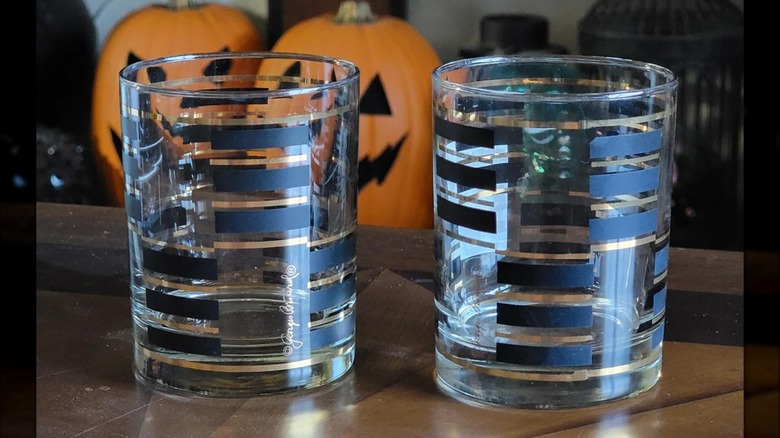
This one's a little different, because Georges Briard didn't make glassware at all. Instead, he designed the artwork for companies that bought it and used it for everything from cocktail glasses to furniture, and he was wildly successful. The high point of his career designing cocktail glasses and sets came in the 1950s, and there's an almost impossibly wide range in what he designed. At the same time, you might pick up a set of old fashioned glasses with a gorgeous Art Deco or Spanish-inspired scrollwork design in 22-karat gold. He also did things like funky, brightly colored ladybug designs, frosted glasses with ice cream cones, and even maritime-inspired designs like fish, ships, and compasses.
Because there's such a wide range of Briard's work out there, it might seem like it's hard to identify. The good news is that many of these pieces will bear his signature, and it's usually prominently placed. (It's visible on the left in our featured image.) For anyone looking to know more, "Designed & Signed" is a great resource that covers mid-century artists, including Briard.
Gay Fad Studios cocktail glasses
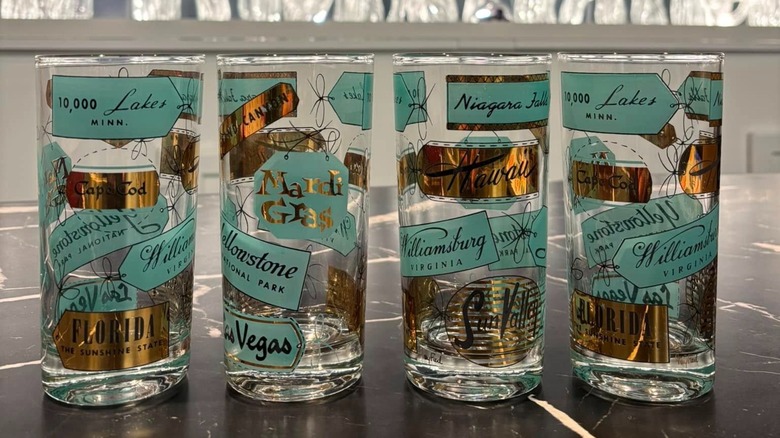
Gay Fad Studios was founded by Fran Taylor, an artist who turned her attention to glassware in 1945. Her initial studio employed 25 female artists, who would hand-paint designs on all kinds of different types of glassware. That glassware came from different manufacturers, but the idea and commitment to craftsmanship was groundbreaking. In addition to hand-painting, vintage Gay Fad glassware also used silkscreen printing and 24-karat gold accents. Over the course of the company's first 17 years, there were at least 1,000 different designs created.
The company is still around — having been relaunched by David and Jason Annecy in 2022, six decades following its initial closure — and it's still selling modern versions of some of Taylor's classic designs. It's well worth keeping an eye out for the vintage glasses, though, and that's everything from bent-stem martini glasses to cartoon characters decorating Collins glasses and can-can girls dancing on tumblers. Unfortunately, many of the vintage glasses were unmarked, although some do bear a "Gay Fad" label.
Vitreon Queen Lusterware cocktail glasses
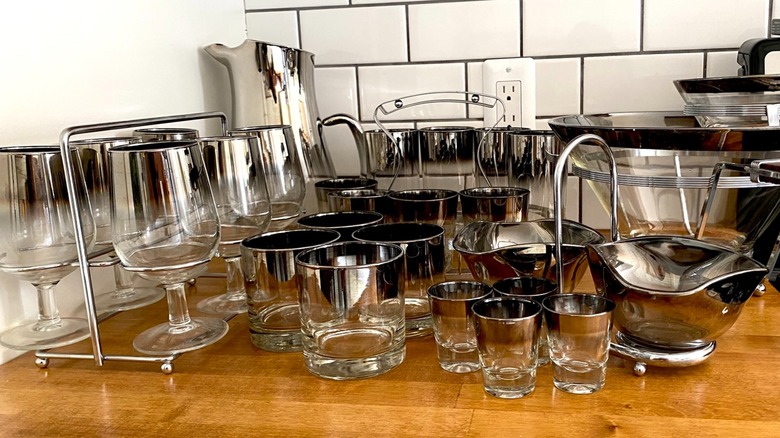
If you happen to have a fan of "Mad Men" in your life who's looking for the perfect glassware for a classic old fashioned, this one's for you. It's called Lusterware, it was featured in the show, and it's made by the Brooklyn-based company Vitreon Queen. Lusterware is given that absolutely magical look because of a coating, which was applied to a number of different materials to get that iconic shine. The technical name for the iridescent and mirrored effect is silver ombre — although you might hear it called silver fade, as well — and it's not a new thing. Interestingly, the use of oxides to give tableware a metallic shine goes back to at least the 10th century.
And yes, Don Draper's old fashioned glasses can still be found. There are also highball glasses in the same style, and sets could also include an ice bucket, pitcher, and carrier. "Mad Men" made the solid version popular, but there are also polka-dot patterns, too.