

What Does The Name M&M's Actually Stand For?
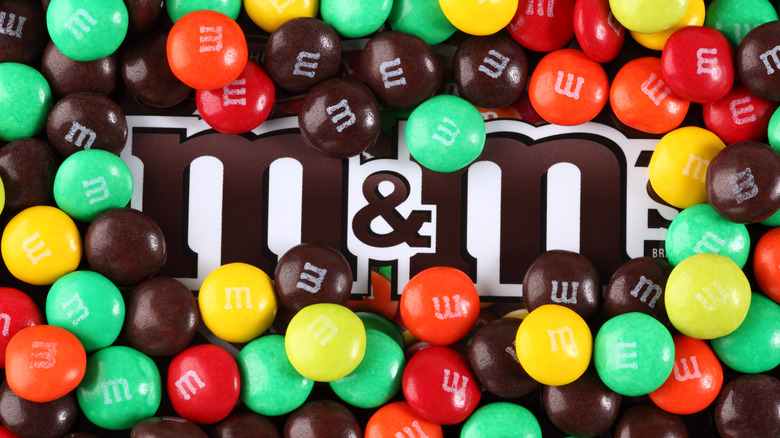
Shakespeare's Juliet asked, "What's in a name?" When it comes to M&M's, the answer is "A lot, actually." When sweet-toothed foodies pop those multicolored pebbles between their lips, the story behind the name is likely the last thing on their minds. But the name "M&M's" stands for "Mars & Murrie's," a nod to the candy's conception and history. Forrest Mars Sr. invented and patented the treat, but his idea never would have taken off on a mass scale without the help of Bruce Murrie of the Hershey Corporation.
The year was 1932, and Forrest Mars Sr. of the Mars candy company had recently moved to England. While in Europe, Mars cut his teeth (literally and figuratively) in the candy business under the Nestlé and Tobler companies. Soon, Mars was selling Mars bars as rations for British troops. Hooray for chocolate, right? There was one major drawback: the heat. Soldiers' chocolate bars were melting left and right. To help the chocolate retain its shape, Mars began manufacturing tiny chocolates coated in a hard candy shell. M&M's even accrued the slogan "melt in your mouth, not in your hand." Thus, M&M's were born ... almost. The candy still didn't have its now-iconic name yet.
"M&M's" arrived in 1940, when Mars returned to the U.S. and approached Bruce Murrie of Hershey to collaborate on his new product. When Mars proposed an 80-20 partnership (80 Mars, 20 Murrie), Murrie accepted; "M&M's" combined their names.
M&M's began as a wartime, melt-proof candy
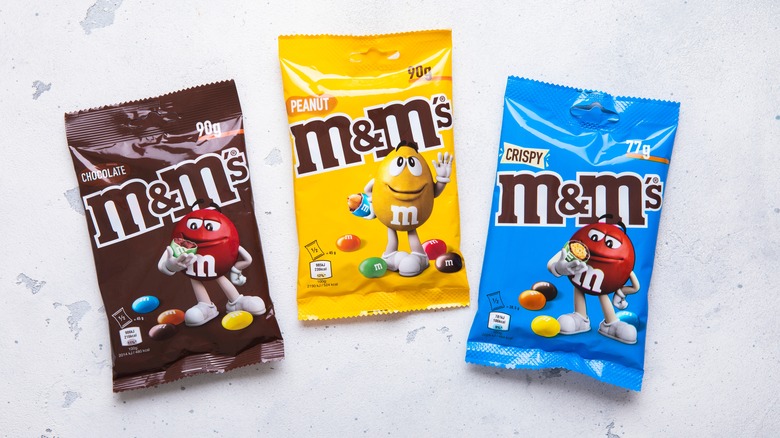
With World War II looming, Mars' idea required Hershey's production capacity to ensure continued access to chocolate as wartime rations tightened. The candy got its patent and debuted on the U.S. market in 1941. When WWII officially began in 1942, M&M's were there as a melt-resistant treat that quickly became popular with soldiers abroad. In fact, part of the motivation behind the deal was that Hershey Co. had already been contracted to provide chocolate for the troops.
In the late 1940s, Mars bought out Murrie's shares and began printing the candies with a single letter M in 1950. There's an involved process behind how each individual M&M gets stamped with its tiny white logo. Originally, the branding was a tool to help consumers know they were eating a real, wildly popular M&M and not just a candy-coated knockoff.
Decades later, when the year 2000 arrived, M&M's were named "The Official Candy of the New Millennium," (per M&M's). Here, the "MM" title served double duty as the Roman numeral for 2000. Over time, the smaller-than-bite-sized candy has inspired Dairy Queen Blizzard and McDonald's McFlurry flavors, as well as a global tourist destination: NYC's iconic M&M's store. Call it a never-ending victory lap for Mars and Murrie.