

We Visited The Old-School NYC Steakhouse Frequented By Marilyn Monroe And JFK
We may receive a commission on purchases made from links.
When two immigrant brothers opened a modest café and pastry shop in 1827 at the southern tip of Manhattan, few could have imagined the legacy they were about to create. John (Giovanni) and Peter (Pietro) Delmonico — originally Del-Monico — changed the course of American cuisine when they branched out into fine dining, bringing a taste of Europe to a bustling city in a still young country. At the time of Delmonico's early rise, people didn't often dine out at "eating houses," but Delmonico's brought something new to the table, at a place which started being known as a "restaurant."
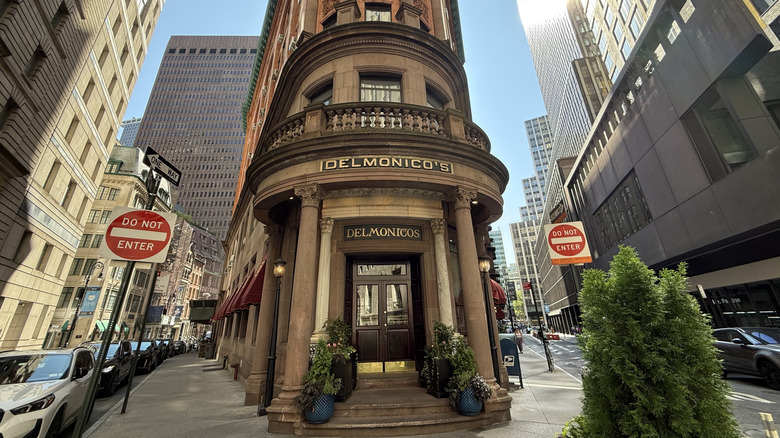
The brothers, following Delmonico descendants, and the Tucci family who followed in their footsteps, along with a slew of exemplary chefs in their employ, not only helped to change the perception of dining in America, but practically defined it. While Delmonico's has existed in 10 different locations, many opened at the same time, the one that remains left standing resides in a beautifully elegant, triangular building where Beaver and South William Streets meet.
This longstanding Delmonico's location, known as "The Citadel," has survived Prohibition, economic downturns, and pandemics. It is here where Tasting Table has entered its doors to break bread with current managing partner Dennis Turcinovic and learn about its incredible storied past, present, and bright future. We also spoke with third-generation partner and brand ambassador Max Tucci, who literally wrote the book about "The Delmonico Way." Pull up a chair as we dive right into the rich and supremely delicious history of one America's most storied dining institutions.
Delmonico's is home to many historical restaurant firsts
A place that's often referred to as America's first fine-dining restaurant, it's no surprise Delmonico's is home to many other firsts in the entire industry. When I asked Max Tucci to name some, he quickly rattled off a list that seems almost inconceivable that they all belonged to one restaurant. That's probably the reason why Delmonico's is the first restaurant to be a question on "Jeopardy!" 10 times.
Beyond introducing a litany of famous dishes to the world, Delmonico's laundry list of incredible firsts includes, according to Tucci, the first tablecloth, the first to accept American Express, and the first to not only bring the menu to the table, but to also have a menu printing press. "My grandfather [Oscar Tucci] had a menu printing press on the ... third floor of the building, and so every day when the menu would change, they just went upstairs to print them," he says. If that wasn't enough, Delmonico's was also known as "the first to have the bar stool at the bar instead of just standing."
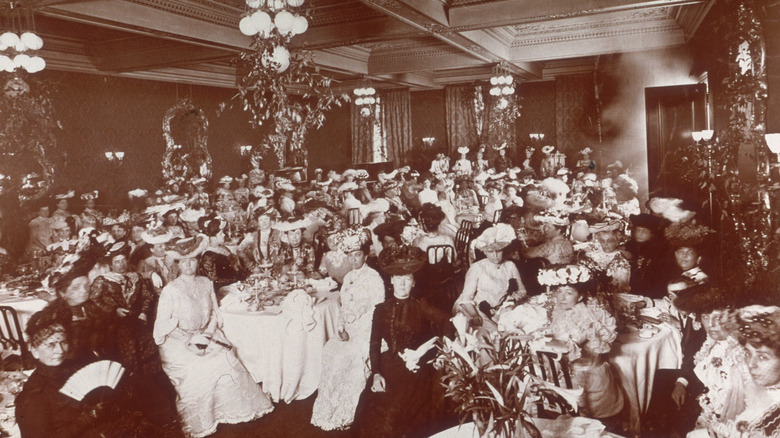
Perhaps one of Delmonico's most landmark firsts involves the inclusion of women. In the 19th century, it wasn't common for women to dine alone, without the accompaniment of men, but that all changed on April 20, 1868. While many other restaurants denied their request to congregate there, Delmonico's opened its doors to the all-women's club Sorosis, and in turn opened a new chapter in the women's liberation movement.
It was the place to be during The Gilded Age
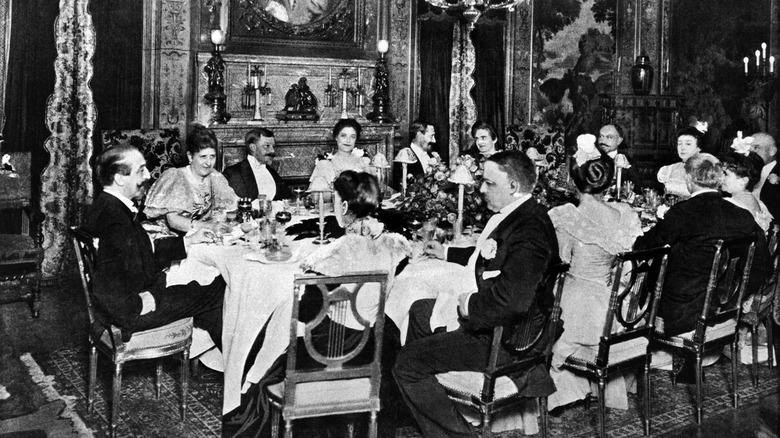
The golden age of Delmonico's was overseen by Lorenzo "The Great" Delmonico, who ran the steakhouse from about 1845 to 1881. It coincided with the end of the Civil War and the launch of The Gilded Age, which saw captains of industry flush with money and a new scene of opulence where it could be spent. In high society, private balls were held in one's own home, but banker Archibald Gracie King broke the mold by holding one at Delmonico's in 1870 to debut his daughter. That literally set the "ball" in motion for more soirées and parties of the rich and famous to be held at Delmonico's.
While there was a plethora of splashy dinners held at Delmonico's, perhaps the most memorable of all time occurred in 1873. Importer Edward Luckmeyer was looking to make a name for himself in high society and threw a legendary party. At this fete, a 30-foot-wide lake was constructed and filled with plants, waterfalls, and even swans on loan from Brooklyn's Prospect Park. The reported cost ranged from $10-15,000, which today, when adjusted for inflation, would be somewhere between a quarter or almost half a million dollars.
Charles Ranhofer — America's first celebrity chef
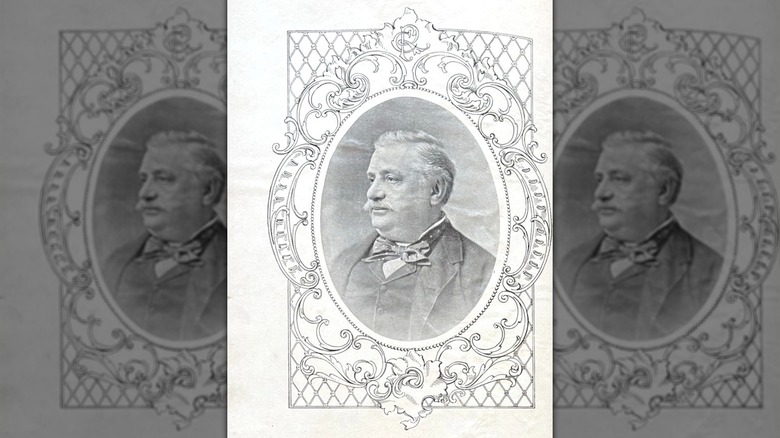
While many chefs have sharpened their knives within Delmonico's kitchen, the one name that looms largest of all is Charles Ranhofer. Ranhofer honed his skills in France and made his way to the States in 1856. He was later quoted by the Cherryvale Republican as saying, "It is a wonder that you have not ruined the national digestion with your careless cooking and hasty eating. I must teach you something." He joined Delmonico's in 1862 and indeed taught America how to eat over the next 34 years. Ranhofer's inventiveness in both dishes and presentation knew no equal at the time, as it was commonly said he was NYC's "first chef, and there was no second," per "Delmonico's: A Century of Splendor."
Ranhofer inscribed his knowledge and expertise into a single monumental volume, "The Epicurean," which remains a lasting contribution to culinary history. His food bible was published in 1893, and in the preface, the chef laid out its purpose, to serve as "the best and most effectual manner of preparing healthy and nutritious food."
"The Epicurean" not only contained 3,500 recipes, but also included tips and tricks for table service, suggested bills of fare, wine pairings, and even when certain fruit was in season. Ranhofer also paid homage and gratitude to his employers, writing, "The profession will acknowledge its indebtedness to the Messrs. Delmonico for the interest shown by them in developing the gastronomic art in this country. Many will recall the business receptions given to distinguished guests under the supervision and direction of Delmonico."
Delmonico's set the standard with many inventive dishes now served worldwide
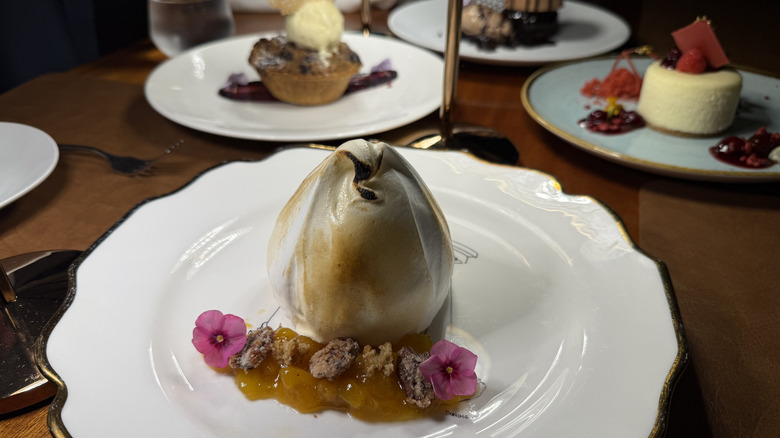
Many dishes etched within Charles Ranhofer's "The Epicurean" have fallen out of fashion, and yet several remain at Delmonico's and are served around the world. While Ranhofer and his predecessor, Alessandro Filippini, served a signature sirloin steak, today the ubiquitous term "Delmonico steak" refers to a juicy ribeye, which Delmonico's sources from Holstein cows raised in California.
The baked Alaska, commemorating the 1867 purchase of the future state from Russia, may have been invented elsewhere, but the hot-and-cold dessert was made famous by Delmonico's. Ranhofer's version layered walnut spice cake, apricot marmalade, banana ice cream, and a toasted meringue shell. It remains a mountainous seller, with an average of seven out of 10 diners ending their meal with one. While the name chicken à la king has long reigned for the creamy sherry-sauced dish with peas, tomatoes, and asparagus, its original name, supposedly honoring Olympic gold medalist Foxhall P. Keene, still holds court at Delmonico's as chicken à la Keene. Today, a plant-based version lets a lion's mane mushroom do the lion's share of the work.
Other famous dishes popularized by Delmonico's include eggs Benedict, reportedly created to please stalwart customer Mrs. LeGrand Benedict, and the creamy lobster Newberg. The latter was conjured up by Captain Ben Wenberg and first appeared on the menu in 1876. After an apparent falling out between Wenberg and Charles Delmonico, the "w" and "n" were switched to give it its current name. Even the wedge salad made its debut here in the 1930s, though Max Tucci noted his grandfather Oscar Tucci's original leaned on heirloom tomatoes instead of cherry ones.
Mark Twain, Oscar Wilde, and Charles Dickens were all well read on its menu
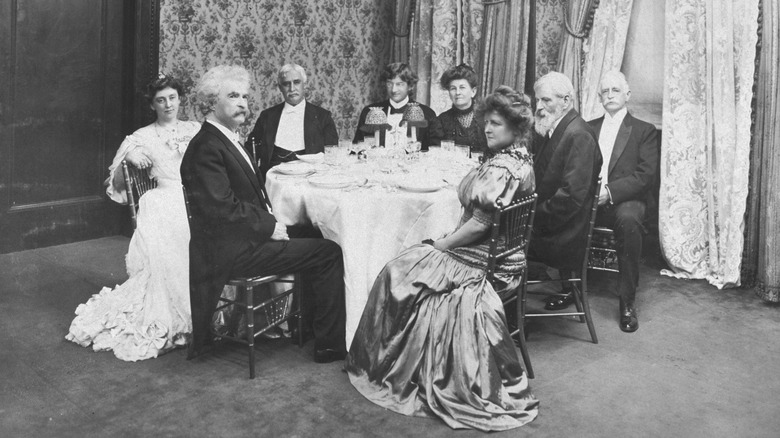
Delmonico's name has been splashed in many a newspaper and even immortalized in books. Oscar Wilde was so taken by its pleasures that he gushed in a literary review, "Indeed, the two most remarkable bits of scenery in the States are undoubtedly Delmonico's and the Yosemité Valley; and the former place has done more to promote a good feeling between England and America than anything else has in this century."
Edith Wharton conjured up the image of a "little oyster supper" in "The Age of Innocence," Booker T. Washington referenced it in his autobiography, and Delmonico's found its name within the works of O. Henry, Theodore Dreiser, Henry James, and Mark Twain, notably in his novel that named an era, "The Gilded Age." Speaking of, another Delmonico's first Max Tucci relayed is it was the "only restaurant that hosted Mark Twain's 70th birthday." 170 guests and even a 40-piece orchestra came together for the legendary humorist's birthday in 1905, and each guest was gifted a foot-long bust of Twain.
Charles Dickens wasn't exactly enamored with America's eating habits upon his first visit in the 1840s and went on to trash them in two books. He had a change of heart in his second visit in 1868, and it was thanks in part to Delmonico's. A gala was held in his honor there, where Charles Ranhofer prepared literary theme-dishes like agneau farci à la Walter Scott and côtelettes de grouse à la Fenimore Cooper. Per "Delmonico's: A Century of Splendor," Dickens noted in a speech, "I have been received with unsurpassable politeness, delicacy, sweet temper, hospitality, consideration, and with unsurpassable respect."
Nikola Tesla was such a huge fan that a private dining room was named in his honor
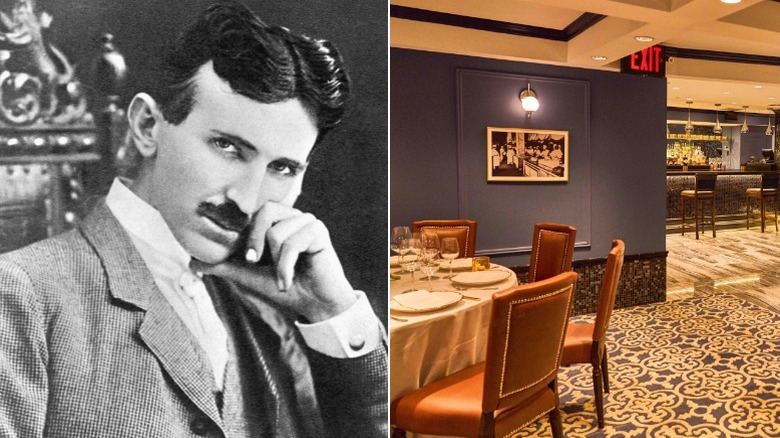
While Thomas Edison may have edged out Nikola Tesla in the electrical current war, Tesla's name has perhaps resonated more so in modern times. He was portrayed by David Bowie in the 2006 Christopher Nolan film "The Prestige," got an electric car company named after him, as well as a private dining quarter, complete with a fireplace, named in his honor at Delmonico's — Tesla's Quarters.
Dennis Turcinovic tells us, "[Tesla was] here all the time, [as it was] his favorite restaurant." If you surveyed the press at the time, it sounded like "The Wizard of Delmonico's," as The Kansas City Star called him, never ate anywhere else. The Buffalo Sunday Morning News noted that, in 1894, the scientist "could be found at Delmonico's nearly always at breakfast and dinner," while the Great Falls Weekly Leader, a year later, boasted how it was his daily lunch spot, where "his is a case where genius is neither hungry nor out at the elbows." Whenever he was there, Tesla preferred to dine at a table near a window.
He was so associated with the restaurant that newspapers would even recall his past times there decades later. In 1932, The Ogden Standard-Examiner romanticized such a meal where Tesla reportedly held up a glass and declared, "If I could release the power locked in the atoms in this glass, I would have energy enough to run a locomotive many times around the earth."
Delmonico's has long been fit to serve the president
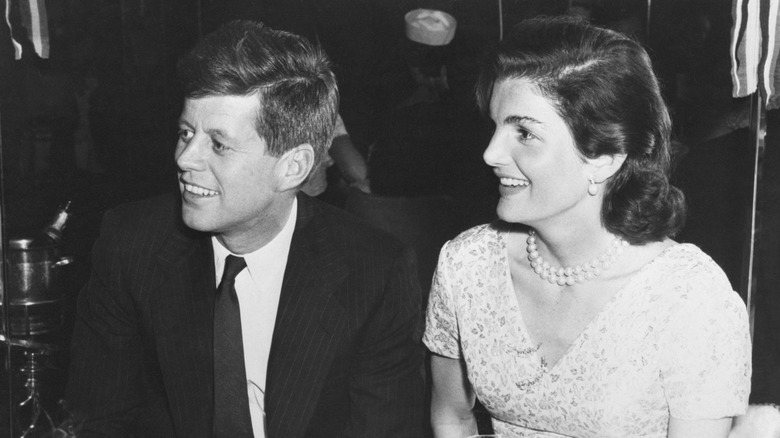
George Washington never set foot in Delmonico's, but it's been fit to serve many U.S. presidents and their first ladies. Pretty much every POTUS, starting with the fifth, James Monroe, has entered its doors.
While the Civil War was being waged, Abraham Lincoln would hold secret meetings with his generals there. Per American Heritage, he once told owner Lorenzo Delmonico, "In Washington, where I live, there are many mansions, but no cooks like yours." Delmonico refused Lincoln's money for his meal and room, so Honest Abe instead left his own pocketknife as a form of payment. Andrew Johnson tackled a 10-course dinner with seven wine pairings in 1866, which was capped off with a pastry in the shape of the Washington Monument. Presidents Ulysses S. Grant and William McKinley were such fixtures that they befriended the gentleman who cared for the carriages that pulled up in front of Delmonico's.
According to a Facebook post shared by The Delmonico Way, Franklin Delano Roosevelt told Max Tucci's father, Mario Tucci, he "had waited a very long time to come to Delmonico's." Oscar Tucci always had a slice of custard pie for Harry Truman, despite it not being listed on the dessert menu. John F. and Jackie Kennedy would often dine there when in town, and Richard Nixon was so close with Oscar that he was gifted an urn of Delmonico's coffee for The White House.
Marilyn Monroe and other stars glamorized the guest list
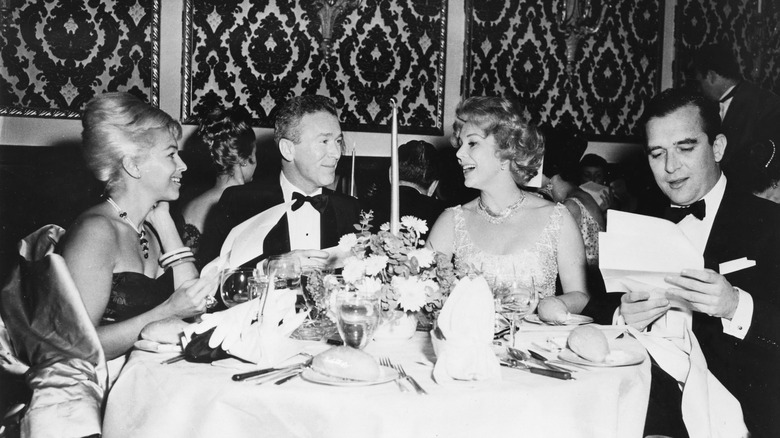
While titans like the Astors and Boss Tweed were some of the big names that dined there in the 19th century, it's the gaggle of glamorous stars who swung by Delmonico's in the 20th century that really left its mark. According to Max Tucci, Marilyn Monroe would come in and order up the broiled grapefruit topped with sugar and cherries. Marlena Dietrich's tooth ran sweeter, and her go-to dessert was the cherries jubilee. Famed burlesque dancer Gypsy Rose Lee once used a menu to cover her assets while performing a striptease on a table. Elizabeth Taylor would walk in with Rock Hudson, and while she'd settle in at a booth, he scurried away to a private penthouse upstairs to meet with dates.
Sports figures love a big meal after a long game. And Delmonico's has been welcoming athletes for ages, from pioneering baseballers like Cap Anson, to regulars Mr. and Mrs. Babe Ruth, and golf legend Arnold Palmer, whose namesake drink got placed on the cocktail menu with a splash of vodka.
Delmonico's was always a central hub for celeb spotting, where columnists like Cindy Adams had been keeping an ear open since 1959. Even a simple lunch, like one celebrating Whoopi Goldberg's 61st birthday, a rare public sighting by a Wendy Williams, or a $1,400 steak dinner bill for Rick Ross and guests were perfect fodder for the New York tabloids.
Elvis and others literally sung its praises
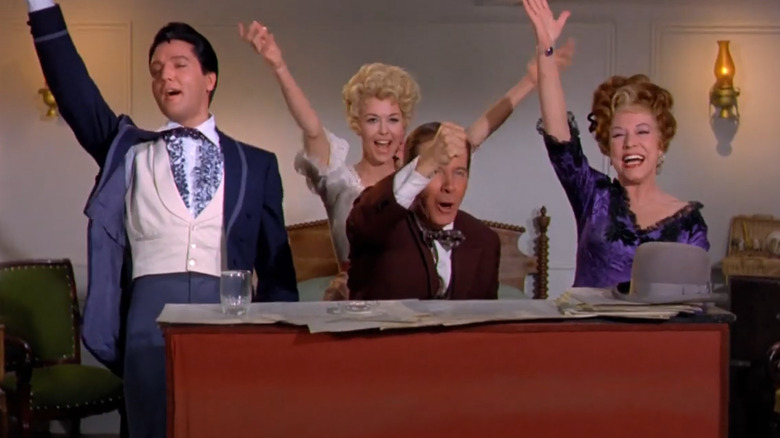
Delmonico's has been blessed several times over to be gushed about in song. During the "Put on Your Sunday Clothes" number of the 1964 Broadway musical "Hello, Dolly!" the characters dream of escaping Yonkers and heading south to where all the action is in New York City. On the top of their night's wish list is to "see the shows at Delmonico's." The song was made even more famous when it appeared in the 1969 big screen adaptation starring Barbra Streisand. The version from the film was memorably re-used in the opening scene of the 2008 Pixar film "WALL-E," where a desolated, trash-filled NYC is no longer the place to be.
In the 1966 film "Frankie and Johnny," Elvis Presley plays a riverboat gambler who warns New York in "Look Out, Broadway" that he was done eating hot dogs, and instead declares in song, "We're going to dine on steak and wine at Delmonico's." In E.L. Doctorow's novel "Ragtime," centered on early 20th-century life, and the 1981 film version by Miloš Forman, a whole scene takes place at Delmonico's. Randy Newman composed the bouncy "Delmonico Polka" instrumental track in its honor.
Delmonico's has always been ready for its close-up
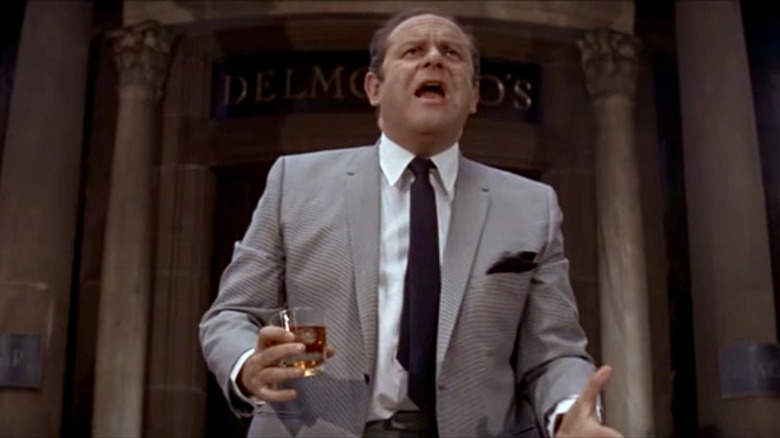
This old-school steakhouse has not only played host to Hollywood royalty, but it's also played as an actual backdrop to films and TV shows for well over a century. Delmonico's good name has been casually mentioned as a place to be or wanted to be seen in such films as "Yankee Doodle Dandy" with James Cagney, the 1949 John Wayne picture "She Wore a Yellow Ribbon," and Mel Brooks' 1968 classic "The Producers." TV shows such as "Cobra Kai," "Outlander," and, fittingly, HBO's "The Gilded Age" give the esteemed eatery an oral nod, as well.
Delmonico's has also kindly lent its walls, both exterior and interior, to film crews. In the 1969 film "The April Fools," Jack Lemmon spills his guts over a very liquid lunch with a friend. In 1996's "The Associate," Whoopi Goldberg learns the hard way that she was looked over for a promotion as she spotted co-worker Tim Daly and their boss leaving Delmonico's with smiles on their faces. While Delmonico's triangular exterior has been mistaken for the Continental hotel setting from the "John Wick" universe, scenes from its TV spinoff show did shoot scenes in its interior.
Sometimes, the restaurant and its lavish dining rooms have been recreated to evoke another era. This happened in the 1947 film "Life with Father," and the 2018 TNT miniseries "The Alienist." Covering so many eras, both past and present, Delmonico's is always ready for its next close-up.
Delmonico's today and forever
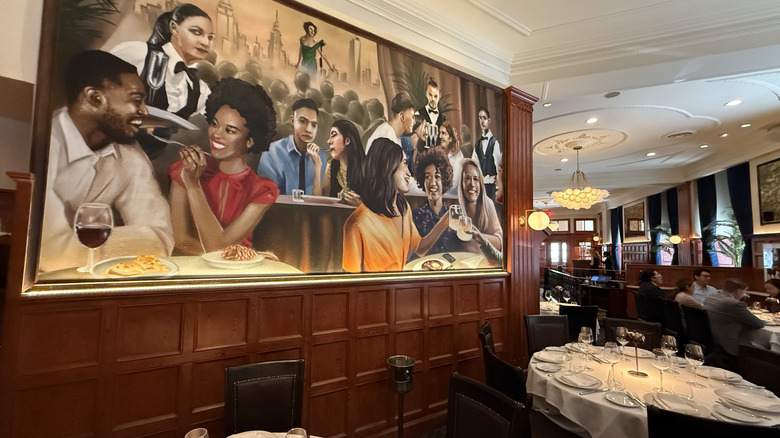
Delmonico's was hit hard by the impact of the COVID-19 pandemic, sadly closing its doors in March 2020. While it was closed, Delmonico's was almost evicted from its home since 1891, 56 Beaver Street, and endured a terse ownership battle. After the dust settled, Dennis Turcinovic, Max Tucci, and a group of partners re-opened Delmonico's to much fanfare in September 2023.
Delmonico's interior was renovated, but some things never change, like the Pompeii pillars that welcome guests through the front door, and the familiar favorites that have dotted the menu for almost two centuries. Turcinovic has been ensuring that Delmonico's stays true to its roots, while tweaking the menu, service, and presentation to maintain its importance and relevancy. While ordering lobster Newberg or Delmonico steak seems like a must for first timers, don't sleep on some of the newer creations being served up, like its delectable yellowtail crudo, steak on toast, and Caesar salad, which Turcinovic states "is the best in the city," a claim my mouth can certainly back up.
As a third-generation partner and walking Delmonico's encyclopedia, Tucci is a vital link from past to present, ensuring the famed restaurant's stories and legends endure. He opines, "My grandfather introduced what we called 'The Delmonico Way' ... but what he brought in was continuing the legacy that Delmonico's had." This includes fine dining, tablecloths, extreme service and hospitality, and entertainment. By all indications from our visit, Delmonico's is in very good hands, with many more great meals to be served, famous firsts to be forged, and tantalizing tales to be spun in the centuries to come. Cheers to you, Delmonico's.