

The Banned-In-America Preservative Still Showing Up In European Caviar
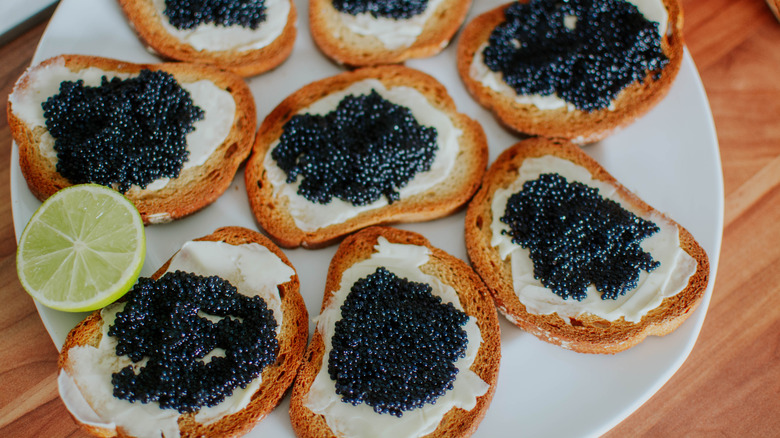
Food safety regulations are a funny thing: in some countries, a substance is considered totally fine for consumption, but in others... not so much. For example, the EU refuses American beef because it's hormone-treated. But when it comes to caviar, the situation flips: in Europe, some jars contain a preservative that the U.S. has long banned from food and thus, can't be legally imported here.
That preservative is borax (also known as E285, sodium tertraborate) — yes, the same compound that can clean your sink or boost laundry detergent. A close cousin, boric acid (E286), sometimes substitutes for it. Caviar makers prize both because they're remarkably effective: they fight bacteria, firm up the delicate roe, and even mellow out that sharp "fishy" taste.
But there's a "small" problem: health authorities around the world — from the FDA in the States to the New South Wales Food Authority — agree that borax is far too risky for the dinner table, the latter calling it as posing "an unacceptable risk to human health when used in food." Studies link ingestion to risks ranging from organ damage to outright poisoning. So, with that in mind, we wouldn't blame you for having the natural question: why are Europeans still putting borax into their caviar?
Why is borax still used in the EU?

Borax is banned as a food preservative across the European Union, but caviar is the lone exception: producers are allowed to add up to four grams per kilogram. Why? Because caviar is considered a rare specialty food, not a daily staple.
The European Food Safety Authority (EFSA) has argued that consumers of caviars are exposed to such small amounts of boron (the key element in borax) that they're unlikely to exceed the safe daily intake of 0.16 milligrams per kilogram of body weight. In exchange, the preservative delivers the texture and flavor qualities that make European caviar so prized. It also helps that caviar is big business for EU countries like Germany, Italy, and France, all top producers and exporters of all kinds, from beluga to osetra caviar.
The U.S., however, takes a harder line. While the American market produced $4.6 million worth of caviar in 2022, the FDA never approved borax for culinary use. Stateside producers rely on salt for preservation instead — which means American caviar always tastes brinier, with a stronger bite. So the next time you notice how mild European caviar tastes, you'll know the reason. But with the knowledge that the secret ingredient being a cleaning powder... well, it might take away some of the tastiness when it's served up to you (along with the bougie caviar-eating spoon).