

8 Vintage Wines That Are Worth Top Dollar Today
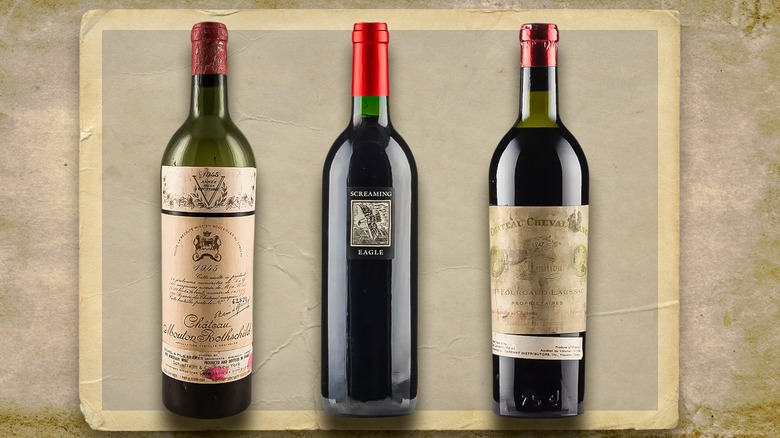
Like fine cognac and expensive whiskey, wine is a liquid luxury. For the most part, it is an attainable extravagance that most wine lovers can purchase and enjoy. However, exceptional vintages from premium producers will sell for top dollar beyond the price most oenophiles can afford. While the suggested retail price of a typical bottle from these ultra-premium producers, such as first-growth Bordeaux, may be a few thousand dollars, the most expensive of these extraordinary wines have gone for hundreds of thousands of dollars.
There are several factors that contribute to the high prices these selections command. Their limited availability drives up demand, as does the pedigree of the vineyard and terroir, the provenance of the winery and reputation of the winemaker, and the age or age ability of the wine. Add in an interesting backstory or historic significance, outstanding quality of the vintage, and rarity of the selection, and auctioneers will have paddles flying into the air as anxious bidders try to grab one of these remarkable, yet highly expensive wines. The following vintage options in this story achieved not only some of the highest prices paid for a single bottle of wine, but each has an equally interesting backstory.
1907 Heidsieck & Co. Monopole - Goût Américain Champagne ($275,000)
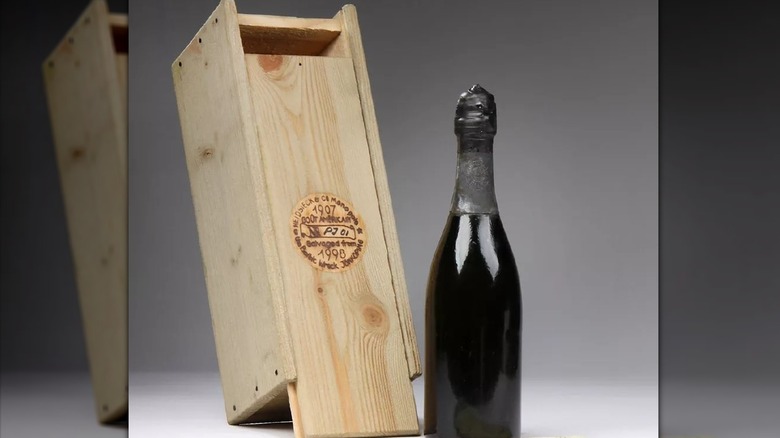
The way you store a bottle of wine significantly contributes to its aging potential. Proper storage of a wine bottle involves keeping it in a cool, dark place at an angle away from light, heat, and vibration. Although many winemakers may not consider the bottom of the ocean to be the most ideal representation of this storage solution, thousands of bottles of 1907 Heidsieck & Co. Champagne proved it to be so.
In 1998, a sunken Swedish freighter, Jönköping, was discovered off the coast of Finland. The ship sailed in 1916 with the bottles destined for the Russian Imperial Court. It met with a German U-boat, which sank the vessel into the still, dark, frigid cold Baltic Sea water. Within the wreckage were about 3,000 bottles of 1907 Heidsieck & Co. Monopole – Goût Américain Champagne. Interestingly enough, when divers discovered the wreckage of the sunken ship Titanic in 1985, they also found bottles from this vintage and producer.
In both cases, the immense pressure of the oceanic environment kept the sparkling wine's palate fresh, resulting in a remarkably drinkable Champagne. The overall character showed the complexity that comes with considerable aging. International auction houses began offering the bottles found on the Jönköping for auction in 1999. The winning bids for some bottles were as low as $2,000. However, one auction brought $275,000 for a single bottle, making it one of the most expensive Champagnes ever.
1869 Château Lafite-Rothschild ($233,972)
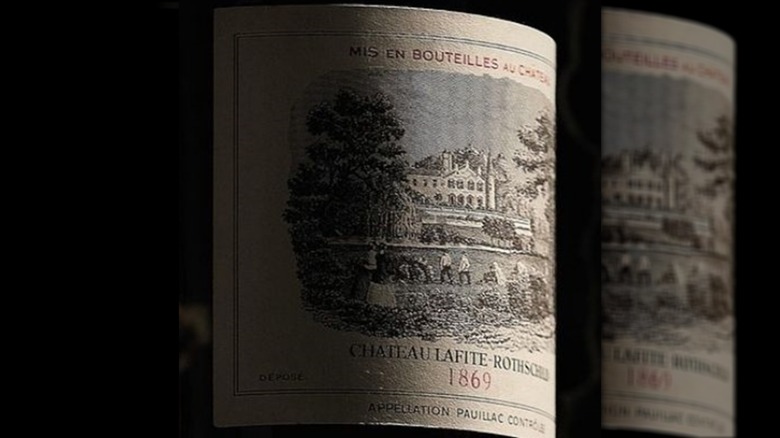
Sotheby's earned the distinction of auctioning the most expensive bottle of wine in the world in 2010 when an anonymous bidder purchased not one but three 750-milliliter bottles of 1869 Château Lafite-Rothschild for an astounding price of $233,972 each. The auction house held the event in Hong Kong in the midst of a strong surge of interest from Asia into the international wine market, particularly high-end Bordeaux.
Château Lafite-Rothschild was one of five wineries to receive Premier Grand Cru Classé status in the 1855 classification of Bordeaux wines. Set in the Pauillac region on the Left Bank of Bordeaux, next to prestigious neighbors including Château Mouton-Rothschild and Château Latour, the historic Château Lafite-Rothschild crafts its cabernet sauvignon-based wines from around 276 acres of vineyards.
The 1869 bottles were extremely rare as they represented the last vintage before the phylloxera infestation within the region. The detrimental louse destroyed 80% of the vineyards throughout Bordeaux, along with a significant number of European vineyards. The Château stored the wine in its cellars until Sotheby's shipped it to Hong Kong for the 2010 auction, an ideal location for wine storage. Today, the Certified B Corporation farms its land sustainably with an eye on maintaining regional biodiversity, embracing science, research, and innovation while honoring its first-growth traditions. If you are interested in trying a pre-phylloxera bottle, you can purchase a bottle of the estate's flagship wine from the 1806 vintage for $200,000.
1811 Château d'Yquem Premier Cru Sauternes ($120,000)
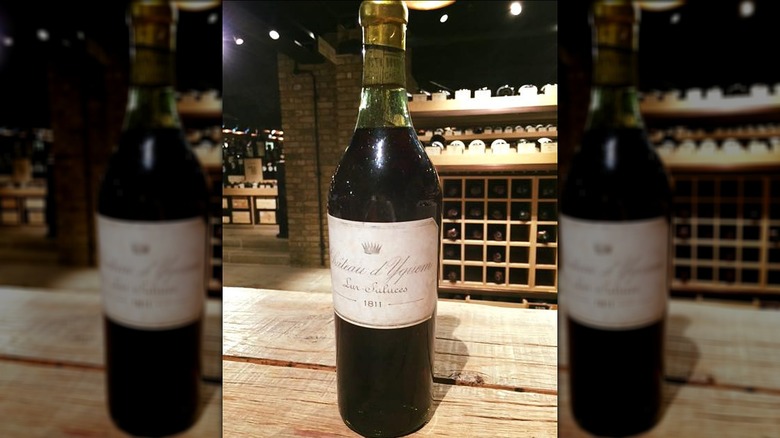
The production of Sauternes is one of the most laborious in winemaking. Delicate sauvignon blanc and semillon fruit achieves what is known as noble rot by hanging on the vine well past its ripeness in Bordeaux vineyards of the same name, where they intentionally develop a powdery mold known as Botrytis cinerea. This fungus decays the fruit, causing it to lose water while maintaining the sweetness, helping it develop an unctuous texture and complexity with rich, palate coating, candied honey and stone fruit flavors.
While you can find botrytized wines in other European countries, like Hungary, Germany, and Austria, the Bordeaux Sauternes region within France produces some of the finest selections. Arguably one of the best is Château d'Yquem. The Château was the only sweet wine to be named a Grand Premier Cru in the 1855 Classification of Sauternes and Barsac in Bordeaux. The history of the estate dates to the Middle Ages, with wine growing and production beginning as early as the 1600s.
In 2011, French restaurateur, wine collector, and judge at the 1976 Paris Tasting, Christian Vannequé, invested in the liquid gold by purchasing a bottle of 1811 Château d'Yquem for 75,000 euros, the equivalent of around $120,000 at the time. The collector was going to display the bottle of sweet, honeyed sunshine at his Balinese restaurant. If you care to invest a bottle, the 1847 vintage of Château d'Yquem is available for around $130,000.
1787 Château Margaux ($225,000)
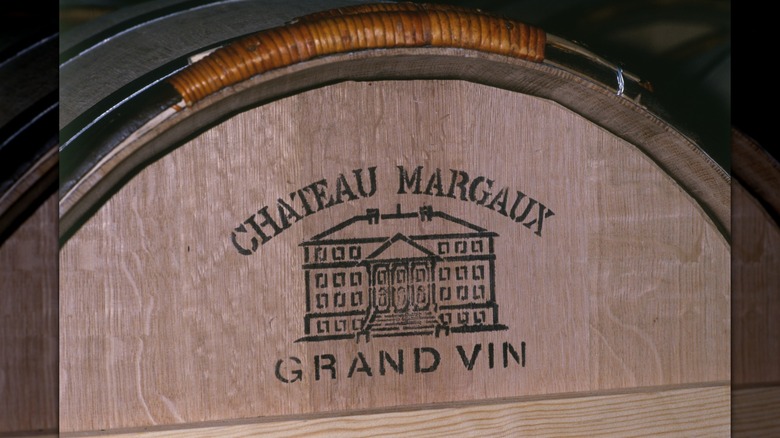
Accidents can indeed happen at any time, any place, and to anyone. However, one would hope that the accident would not involve a valuable piece of liquid history. On April 23, 1989, at the Four Seasons Restaurant in New York City, a bottle of 1787 Château Margaux was accidentally broken. At the time, the bottle belonged to wine merchant William Sokolin, who had taken the bottle to the restaurant to show a group of wine enthusiasts.
However, the TJ initials on the bottle supported the belief that the bottle was a part of the personal cellar of the third President of the United States Thomas Jefferson. Jefferson was a lover of French Bordeaux. He stocked his Monticello cellar with the wine, including Château Margaux, after returning to America from his time as Ambassador to France.
The picturesque first-growth Château Margaux was a place where royals gathered in the French Bordeaux countryside for centuries before the estate began growing grapes and making wine. In 1572, the then-owner, Pierre de Lestonnac, began planting the estate's vineyards and making wine. Château Margaux was one of the original five first-growth wines to receive the Premier Crus designation in the 1855 Bordeaux Classification. Due to the connection with Jefferson, Sokolin was asking $519,000 for the bottle before it broke. However, insurance only covered a payment of $225,000 to Sokolin.
1945 Château Mouton-Rothschild ($310,700)
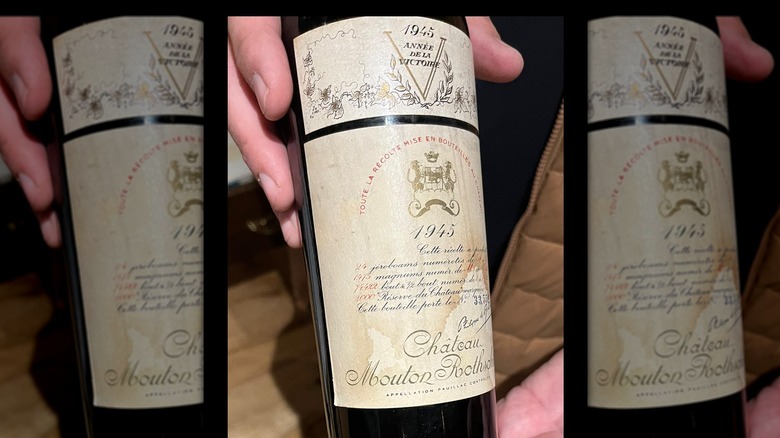
During World War II, German soldiers seized vineyards and occupied prestigious estates throughout France, beginning in 1940. Baron Phillipe de Rothschild, the Jewish owner of Bordeaux's Château Mouton-Rothschild, fled to Britain when his vineyards were seized. While the German forces were tasked with maintaining the Bordeaux wine trade, they did not tend the vineyards with the meticulous dedication of Rothschild. The 1945 vintage came on the heels of the end of the war, with the Allied troops defeating the Nazis in 1944.
Rothschild returned to his beloved estate to oversee the vintage that he would dub as his "victory vintage," symbolizing the tenacity and resilience of France, by displaying Année de la Victoire and the letter "V" on the label. 1945 Château Mouton-Rothschild has been dubbed one of the finest wines ever produced. The wine's quality helped in Rothschild's reclassification crusade for the estate to be named a first-growth winery, which it received in 1973.
Rothschild commissioned the label artwork from artist Philippe Jullian. This bottle marked the first of what would become the artist series, with every bottle of Mouton-Rothschild going forward featuring labels with artwork designed by influential artists of the time, including Chagall, Picasso, Dali, and Warhol. In 2007, Sotheby's held an exhibition of the artwork from the labels along with an auction of rare bottles from the personal cellar of Baroness Philippine de Rothschild, Phillipe's daughter. In that auction, a 4.5-liter jeroboam of the Château Mouton-Rothschild 1945 sold for a record-breaking $310,700.
1947 Château Cheval-Blanc ($305,000)
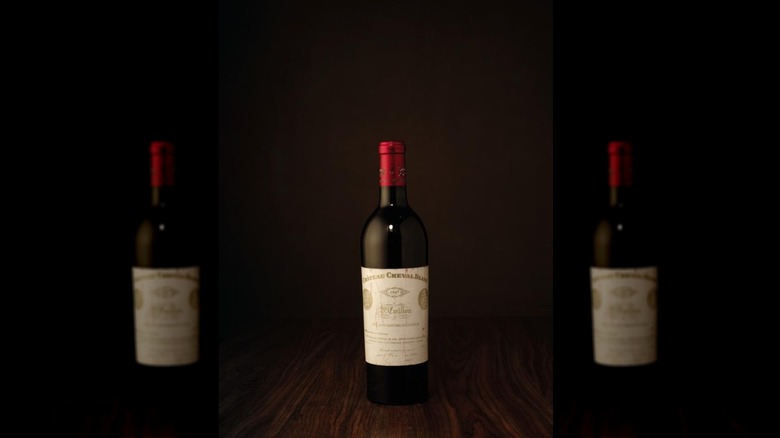
The effects of World War II wreaked havoc on wineries throughout France. In addition to old barrels and basic supplies like bottles and corks becoming scarce to find, the vineyards themselves were in disrepair after years of occupation by the German forces. However, the years that followed the country's liberation delivered three of the finest Bordeaux vintages ever in 1945, 1947, and 1949. The merlot-based Right Bank wines shone brightly in 1947, as exemplified by the 1947 Château Cheval-Blanc Premier Grand Cru Classé (A).
Cheval-Blanc's wine strayed from the norms in Bordeaux. The wine would garner such immense appreciation and acclaim, earning it recognition as one of the finest wines in the world. The summer of 1947 was atypically hot. The extreme temperatures in Saint-Émilion through July, August, and September caused the fruit's sugars to rise, creating a jammy, fruit-forward style with a high alcohol content. Instead of the typically supple, soft wine that one would expect from a merlot and cabernet franc blend from Saint-Émilion, Cheval-Blanc delivered a bold, inky wine with robust character.
Though some would consider it to be a flawed wine due to the intensity and somewhat cooked fruit character, the '47 Cheval-Blanc was rich, fleshy, and opulent, giving it the ability to age gracefully for decades, while also tasting delicious upon release. In 2010, an anonymous buyer at a Christie's auction in Geneva, Switzerland, paid the equivalent of around $305,000 for a 6-liter imperial bottle of the wine.
1992 Screaming Eagle ($500,000)
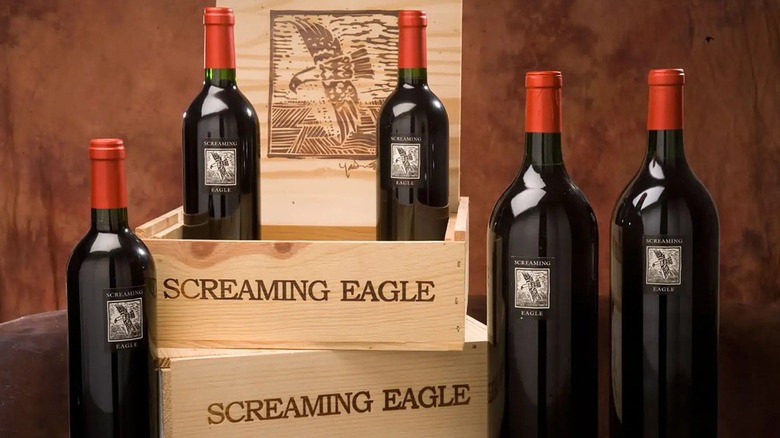
Since the Napa Valley Vintners began Auction Napa Valley in 1981, the region's wineries and guests have come together to give back to their community. They do this while indulging in regional wines and tasty bites from favorite Napa Valley restaurants. The event has raised over $230 million since its start. An imperial bottle of 1992 Screaming Eagle became one of the most significant single bottle contributions to this fundraising effort when, at the 2000 auction event, it fetched $500,000. The lucky bidder was a first-time auction attendee named Chase Bailey. The event's excitement must have energized Bailey, as he gave over $1.7 million to the auction that year, taking home five auction lots.
Screaming Eagle is one of Napa's original cult cabernet sauvignon wines. 1992 was the first vintage of the wine with Heidi Barrett at the helm as the inaugural winemaker. Barrett produced only 175 cases that year from Oakville-grown fruit. Upon release, a 750-milliliter bottle was available for the high price of $75, one and a half times that of a typical Napa Valley cabernet sauvignon at the time. The wine quickly rose to unprecedented popularity after receiving a perfect 100-point score from wine critic Robert Parker.
Due to the limited production, it may be challenging to find a bottle of the 1972 vintage. However, a bottle of the current (as of this writing) 2022 release under winemaker Nick Gislason is available for around $2,400. That is, if you can earn a spot on the winery's highly limited allocation list.
1945 Domaine de la Romanée-Conti ($558,000)
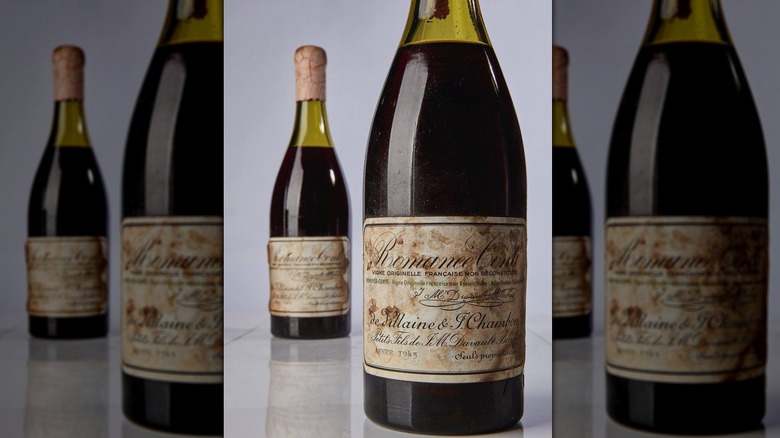
Over the years, wines produced within Burgundy have captured top dollar. This includes a 9-liter case of 2007 Domaine d'Auvenay Chevalier-Montrachet white Burgundy for $240,412, and $144,893 for a single 1.5-liter jeroboam of 1978 Henri Jayer Vosne-Romanée Cros Parantoux. However, these bottles don't touch the reigning leader of expensive wines, Domaine de la Romanée-Conti.
In 2018, Sotheby's auctioned a lot of wines from the cellar of one of Burgundy's most highly regarded winemakers, Robert Drouhin, former head of Maison Joseph Drouhin. Two bottles of Domaine de la Romanée-Conti 1945 were auctioned to the same bidder. The first bottle went for a record-breaking $558,000, and the second for $496,000. The lucky auction winner was Rob Rosania, a New York City developer and wine collector who was attending the auction specifically to acquire the precious wine.
The wine was from the 4.47-acre Côte d'Or Romanée-Conti vineyard, a Grand Cru site that is located above the Vosne-Romanée village within Burgundy's Côte de Nuits area. The eastern-facing slope of the land, mineral-rich, well-draining limestone soils over clay, and somewhat higher elevation are ideal for growing concentrated, complex pinot noir wines with elegance and a refined character. DRC's low-yielding pinot noir vines on this tiny plot of land only produce enough fruit for around 500 cases per year, adding to its allure with collectors spending top dollar on bottles today. As of this writing, the average 750-milliliter bottle price of the most recent release — the 2022 vintage — is almost $24,000.