

What Is Costco's 'White-Labeling' And How Can It Help You Save?
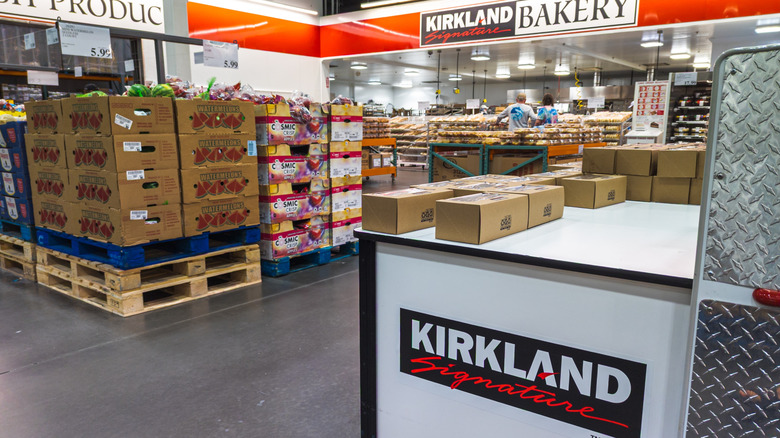
Other than super-cheap goods sold by the pallets, another signature of Costco that's driven thousands of people to sign up for (and keep) their membership is the retailer's white-labeled products. Doesn't sound familiar? That's because these products are called by a different name: Kirkland Signature.
White labeling is an industry term for a product that's made by one company, but is then resold under the branding and labeling of a second company. The "white" label here refers to the blank label that the reseller can customize with its own branding. In this case, all of the Kirkland products you find, from the tortilla chips to those super-cheap whiskies, aren't actually produced in-house by Costco. Its signature tortilla chips are most likely produced by Mission Foods, a company that specializes in Mexican food products. The whiskies could be sourced from distilleries all around the world, depending on the type you pick.
For instance, the Kirkland Canadian Whisky is made by Crown Royal and, if you pick its line of Scotch, you've got California-based Alexander Murray & Company to thank (a company that handles the juices in everything from cheap blended Scotches to higher-end expressions like the 16-year Highland Single Malt). Some products will have the name of the source written right on the label, while others will need a bit of digging. It's actually some pretty fun detective work to learn where these products came from!
How Kirkland Signature can help you save
Compared to a product of similar quality, you'll always find Kirkland's to be cheaper — the reasons come down to the economics of white labeling. When you think about it, you can cut a lot of costs by getting the product from another company and selling it under your own name. No need to buy and invest in production facilities, no need to spend years and millions in research and development, and so forth. All you need to spend money on is marketing and figuring out how to distribute all these products.
But for Costco in particular, the brand hardly spends on traditional marketing of their Kirkland products. Its reputation is known throughout the country, and you're bombarded with the brand as soon as you walk into a warehouse. Plus, just about everyone knows you're getting one of the best prices possible when buying Kirkland. This minimal marketing approach further drives the cost-to-market of Kirkland products down.
Since Costco's selling Kirkland goods by the pallet, it can guarantee its partners huge production volumes, which gives it extra leverage when it comes to negotiating prices. In an interview with the Wall Street Journal, Ron Vachris, the current CEO of Costco, mentioned that most of its partners "take lower margins as a percent and [instead] focus on high volume." More specifically, Costco's profit margin for a Kirkland product is about 15% (in most other places, it's 20% or more). Not every company out there can negotiate such deals!