

The Quirky Milk Bag Canadians Use That's Actually Eco-Friendly

Bagged milk probably sounds weird to most people, and then, after you think about it for a moment, it gets even weirder. How would you even get the milk out of the bag? And how does the milk even get into the bag in the first place? A carton or a plastic jug makes sense, but a bag is floppy, awkward, and has no way to get into it unless you cut it. Well, if you've ever visited the eastern parts of Canada, you have likely seen bagged milk everywhere. It's available in Ontario, Quebec, and most of the Maritime provinces. And there's actually a good reason for it.
Canada, unlike the United States, relies on the metric system. Those bags of milk are 4 liters, which is slightly over a gallon. Canada only adopted the metric system in the 1970s. Prior to that, milk was sold in glass bottles and milk jugs measured in pints and quarts. Converting to metric meant a logistical problem for all the factories that had been set up for imperial measurements.
One-quart bottles were easily converted into 1.33-liter bags. It was much cheaper to switch to bags rather than modify bottles and jugs, so the industry quickly adopted bagged milk as a standard. That's why today Canada's eastern provinces sell 4-liter bags containing three individual 1.33-liter, or 1-quart, bags inside. In addition to the logistics, milk bags are more environmentally friendly. They only produce about 20% to 40% of the greenhouse gases compared to jugs and cartons. Rinsed out milk bags are also recyclable.
How does bagged milk work?
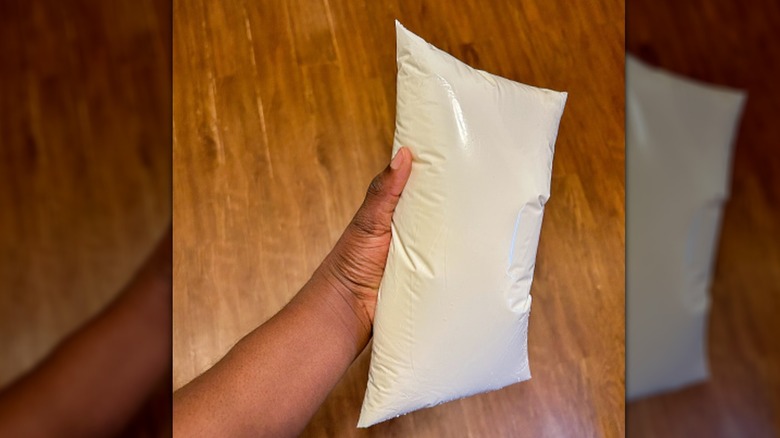
If you haven't experienced a bag of milk, it might be hard to imagine — a literal bag of liquid (the formal industry term is "pillow pouch"). The individual 1-quart bags are very jiggly. Canadians typically place each of those smaller bags in a reusable pitcher. The bag, shaped like a long sleeve, is snugly supported so it doesn't slip or spill. The top corner of the bag is cut to allow for pouring. All milk, including chocolate milk, is packaged this way, although cartons are also available.
Milk is sold in a variety of ways around the world. Canada is not the only country that has adopted milk bags as a standard practice. Although bottles and jugs are still on grocery store shelves, the United Kingdom and Israel also offer milk in bags. India is switching to newer, biodegradable bag-like packets. China, Russia, Iran, South Africa, and several South American countries also offer milk bags. While not as common as in Canada, milk bags can still be found in these countries.
The United States is no stranger to bagged milk, either. Although it was not widespread, bagged milk was introduced in 1993 as an alternative to cartons in some school cafeterias. Students could drink the milk by piercing the bag with a straw, much like a Capri Sun. DuPont, which made them, supplied 3 million units per day to schools in Virginia. Schools in Omaha were trying them out as recently as 2015. While bagged milk may seem weird to some, to others it's an everyday thing.