

9 Vintage Beer Signs That Are Worth A Fortune Today
We may receive a commission on purchases made from links.
Anyone who's been to a bar or pub can attest that they are often filled to the brim with colorful signs advertising their different beers. Throughout time, beer signs have seen many different iterations and innovations, which have led to some extremely creative (and now rare) pieces being sold on the likes of Facebook Marketplace, eBay, and various online auction sites. These vintage beer signs were once popular with restaurants, sure, but they would eventually work their way into consumers' homes in the form of smaller models. While they may have served as relatively cheap advertising for these breweries, the novelty of these signs has led to a budding market for collectors and connoisseurs.
Some of these signs date back to before the implementation of Prohibition laws (and even into the late 1800s). While some collectors like to track down vintage beer steins or even manage to find vintage barware on a budget, others have found that some old beer signs are now worth significantly more than when they were originally produced. From antique lithographs to scene-changing dioramas and spinning animatronic animals, here's a look at some vintage beer signs that are worth a fortune today.
Hamm's Beer starry sky motion sign
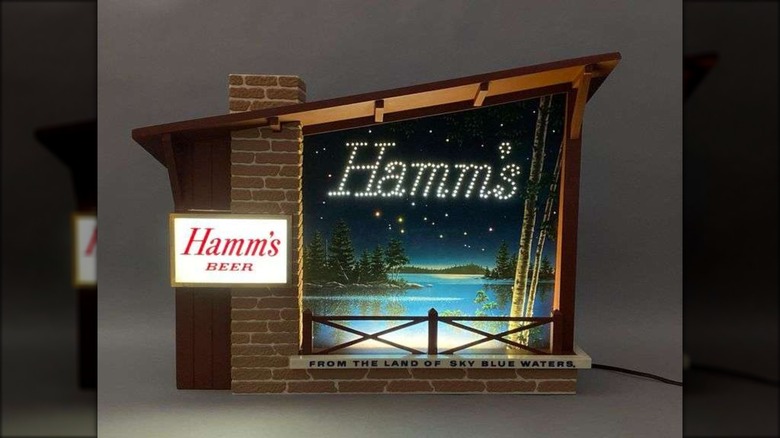
Hamm's Beer, similar to Camel and other cigarette companies in the decades to follow, began an aggressive advertising campaign in the mid-20th century that featured cartoon mascots and the production of a myriad of different novelties. This would include items such as shirts, hats, clocks, cups, figurines, and, of course, beer signs. Its most iconic signs would come in the form of typically multi-paneled displays depicting nature scenes that would animate in different ways within the frame.
For example, the Hamm's Beer starry sky motion sign from around 1960, which often sells in the range of $1,600 to $2,500 today, is single-paneled and shaped like a 15- by 20-inch wooden house with a slanted roof and a brick chimney. Inside the frame of the house is a starry night sky above trees and a lake. When turned on, the stars in the sky flicker with light until they eventually spell out "Hamm's." The word fades back into stars, and this process repeats on a loop, where the stars will also eventually turn into glasses of frosty beer in the night sky.
Schoenling bubbler motion beer sign
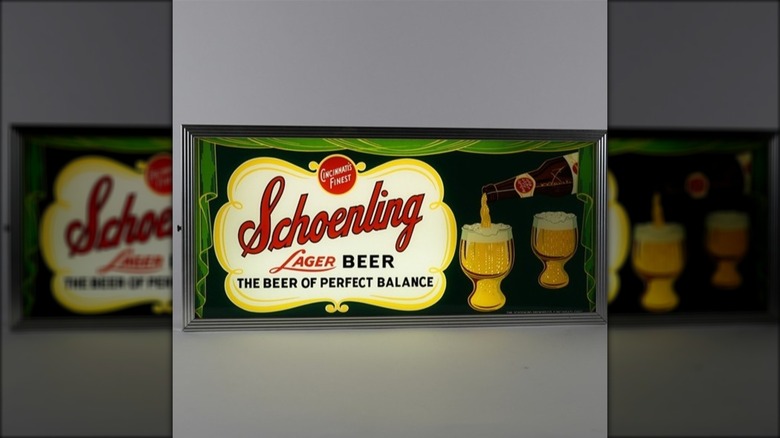
Schoenling Brewing Company, founded in Cincinnati, Ohio, in 1934, was part of the city's bustling beer market and was known for its iconic Little Kings line. This beer is a cream ale served and sold in 7-ounce bottles and often used as a chaser for mixed drinks. Introduced in 1958, Little Kings helped Schoenling outlast the mergers that befell other major breweries in Cincinnati until 1986, when the company would merge with Hudepohl. Although Little Kings has seen a return in recent years, Schoenling merchandise that predates this merger can fetch a pretty penny.
This sign, backlit and with a silver frame, features the brand's name in large red cursive on the left and a bottle pouring beer into two glasses on the right. Above the "Schoenling" is a red crest that says, "Cincinnati's Finest"; and below, it reads, "The beer of perfect balance." Along the edges of the top and sides is the design of a green curtain, as if framing the stage of a play. The back of the sign is a thick metal box holding the lights, with a string of metal beads on the side to turn it on and off, and a chain on top to hang it.
When turned on, the sign is lit, and the pattern on the beer makes it appear as if it is bubbling. Today, this vintage beer sign may sell from around $1,000 to as much as $2,700.
Hamm's Beer four-sided lighted lantern
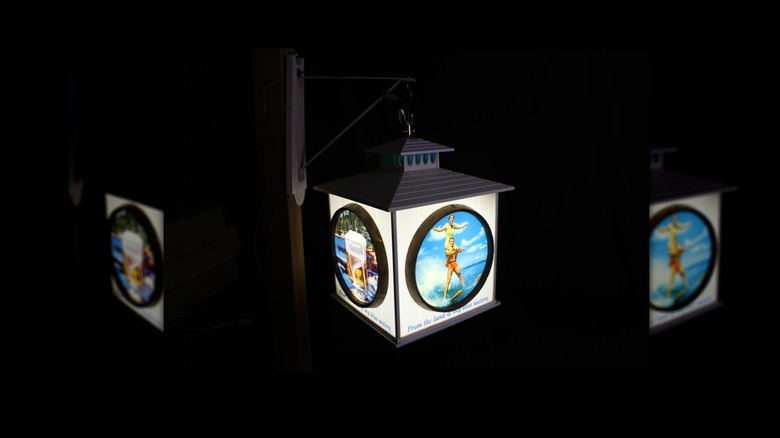
Unlike the Hamm's Beer clocks that would be produced in the following years, this piece (which is from the 1960s) doesn't seem like something that was cheaply made. Although constructed primarily of plastic meant to imitate wood, its frame gives it a level of sustainability that the company's later merchandise became more and more bereft of with each passing decade. With this sign's age and novelty, it can fetch a price of just under $3,000 nowadays (though some auctions have sold it for about a third of this price).
This beer sign — or lantern, rather — features a cube formed by four plastic sides painted white to look like wood. One side features a clock, and the others have circle-shaped photos — two of which show a glass overflowing with Hamm's Beer, while the third features a man water skiing with a woman on his shoulders — and each is taking up the majority of its side's space. Each panel also has "From the land of sky blue waters" written across the bottom. The lantern has a small vent hanging from the bottom and a hook on top to hang it. When turned on, the light bursts through the thin walls, giving the impression that the entire clock is glowing.
Buffalo Brewing Company Old West beer sign
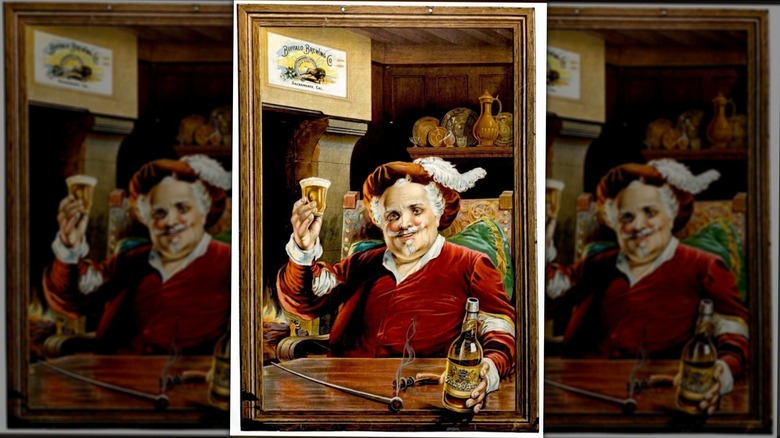
Buffalo Brewing Company (based out of Sacramento, California) was most prominent during the pre-Prohibition era. While it was able to stay afloat during Prohibition due to its soda production, the company struggled to gain the same footing on the beer market it once had when Prohibition was lifted, leading to its closure in 1949.
This sign features an older man sitting at a desk holding a bottle of New Bru in his left hand and a glass of beer held high in his right. On the desk in front of him is a pipe and a bottle opener, and the wall behind him has the Buffalo Brewing Co. logo hanging above a fireplace. The company did put out a lot of these kinds of displays, but because it was primarily before Prohibition, most of them have unfortunately been lost to time. Similar to most of the company's signs, it's in the style of an oil painting that (if it weren't for the blatant advertising) would almost come off as a genuine work of art. Due to the style and rarity of this piece, it's selling for around $4,000 today.
Budweiser Clydesdales lighted bar sign
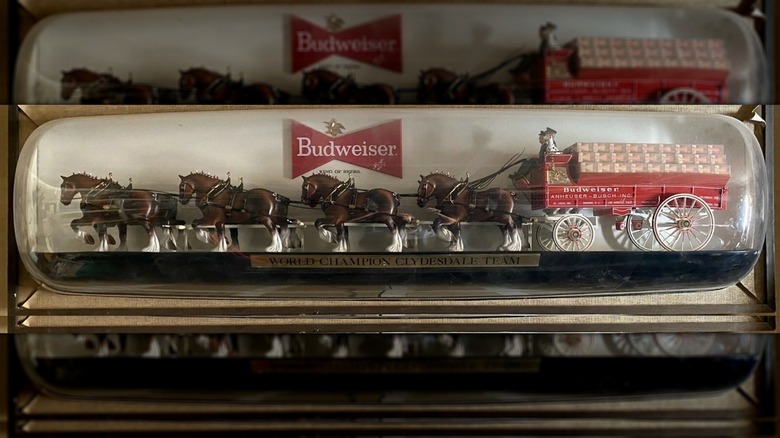
When Prohibition was repealed in the early 1930s, two brothers in the Busch family gifted their father a six-horse Clydesdale hitch to celebrate. While the gesture itself was nice, the family extended it to their company by holding parades featuring a hitch and horses as the central figure of a new marketing campaign. This eventually led to Anheuser-Busch naming the horses the mascot for its Budweiser line, and thus, the merchandising for this popular beer began. More shirts, signs, cups, clocks, and anything in between could be found embellished with these horses as they became synonymous with the brand. Most of these items can be found for relatively cheap prices nowadays, but the signs that were intended for restaurants or bars, rather than knick-knacks intended for consumers, are much rarer and can sell for much higher prices.
This particular Budweiser sign, which tends to sell for around $4,000 today, features eight figurines of the iconic Clydesdale horses leading a coach of Budweiser, helmed by two drivers and a dalmatian. The figures are in a white-backed glass case protruding out from the frame, and below them is a golden plaque that says, "World Champion Clydesdale Team." When plugged in, the floor underneath the figurines lights up.
Hamm's Beer Scene-O-Rama waterfall sign
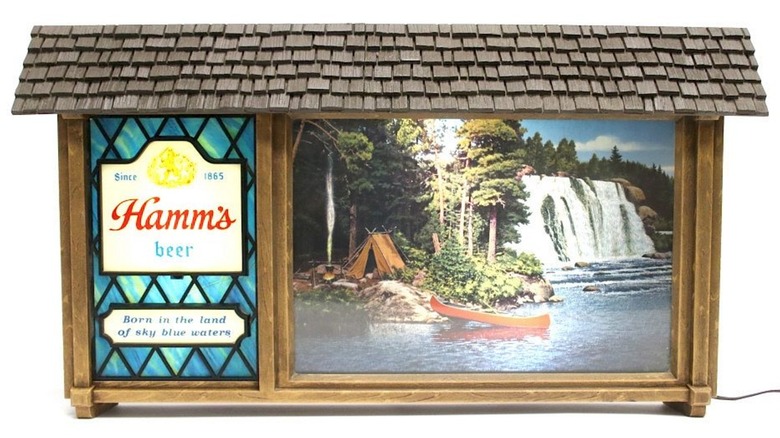
As mentioned, Hamm's produced several beer signs that would animate within their frames, and the company's most iconic line of these was its Scene-O-Rama signs. These would range anywhere from one to three panels, the center of which would have a nature scene scrolling across when activated, while the others featured logos, slogans, and other branding.
While a lot of the Hamm's Scene-O-Rama signs were three-panels wide, this particular sign is only two. The left (and smaller) panel is modeled after a latticed glass window, with the beer's logo and slogan in smaller white boxes. The right panel (which takes up about two-thirds of the sign's space) features a campsite and a canoe at the bottom of a running waterfall. Both panels are encased in a wooden frame that is (as is custom with this line) meant to look like a house. When activated, the waterfall scene slowly pans to the right to reveal more water and trees before looping back to the original scene. Produced in sizes varying from 3- to 5-feet long, and as one of the rarer Hamm's displays these days, this sign can sell from around $3,000 to even upwards of $6,000.
John B. Busch Brewing Co. lithograph
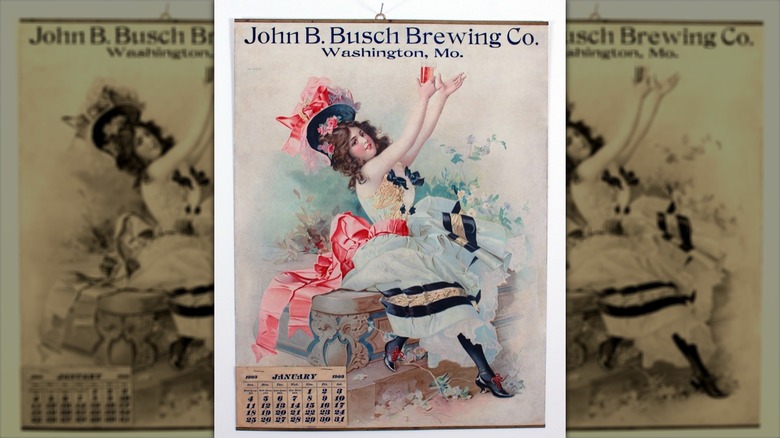
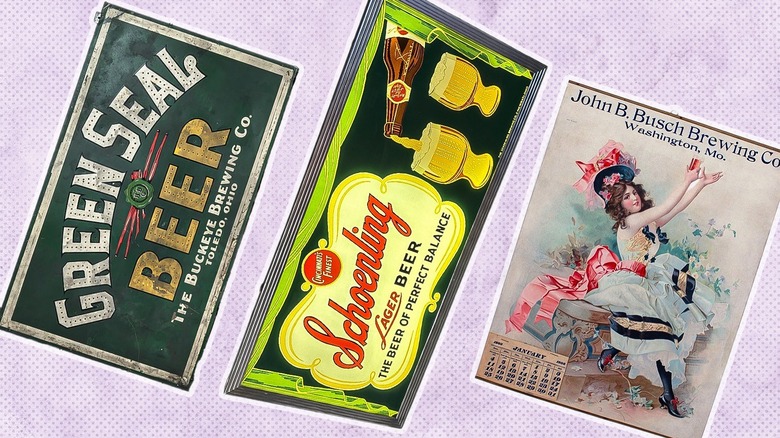
This antique lithograph from 1903, which can sell for between $8,600 and $12,000 these days, features a woman sitting on a curb wearing a white and gold dress and a black hat, with a pink sash around her waist and a matching bow on top of her hat. Her arms are raised while holding a glass of beer, and below her feet in the bottom left corner is a small paper calendar. Just above her glass, it says "John B. Busch Brewing Co. Washington, MO" in black letters, as if she is toasting not just the person viewing the poster, but the company behind it.
Lithographs were an integral part of beer's advertising in the late-19th and early-20th centuries because they allowed companies to produce posters at a high rate that used vibrant colors to highlight their products and draw the attention of customers. The posters made in the U.S. primarily depicted women with glasses or bottles of beer, and while they were extremely prominent for a while, they would eventually be phased out by more effective advertising methods and the start of Prohibition.
John B. Busch Brewing Co. was established in 1855, and its founding group included (as you may have already guessed) John Busch, whose younger brother was none other than Adolphus Busch (co-founder of brewing giant Anheuser-Busch). The former brewery would be passed down through the Busch family for a couple of generations before finally closing in 1953.
The Buckeye Brewing Company Green Seal Beer sign
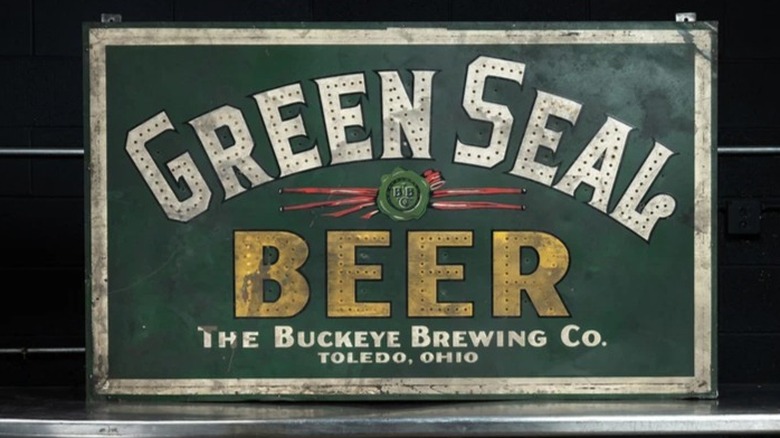
This pre-Prohibition sign for The Buckeye Brewing Company advertises its Green Seal Beer. The top of the backlit sign features "Green Seal" in white, all-cap letters, with a green seal containing "BB" and accented by red lines (the beer's logo) in the center, as well as "Beer" in large, bold gold letters underneath. Each of these letters has holes within them to allow light to pass through, and below them is the company's name and "Toledo, Ohio." The sign measures 60 by 36 inches, with two brackets on top to hang it by. Due to the sign's size and age, it is valued between $22,000 and $25,000 today.
The Buckeye Brewing Company was founded in Toledo in 1886 and was a prominent brewery in America before being bought by Miller Brewing Company in the mid-20th century. Especially popular before the implementation of Prohibition, The Buckey Brewing Company's beer saw most of its consumption in bars and restaurants, and thus, these places would buy and hang signs to advertise these drinks.
Lone Star 'Curious George' monkey mechanical sign
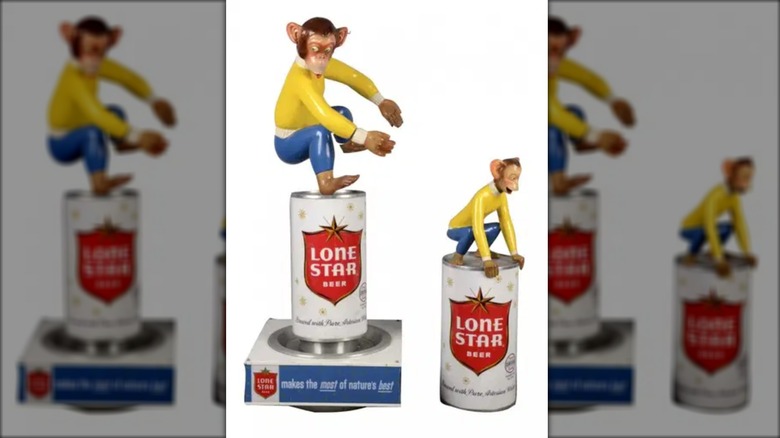
Around the halfway point of the 20th century, a man named Paul Stanley founded what would become one of the quirkiest and most original advertising display companies of its time. Often large and containing colorful characters, the company's signs were famous for having (sometimes multiple) moving parts. This particular Paul Stanley design is for Lone Star beer. It features a blue square base with the beer's logo on the left and the slogan across it in white. On top of this square is a slightly tilted, oversized Lone Star can with the monkey from "Curious George" dressed in a sweater and jeans, holding a smaller (but still oversized) can of Lone Star beer with another monkey dressed the same on top.
Paul Stanley & Company's signs were so novel (in both design and cost) that they were frequently moved around to various stores, leading to only a few (at most) models typically being made for each design. Although it produced displays for a multitude of food products, these types of beer signs were the company's bread and butter.
When activated, the main Lone Star can in this mechanical beer sign spins around the base, twirling the cans and monkeys in a counterclockwise circle. Due to the limited production of these vintage Paul Stanley beer signs, this display is priced at just under $30,000, as of this writing.