

We Asked 3 Interior Designers How To Make A Small Kitchen Feel Luxe
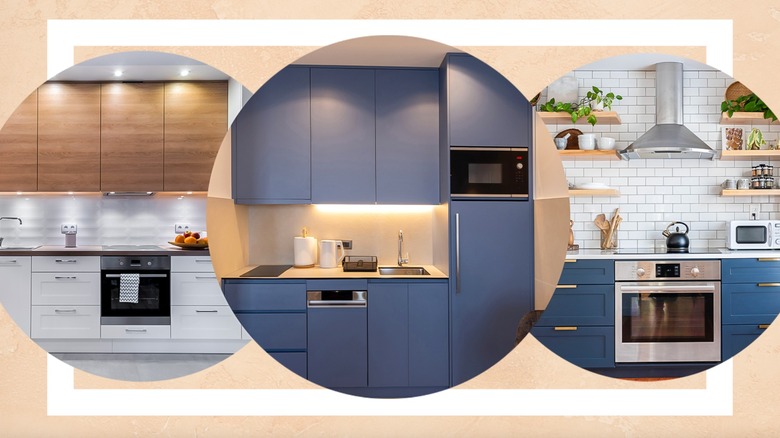
Whether you're renting or buying, there is always at least one thing about a new home that could use some improvement. You might want to change a frosted glass window to one that lets in more natural light or put fun tiles in the bathroom in place of a linoleum floor. But when it comes to the size of rooms, you might feel pretty limited unless you plan to knock down some walls. A small kitchen can be particularly frustrating. Kitchens are where you get things done. They need to be functional. Running out of storage space, feeling cramped even when you're trying to whip up a simple recipe, and struggling to keep things clutter-free are not just logistical headaches, but design ones, too. How do you make a small space functional and feel luxurious, too?
"The kitchen is the heart of the home, and even in a small footprint, it should feel inviting, easy to use, and intuitively laid out," Nicola Fontanella, the founder and CEO of interior architecture and design studio Argent Design, told us. "Prioritizing functionality ... makes the space feel calm, luxurious, and effortless to live in. Thoughtful restraint in decoration also helps to avoid visual clutter, enhancing both elegance and practicality." We spoke with Fontanella and two other interior designers to get the inside scoop on how to do all this in even the smallest kitchens.
Use a single, soft color for the walls and ceiling
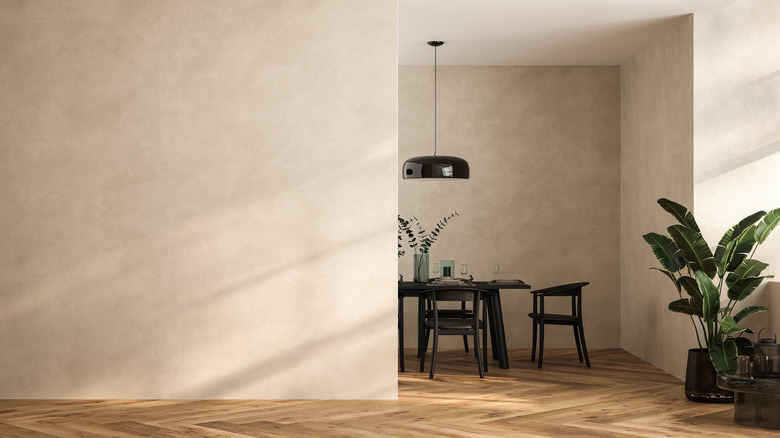
One of the easiest and most affordable adjustments you can make to a kitchen is the color of the room, and it's here that restraint should be your guiding light. Angel Tan, the owner and CEO of interior and garden design company The House Directory, told us why. "Wrapping the same color around the room — using tonal and textural variations for walls, cabinetry, and even the ceiling — creates a seamless, more spacious feel," she explained. Nicola Fontanella agreed. "Color sets the tone," she said. "A limited, cohesive palette ... creates a more intentional, elevated look." She also cautioned against mixing too many finishes and tones because it can feel chaotic.
Tan suggested painting the ceiling the same shade as the walls because it creates a blurring effect on the corners that will make the room feel taller. You might not be able to physically expand the room without remodeling, but if you can make the ceiling feel higher, you've already helped make the space feel more breathable. In the end, the most important thing to think about with the paint scheme is cohesiveness. "Avoid chopping the room up with too many contrasting colors, as this can make it feel smaller and more cluttered," Tan concluded.
Use reflective surfaces
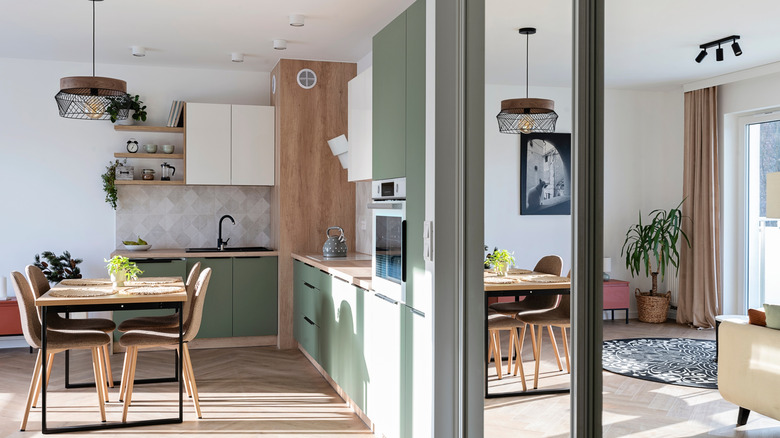
Another way to create the illusion of spaciousness is reflective surfaces. It isn't just about creating reflections, either. "Reflective and glossy surfaces can be effective at bouncing light around and creating the impression of depth," Angel Tan explained. "High-sheen cabinet doors, or polished stone worktops can all help." Mirrors, too, can be an effective trick, appearing like windows rather than flat surfaces. Nicola Fontanella pointed out that a mirrored backsplash is one of the best places to add a reflective surface to your kitchen, adding depth and elegance.
You don't have to go all out and make every surface shiny or reflective, but it's worth thinking about when you're choosing the material to use for your countertops and the type of appliances you buy. If you aren't able to change permanent elements like these, you can always just opt for hanging a mirror or two on the walls.
Use integrated appliances
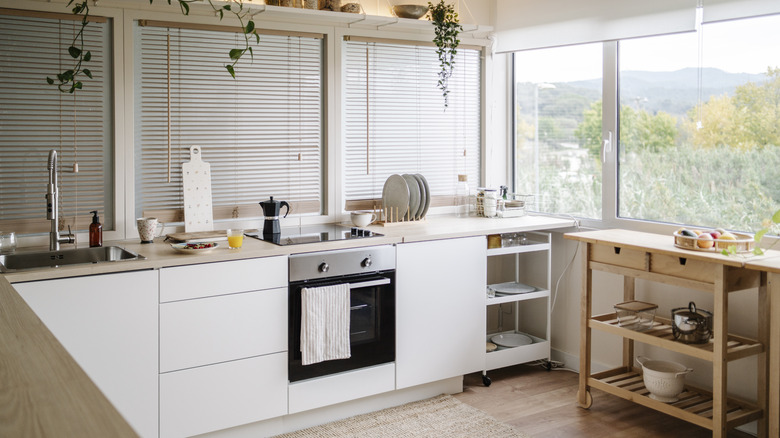
You can simplify your all you want, but there are certain appliances that every kitchen just has to have, and unfortunately for people who are working with small spaces, most of those appliances take up a lot of room. A refrigerator, stove, and sink are non-negotiable, and many of us like to have a microwave and dishwasher as well. This is where integrated appliances come into the equation. Instead of cramming in a standalone fridge or dishwasher, these appliances are built into your cupboards and paneling to disappear seamlessly into the flow of the room.
"Integrated appliances keep a kitchen streamlined and visually uncluttered," Angel Tan told us. "An undermount sink and a flush-mounted hob create a cleaner, more expansive worktop. In a small kitchen, it is easier to maintain a tight work triangle between the sink, fridge and cooking area for ease of use which in itself feels like a luxury."
Speaking of having a tight work triangle to maintain flow, you might want to consider ditching the idea of a kitchen island. We spoke with Sarah Bonstein, the founder of Sukkha Interior Design, who specializes in designing tiny homes, and she pointed out that having a large feature in the center of the room doesn't always work with small spaces. "I never say never, but kitchen islands can be challenging in tiny spaces where there isn't room for clear pathways and flow," she said.
Maximise the natural light
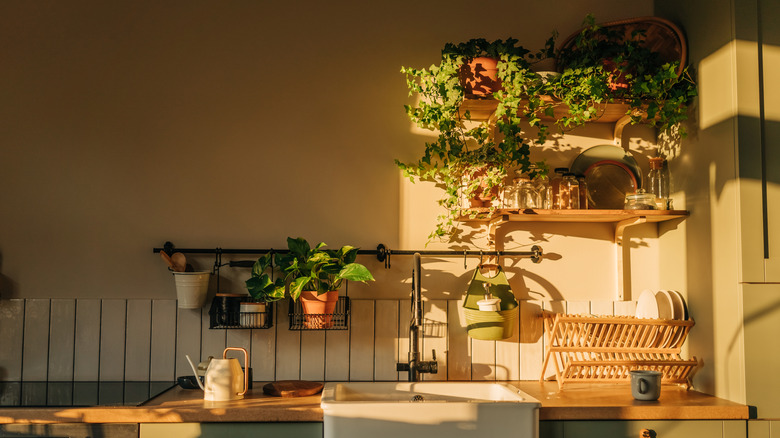
Reflective surfaces can give the illusion of space, but natural light is one of the best ways to avoid one of the biggest potential pitfalls of a small kitchen: cavelike claustrophobia. If there's no natural light, it will be very challenging to make your room feel luxuriously airy. You can use the tricks of soft colors on the walls and strategic lighting, but nothing can replace sunlight.
Replacing or adding new windows is costly and logistically challenging, though, so it's worth making the most out of the windows you already have. "If there is a window, maximise natural light with a simple linen Roman blind or sheer that allows daylight to filter in," Angel Tan advised. This is one of the many types of light that can help increase the sense of depth in the room, making it feel like there are multiple zones and spaces within the room rather than just one cramped area.
Layer your lighting
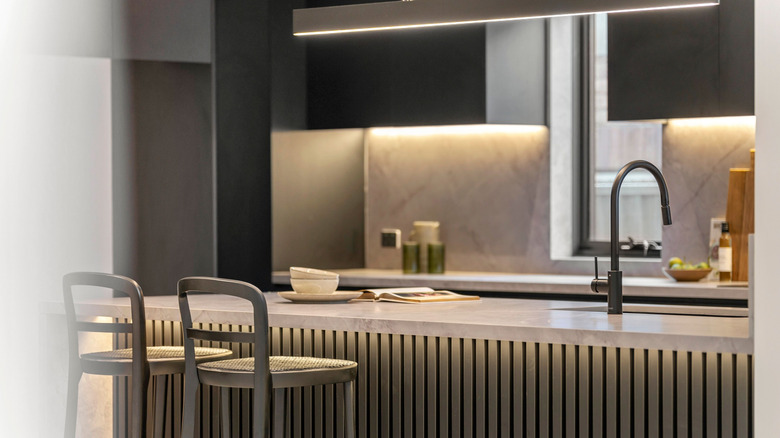
If you have a small kitchen, you might be tempted to flood it with as much light as possible, hoping that, by illuminating every inch of it, you'll maximize its dimensions. But according to the designers we spoke to, the best method for not only creating an illusion of space but also increasing the feeling of luxury is to use multiple light sources and tones.
"Layered lighting elevates the mood," Nicola Fontanella said. "Use linear LEDs under cabinets for ambient glow and pendants over islands or dining nooks to bring elegance and character. Include both bright task lighting and dimmable options for versatility."
Angel Tan also emphasized the importance of task lighting, but had another idea as well. "Instead of relying on a standard grid of downlights," she said, "Focus on key working areas and layer it with softer, ambient lighting elsewhere." Like Fontanella, Tan is a big proponent of LED strip lighting, saying that concealing them around your backsplash and worktops will create a warm, luxurious glow.
Maintain open sightlines
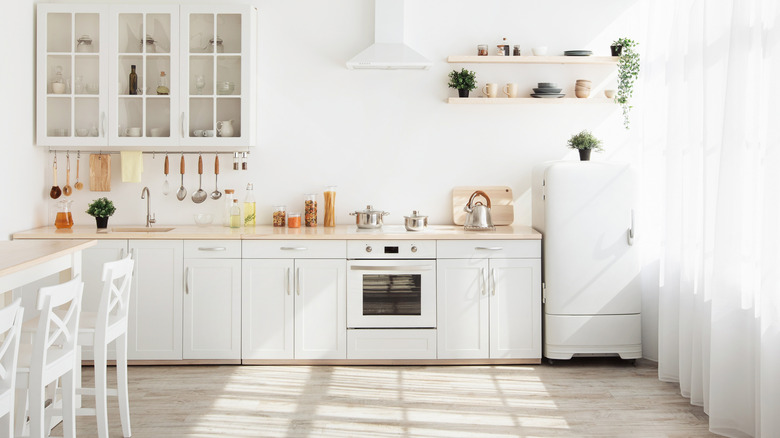
One of the best ways to make a kitchen look elegant and luxurious is to make sure the design flows. You could spend a near-infinite amount of money on expertly crafted, bespoke cabinetry and appliances, but there is a much simpler way to keep things cohesive and easy on the eye: maintain open sightlines. That's easier said than done in a small kitchen, but Angel Tan has a few ingenious hacks.
"Keep tall cabinets to one side to maintain open sightlines," she said, "And consider glazed doors to reduce visual bulk." The goal is to make the space as unobstructed as possible. This doesn't just give it a sophisticated appearance; it will pay dividends in terms of ease of use. An open plan will give you more room to move around without bumping into things when you're trying to get a meal on the table. That's the idea behind one of the most enduring tenets of kitchen design, as Nicola Fontanella explained. "The kitchen 'golden triangle' between sink, hob, and fridge is timeless for a reason," she said. "It makes small spaces work smarter."
Use multifunctional features
If you have a small kitchen, you will almost certainly have to make a few compromises. Maybe you decide against getting a mixer because it will take up half your counter space, or grudgingly keep your coffee grinder in storage. Maybe you decide to heat things on the stovetop instead of getting a microwave, or skip buying a toaster and use the oven.
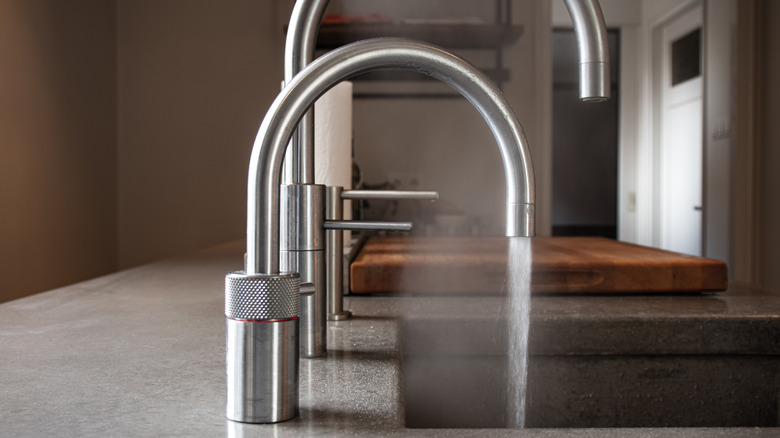
In some cases, however, you might not need to choose between space and ease. As Angel Tan told us, there are some kitchen appliances and storage options that will work double duty. "Wherever possible," she said, "Opt for multifunctional features — such as a Quooker tap which can be tap, kettle, and filtered water dispenser, or a fold-out worktop to increase prep space or function as a breakfast bar when needed." Taps that can deliver boiling water will cut a kettle out of the equation and save you from having to boil water on the stove. Meanwhile, a worktop extension can fold back into place when you're finished using it, leaving your kitchen with those all-important open sightlines and design flow.
Be strategic with patterns and textures
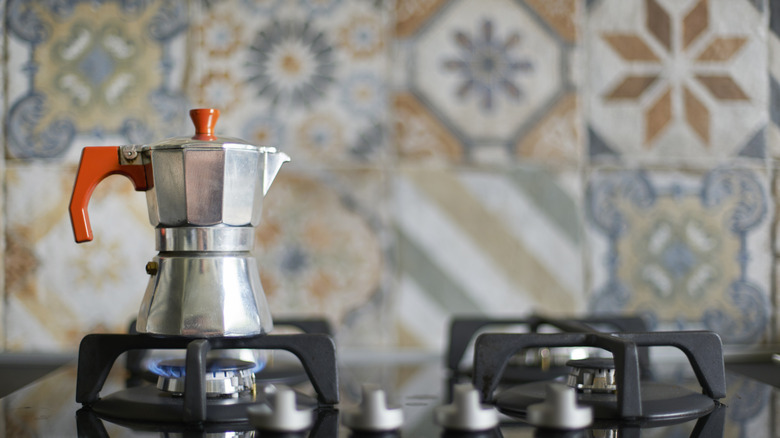
If you love color and patterns, stripping everything back to the bare minimum might feel creatively stifling. In small rooms, too many colors and patterns can overwhelm the space and make it feel cluttered and aesthetically disorganized rather than stylish and opulent. Counterintuitively, restraint will make it feel more luxurious.
Luckily, both Angel Tan and Nicola Fontanella said that eye-catching design elements do have a place in small kitchens. "Mixing textures and finishes can create a layered effect without overpowering the room," Tan said. "The floor and [backsplash] are great areas for introducing pattern — whether through decorative tiles, marble or stone ..." Another way to incorporate fun patterns is with wallpaper. "[It] isn't the most practical choice for kitchens," Tan said, "But it can be effective in areas away from the sink and hob, such as a breakfast nook or feature wall. In a small space, even the ceiling can be a playful spot for a subtle pattern or texture."
Fontanella echoed Tan's line of thought. "Use pattern sparingly and strategically," she said. "[Backsplashes], inset wallpaper, or high-level cabinet detailing are perfect spots for contained visual interest."
Make your decor functional
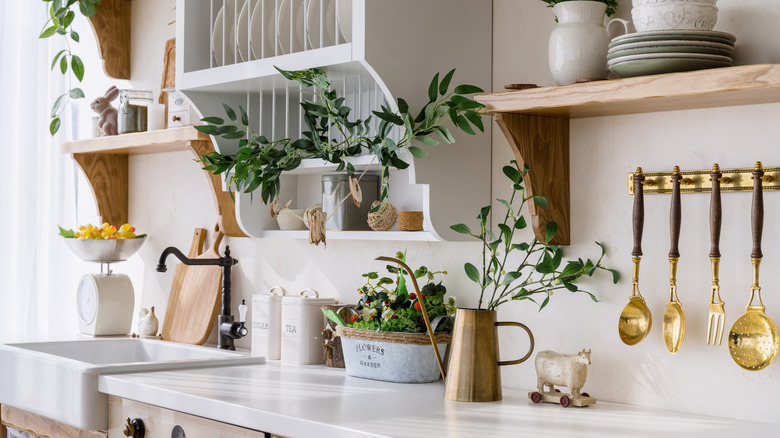
Making a small kitchen functional and aesthetically pleasing poses a real challenge. You don't want to turn your kitchen into a showroom that looks gorgeous but is impractical to work in. Nor do you want to have a kitchen that's purely functional but feels sterile and soulless.
In Angel Tan's experience, people tend to err more on the side of the former than the latter. "A common mistake is overcrowding small kitchens with too much joinery," she said. But it doesn't have to be an either/or situation. "Where possible," she said, "Replace some wall units with a single open shelf and a hanging rail beneath for carefully chosen utensils to open up the space and add personality." If you've gone to the trouble of collecting beautiful dishes or glassware, there's no point hiding them behind wooden cupboard doors. Let them be the decor as well as the all-important crockery that you'll be serving meals on. This is another area where having soft, under-shelf lighting can add a luxurious element to your surroundings. In this case, it won't just create layered light; it will show off your favorite dishes and glassware as if you were in an art gallery.
Keep the floor a single dark color and material
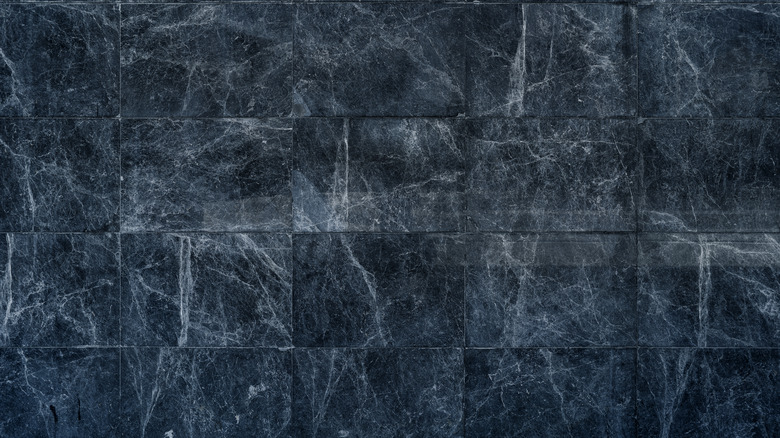
If you're a fan of dark colors and are less than thrilled at the prospect of having to paint your kitchen light, muted colors in order to prevent it from feeling like a grotto, fear not. There is one part of your kitchen that will not only look good with a dark color but would greatly benefit from it. According to Nicola Fontanella, one of the most common mistakes she sees people make is installing white kitchen floors. They are, she said, "notoriously unforgiving" and difficult to maintain. Plus, they might remind you of hospital flooring, which is definitely not what you want to be thinking about when you're making your morning coffee.
A dark kitchen floor will give you the opportunity to add some color variation to the minimalist palette. Plus, a dark color will leave the room feeling calmer and more grounded, a luxury if ever there was one.
Use optical illusions
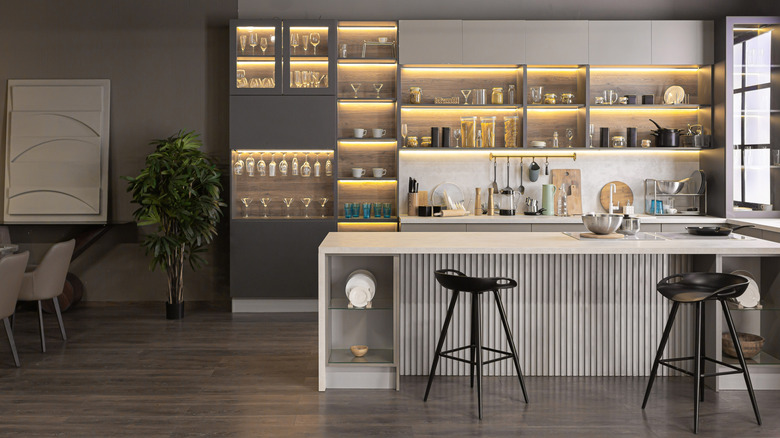
The size of your kitchen is a physical reality that won't change unless you decide to remodel it. However, much of how we perceive space is through our eyes, and our eyes can be easily tricked. That might not sound like a good thing, but when it comes to interior design, it's one of your biggest assets. Sarah Bronstein knows a thing or two about making small spaces feel luxe despite their dimensions. As a designer specializing in tiny homes, she's had plenty of experience using optical illusions to elevate a tight space.
"Typically, replacing upper cabinets with open shelving will make a space feel larger," she said. "Another trick if you have to keep upper cabinets is to paint them white and the lower cabinets a contrasting color. Because of gravity, our eyes are naturally comforted when visual weight is in the lower frame, so this plays on that — the lower cabinets being darker will ground the room while white uppers [have] the same sort of impact as [open] shelving."
Hide things in plain sight
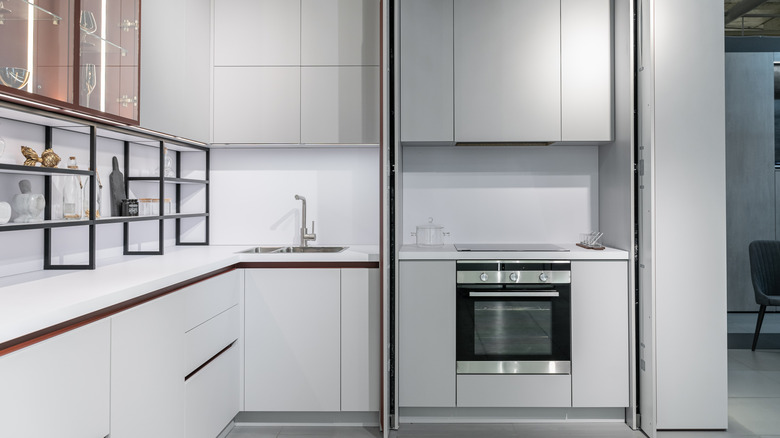
While you might want to put your favorite dishware on full display with open shelving, there will inevitably be plenty of everyday kitchen implements that are better left behind closed doors. No one needs to see the turkey baster or all those extra cookie sheets you've accidentally collected over the years. In other words, you will need plenty of storage, which is exactly what small kitchens lack. To skirt the issue, Angel Tan suggests making the most out of every last inch of storage space you do have. It turns out, you can eke out a lot more space without encroaching on your limited open space.
"Storage fixed to the back of cupboard doors (spice racks, roll holders, baking sheet slots) can increase storage," she said, adding, "Ensure bins, small appliances, and cleaning supplies are tucked away to maintain an open feel." Another way to keep things elegant and streamlined, Tan said, is to opt for handleless, push-to-open drawers and cupboards. In a small kitchen, every little detail will stand out, so keeping the appliances as sleek as possible will ensure that people's eyes are drawn mostly to the decorative design elements.
Choose one statement feature
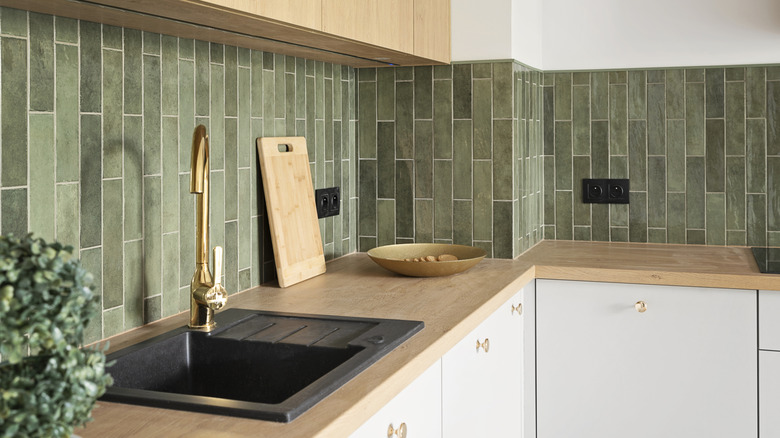
In a large kitchen, you can go all-out with design statements without making the space feel cluttered. But if you want to make a small kitchen feel impeccably put together, focusing on one statement feature will create the biggest impact. No clutter, just one eye-catching element to draw the gaze and make a statement. Sarah Bronstein has two areas where she likes to focus the attention. "I am a firm believer that a tile backsplash is one of the easiest ways to add a wow factor," she told us. "It can add a bold punch or be a subtle way to elevate a more neutral space. Also, lighting fixtures!"
For Nicola Fontanella, that one major design element doesn't have to be a fixture or an appliance; it can be the type of material you use for a particular surface. "One statement material — like a bold stone worktop — can add luxurious depth without overcrowding the room," she explained. You need to choose a material for your countertop or your floors, so you may as well make one of them a show-stopping design statement.
Opt for budget-friendly hacks
It is a simple fact of life that if you have endless financial resources, you can make pretty much any space feel luxurious, even tiny ones. However, for most of us, budgetary concerns curtail any dreams we might have of extravagant fixtures, marble surfaces, and top-of-the-line appliances. Luckily, however, you don't need to have a bottomless budget in order to make your small kitchen feel luxurious. According to Nicola Fontanella, there are multiple ways to scale up the design of your kitchen depending on the size of your budget.
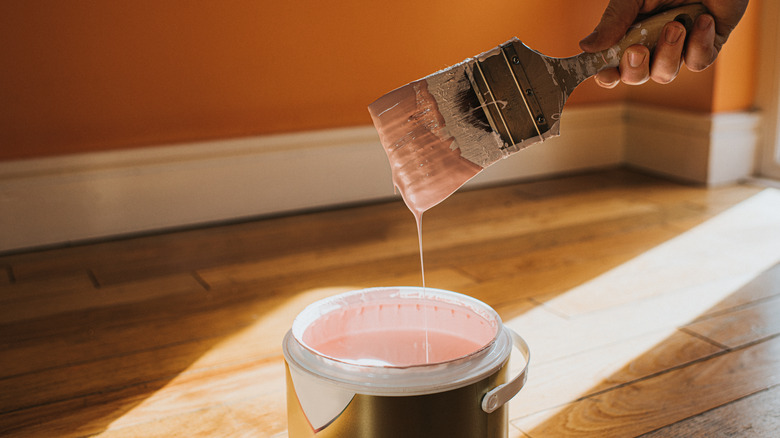
"Paint is your friend," she said. "It's transformative and affordable. Custom hardware, open shelving with curated objects, and even off-the-shelf cabinets upgraded with bespoke doors can make a budget kitchen feel high-end." Ultimately, if you focus on painting the walls a light, muted color, making sure you're not blocking any natural light, and opting for varied but affordable lighting options, you will be well on your way to a kitchen that is far more than the sum of its dimensions.