

The World's Most Expensive Caviar Can Go For More Than $20,000
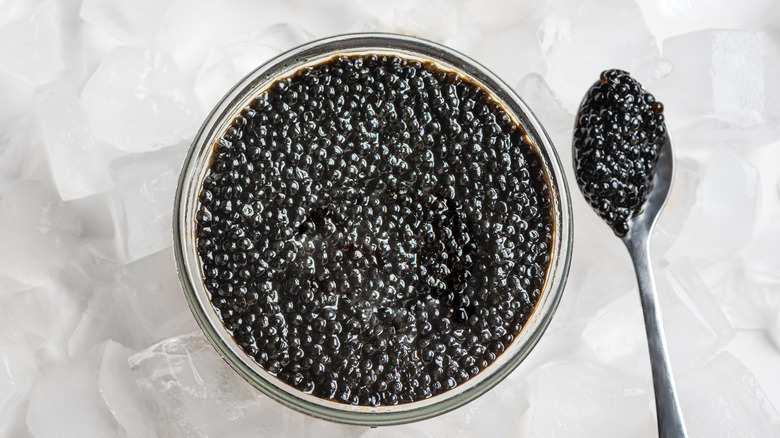
Caviar is often categorized as a luxurious treat. The average rate is $40 per ounce, which totals around $1,400 for 1 kilogram. In all honesty, those price tags shouldn't come as a surprise, making the fact that caviar resembles a tightly packed tin of pearls feels oddly symbolic. Still, there's one variety with a particularly eye-watering price: Almas caviar. If you were to indulge in 1 kilogram of these shimmering golden roe, it would cost more than $20,000 — that's practically a down payment on a house. Mind-blowing, right?
As every caviar enthusiast knows, these eggs are only collected from sturgeon. Almas caviar is specifically harvested from a type of sturgeon called the Iranian beluga, and its taste is characterized by a distinct nuttiness and lack of salinity. If you get the chance to try some, sample it properly. To preserve those highly sensitive flavors, many experts stipulate that you're only supposed to eat caviar with a bougie mother-of-pearl spoon. If you're feeling less traditional, you should try eating caviar right off your hand. Just don't drop any as that would be an expensive mistake.
What makes Almas caviar more expensive?
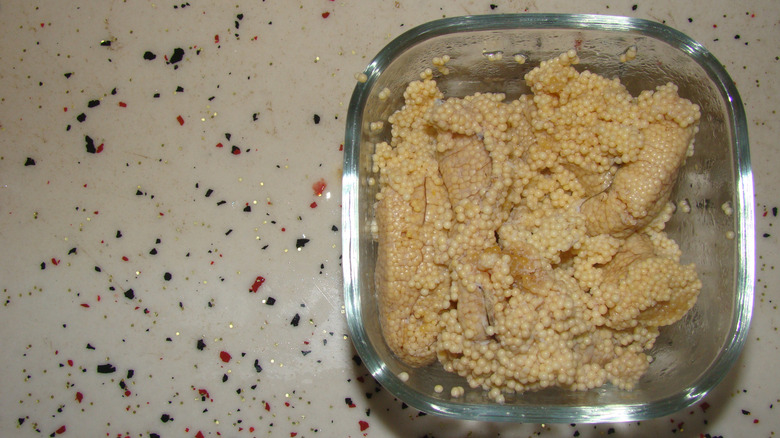
Caviar might be expensive, but Almas is in a league of its own. There are several reasons for this discrepancy in price tags. Firstly, beluga sturgeon are rare — one of the main differences between beluga and osetra caviar is its higher costs due to limited availability. Secondly, Almas doesn't just rely on this notoriously elusive species as not all Iranian belugas are deemed "suitable." To qualify as Almas caviar, the Iranian beluga must carry a rare albino mutation and must be between 60-100 years old. Needless to say, that's like searching for a needle in a haystack.
Albino belugas look pretty dramatic — picture: a 20-foot-long white fish with pink eyes — and it's clear why their rarity drives prices so aggressively. It's challenging to guarantee availability, which is why this caviar is such a rare and unstable presence even on the most luxurious Michelin menus. Between its high quality and mythical existence, it cuts a really tantalizing presence in the industry. To further drive appeal, Almas caviar is often packaged in gold or silver tins.
For those who can't afford $20,000 for a kilogram of caviar, rest assured that it's not the most advisable choice anyway. Due to serious sustainability concerns, many customers are already exploring alternative options. No-kill and vegan caviar are replacements for the real thing. Since the sky-high price of Almas is a red flag for sturgeon conservation, let your wallet breathe a sigh of relief.