

9 Vintage Electric Kitchen Gadgets That Are Worth A Lot Of Money Today
We may receive a commission on purchases made from links.
Kitchen gadgets are much like other kinds of tech: Every year new products launch at trade shows, and every year most of them disappear without a trace (often for good reason!). A few become solidly successful, and a much smaller number become all-time classics that change the way we cook.
With the passage of decades, those all-time classics often become highly collectible. Some people value them just for their aesthetic qualities. Others collect vintage small appliances because their rarity, or their historical importance, means they can be treated as investments and eventually flipped for a profit. If you have the good fortune to live in a period home with a well-preserved vintage kitchen, you may want period-appropriate appliances to fill its shelves and countertop.
The best vintage kitchen items embody all of those characteristics. It's a well-worn truism that "they don't make 'em like they used to," and these older kitchen gadgets collectively represent the best in old-school innovation, manufacturing, and (often) industrial design. I've owned a few of them myself over the years, just because they're fun to own and use. Here are nine kinds of vintage electric kitchen gadgets that can be worth some meaningful coin, should you stumble across a good one.
Vintage stand mixers
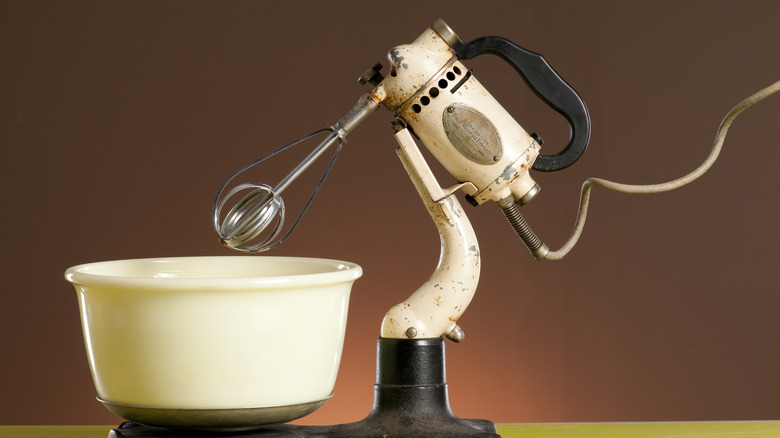
You probably won't see a first-generation KitchenAid anywhere outside of a museum (or that one episode of "Downton Abbey"), but the Model K that was introduced in the 1930s is highly desirable. It established the classic look of a KitchenAid that has largely endured ever since, though a handle on the machine's top was later phased out. Those vintage models are the most collectible, but aficionados have a soft spot for all machines built in the Hobart era, which ended in 1986 when the brand was sold to Whirlpool. Still, KitchenAid today is America's most popular kitchen appliance brand.
They aren't the only vintage stand mixers that can command a notable price, though. Vintage Sunbeam stand mixers are also sought after, especially the stylish models made between the 1930s and 1950s. Other brands and models have their own fans, from Westinghouse Food Crafters (with their odd three-beater mechanism, and "sideways" look) to the English-made Kenwoods, which were the U.K.'s top brand.
Prices can range to $1,000 or more, but a lot of factors affect the price you'll get (or pay) for a vintage mixer. They include its appearance and condition, original manuals, rarity or historic importance, the condition of the economy (people don't splurge in times of uncertainty), or a really full set of accessories. Location matters, too: I owned a Kenwood A701 (a transitional model between the '50s-era A700 and the classic '60s A701A) and would have gotten more for it in the U.K., where vintage Kenwoods are prized.
Classic waffle irons
People have enjoyed some form of waffles since ancient Greece, and waffles have gotten progressively tastier with the passing centuries. For home cooks, manufacturers have come to focus on the thick, round, Belgian-style waffle, but until the late 1990s most commercial models made crisp, thinner waffles instead. If you find one of those appliances now, it's probably labeled as a "classic" or "traditional" waffle maker.
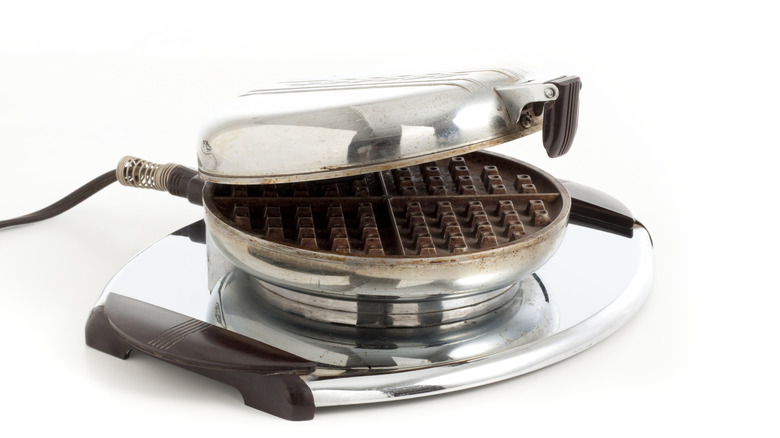
Of course, if you want classic, you can also just buy classic. GE brought its first electric waffle iron to market in 1918, and by the 1930s the market was in full swing. Manufacturers including Manning-Bowman and Universal turned out designs that were beautiful objects on their own, incorporating the Art Deco design motifs of the era. Some also offered ornamental patterns beyond the standard grid, a call-back to the intricate designs of bygone centuries. It's not uncommon for top-tier collectible waffle irons to get into the $1,000 range.
Mid-century models from most of the major manufacturers can also be highly collectible. They don't command as high a dollar, but they're a better option as an iron to actually use. I myself own a vintage Kenmore waffle iron, in glossy chromed steel, which (like me) dates from the early 1960s. It doesn't have a nonstick coating or removable plates for easy cleaning, but it makes a great waffle. I grabbed it gleefully from a thrift store for about $5, but I'll never flip it for a profit. Making waffles with the grandkids is more important.
Early Cuisinart food processors
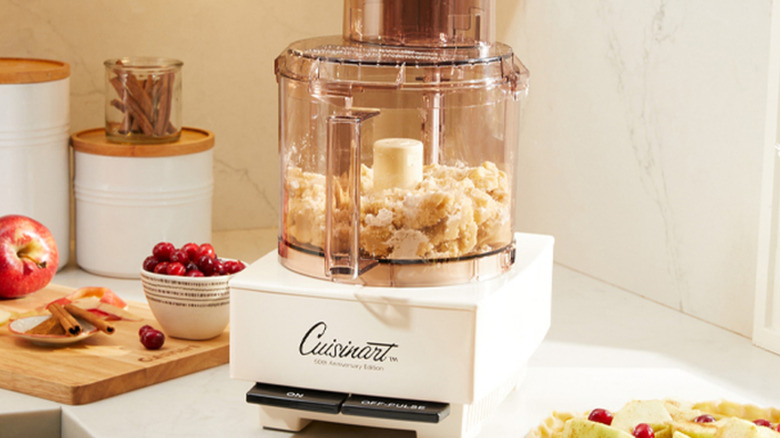
It's hard to imagine, but food processors as we know them only date back to the 1970s. That's when Cuisinart pioneered this new category, taking the basics of bigger, restaurant-sized machines and refining them for the home market (much as Hobart did with stand mixers decades earlier).
Those early-'70s models were made in France by the same manufacturer responsible for the commercial machines that inspired the Cuisinart. Later, production was shifted to Japan, where it stayed until the late 1980s. These early machines were serious beasts, powerful and heavy, and were built to last. Current pricing is variable, ranging from hundreds of dollars at the top end to under $100 at the low end, depending on their condition, accessories, and similar factors. Other brands from that era are less collectible simply because they were not built to last.
My own Cuisinart, a DLC-10, was bought new in 1982 by a former employer of mine for her restaurant. It put in a solid 20-plus years in her kitchen, then put in a shift in my restaurants as well. I've replaced the blade (there was a recall) and the work bowl, and I'll probably need to replace the power cord soon. But I confidently expect to some day pass it along (still going strong!) to one of my kids or grandkids.
Electric percolators
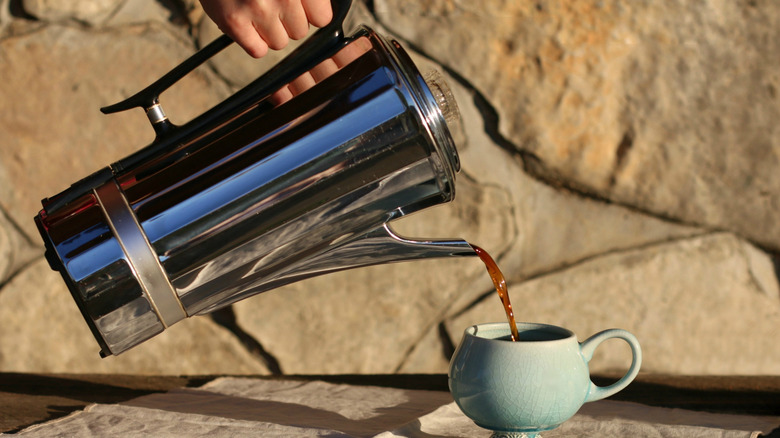
For a whole lot of us, the day doesn't really start until we have a cup of coffee in our hands. And these days we're spoiled for choice: We have automatic brewers, pour-over cones, French presses, home and commercial espresso machines, the portable Aeropress (I love mine), the classic Italian stovetop moka pot, and lots of other options to choose from.
Yet, the old-school percolators are still hanging in there, though they're no longer in every kitchen. In fact percolators are making a bit of a comeback. Why? Well, it may partly be due to nostalgia, or contrarians and hipsters turning their collective backs on modern coffee culture. But percolator coffee has its own fans, and a good percolator does indeed turn out a cup of strong, full-flavored coffee.
Electric percolators have been around for about a century now, and they neatly solved the two big issues with stovetop percolators (heat control and scalding the finished coffee). Many of them are beautifully designed objects in and of themselves, with still-familiar brands like West Bend and Farberware turning out models in full '30s Art Deco or Space Age mid-century modern styles. Really old and rare models can fetch hundreds or even thousands of dollars (one was listed on eBay for $4,999 at the time of this writing), but you can also find appealing options for your personal use at under $100.
Early blenders, from Waring especially
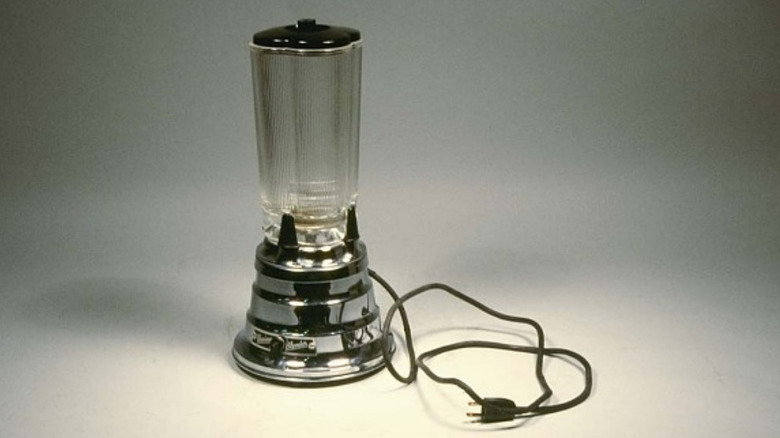
The first electric blenders came to market from the Stevens Electric company in 1919, and they were sold under that name until 1946 when the company was bought out by Oster. Popular jazz-age bandleader Fred Waring (who trained as an engineer before turning to music) eventually became interested in the product, coming up with several ways to improve the basic design. He set up a company to market his new "Blendor" (his spelling, so it could be trademarked).
Prohibition ended around this time, and there was an insatiable appetite for cocktails. Waring's machine opened up plenty of new horizons for professional and amateur mixologists as well as home cooks. The basic layout of a blender didn't lend itself to stylish designs as well as many other appliances, but that was okay. The old models still look pretty cool, and some models can fetch prices of several hundred dollars.
Keep your eyes open for vintage Waring and Hamilton Beach machines or anything that carries the original Stevens name. Other common brands, including Westinghouse, Oster, and Sunbeam, were well represented in the '50s and '60s marketplace. They won't command quite the same prices, but they're attractive and functional in their own right.
Vintage toasters
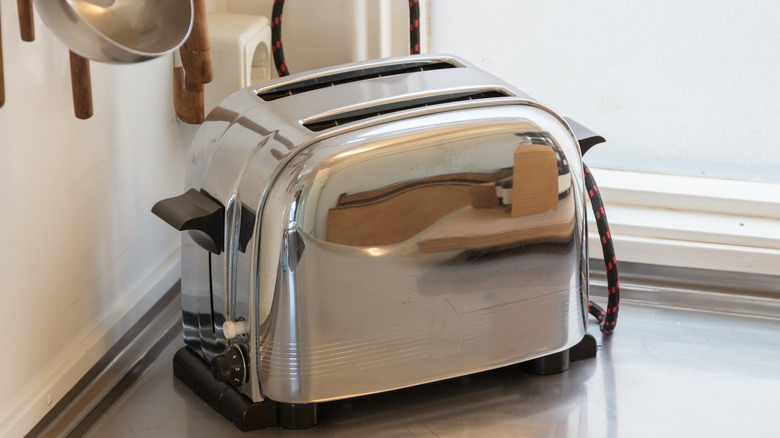
Anyone who's shopped for a toaster in recent years will know how many current models are sadly underwhelming. Some don't toast evenly, some don't toast consistently, some are so fast that the middle of the bread is barely warm (I'm sorry, that's not toast!), and some just take forever.
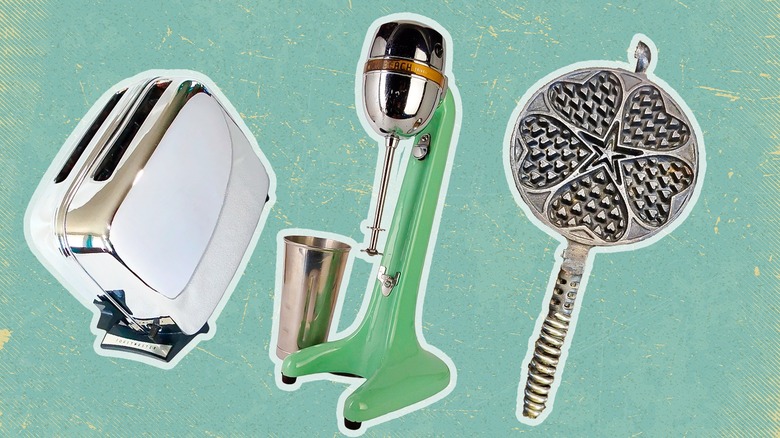
If you've heard your parents and grandparents grumbling that "they don't make 'em like they used to," well ... it's not entirely nostalgia. Vintage toasters from ToasterMaster, Hotpoint, Toast-o-Lator, GE, Sunbeam, and many others are highly collectible, both as beautiful objects in their own right and also (if carefully refurbished to modern electrical-safety standards) still perfectly usable for turning out great toast.
The earliest electric toasters date from before the First World War, but those are museum pieces, and you'll seldom see one. Even vintage toasters from the 1920s, at the beginning of the Art Deco era, are rare. Most of the action, for casual collectors, comes with models built from the 1930s through the 1960s. Classic Sunbeams are especially valued, frequently fetching several hundred dollars for a good specimen, partly because of their timeless design but mostly because there's a case to be made that they were the GOAT, the best toasters ever made.
Classic Vita-Mix blenders
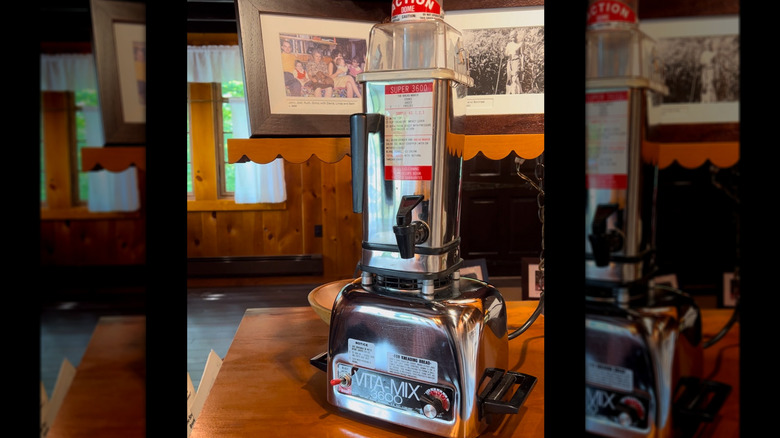
We've already talked about vintage blenders as a broad category, with highly desirable models from a number of manufacturers dating from the 1930s through the 1960s. I'm going to class these Vita-Mix blenders separately (the company didn't become Vitamix until more recently) because they appeal to a different buyer.
The company was founded in the 1930s by a health-conscious family that wanted to promote vegetarianism and healthy eating. Those early blenders from the '30s and '40s are collectible, and so are the 2-speed Mark 20s that debuted in 1950, but they weren't much different from other blenders. It wasn't until 1970 that Vita-Mix found its real niche. That's when the company's then-CEO, son of the founder, made the machine massively more powerful by giving it a big motor designed for a circular saw. That machine was the Vita-Mix 3600, with other upgrades that included a spigot on the jar, multiple speeds, and reversing blades.
Those 3600s, and the more powerful Vita-Mix 4000s that followed in the 1980s, could do anything from grinding grain to making peanut butter, in their signature stainless steel blender jars. They're highly collectible, with rebuilt or well-kept original models fetching hundreds or even thousands of dollars. I'm lucky; I picked up a 3600 at a private sale for $50, and a 4000 at a thrift store for $25. So the bargains (and the potential for profit!) are out there if you keep your eyes open.
Hamilton Beach milkshake maker
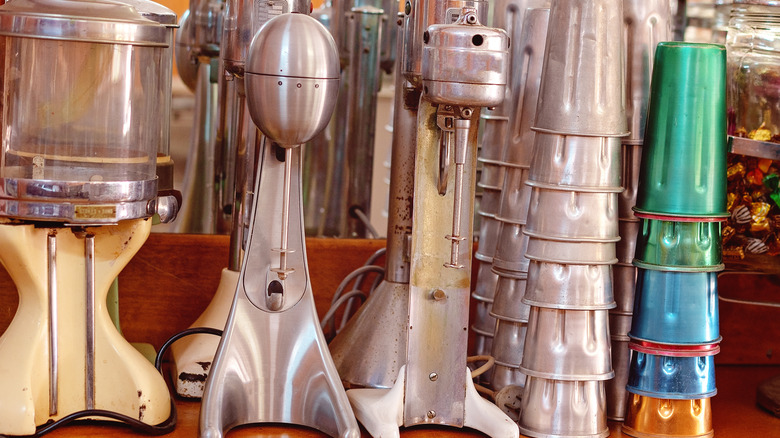
I'm (barely) old enough to remember when drive-in fast food was still a thing, but there are plenty of modern diners working hard at keeping that old-school vibe alive. Some genuinely date back to the era they recall, while others are recreating it with varying degrees of success.
One thing most of us would agree on is that diner milkshakes just taste better. Why? Well, it's partly the ingredients, but it's also very much the equipment they use. Yeah, you know what we're talking about. It's the specialized milkshake mixer. Modern ones often come in smooth stainless steel, but the classic Hamilton Beach milkshake maker — usually in that iconic pastel green, though they made it in other colors, too — is the one we all imagine when we think of a diner.
And really, what could possibly be a more fun, retro, and cool element to bring into your kitchen than one of these old standbys from the days of soda fountains and drive-in restaurants? Models dating from the 1930s through the 1950s are especially desirable and can fetch hundreds of dollars. Bear in mind that these were meant as commercial equipment, so they're built to last and stand up to a lot of use. Hamilton-Beach makes inexpensive lookalikes now for the home market, but if you can get a reasonable price on the real thing, jump on it!
Vintage hand mixers
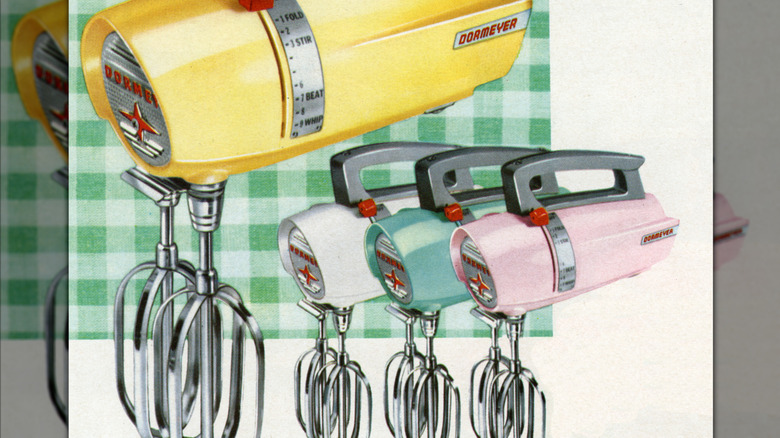
Stand mixers have always been something of a prestige item to have in your kitchen. KitchenAid's iconic Model K sold for $55 at its 1937 launch – that's equivalent to over $1,200 in 2025 dollars. For anyone who couldn't justify spending that kind of money, a hand mixer was the obvious alternative.
Hand mixers may not have the same cachet as their burlier siblings, but they were certainly a step up from wooden spoons or hand-cranked eggbeaters. Today they still have a number of handy uses, even for people who own a stand mixer. I have a big lift-bowl KitchenAid, but my hand mixers get used just as much, if not more.
In sheer dollar value, vintage hand mixers from brands like Oster and Sunbeam just aren't going to command as much money as their stand-mixer equivalents, though exceptional specimens may still command hundreds of dollars. More typically they'll top out in the range of $100 to $150, with fun and cool models across the decades often coming in at even less. This makes them a lot of fun for budding collectors, and they're an affordable entry point to the hobby. Also, many are quite functional. My own early-1970s Sunbeam, in retro harvest gold, is still going strong.