

The Downside Of Waterfall Kitchen Countertops No One Talks About
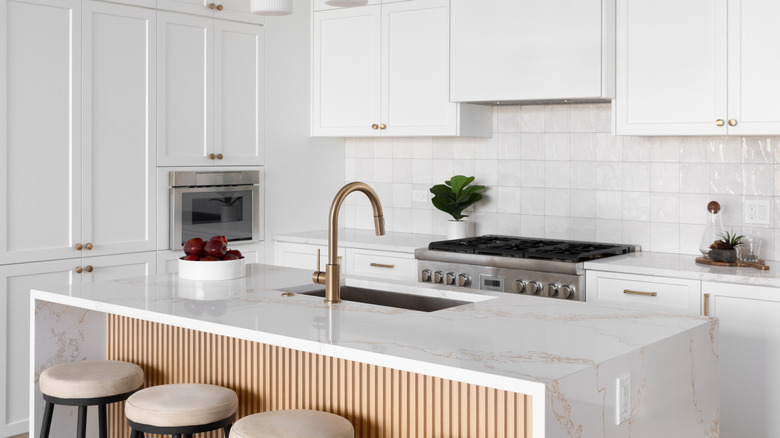
It looks sculptural, like the counter simply cascaded into place — sleek, monolithic, and Insta-ready. Designers love to wax lyrical about the drama and clean lines, and real estate listings practically applaud when they see one in the wild. But there's a practical catch that rarely makes it into the brochure, and you tend to discover it the very first week you actually cook in the kitchen.
It's the waterfall countertop — the slab that flows over the edge and drops straight to the floor. But here's the catch: because the edge is a flush, mitered curve with no overhang or little lip, anything you brush off the counter won't drop into your hand or the dust pan. It plummets straight to the floor and wedges into the hairline gap where the vertical panel meets the flooring. Experts acknowledge that counters without an overhang are harder to wipe clean for this reason.
That gorgeous vertical slab also creates more surface area you have to maintain. This means more fingerprints, splashes, and pet nose smears at kid- and dog-height. Stone pros note that vertical surfaces show smudges and dust more readily, so you're not just wiping the top anymore — you're polishing sides, too. If you choose a natural stone (rather than a fully nonporous engineered surface), that also means more area to seal and reseal over time. And seamless isn't the same as unbreakable. Waterfalls are typically built with precision mitered corners; the crisp edges and long seams are vulnerable to chipping or hairline cracks from impact, movement, or subfloor shifts.
If you're a perfectionist, read this before choosing quartzite
Waterfalls also amplify visual imperfections — especially on materials like quartzite, which we often select for its luminous veining. Quartzite's polish can dull (etch) from acids like citrus and vinegar, and oils or pigments can telegraph through if the stone isn't sealed and maintained — issues that are far more noticeable when the slab is on display across two planes. In short, if museum-perfect is your baseline, minor blemishes may bother you more on a waterfall than on a standard counter run.
Even when fabrication is top-notch, edges and seams in quartzite can chip, making the glue line more apparent. Stone pros (and plenty of battle-tested renovators) point out that this material is notorious for edge chipping, which visually exaggerates seams — again, a bigger deal when those seams live at eye-level down the side of an island.
So what's the pragmatic takeaway? When you're choosing your kitchen island material and style, and you just adore the look of the waterfall design, go in with eyes open and plan for real-life maintenance. You can add floor-level caulk lines, but these will need to be refreshed. You should also keep a handheld vacuum or edge broom nearby and schedule routine resealing if you're using quartzite. If you want the drama without the daily crumb slide, consider a micro-overhang on the top plane or stop the waterfall short of the floor with a recessed plinth — small design tweaks that keep the aesthetic while restoring a functional catch.