

Carl's Jr. Didn't Start Out By Slinging Burgers — And Its Name Tells The Chain's Story

Have you ever driven past a Carl's Jr. and wondered who Carl Sr. was? Or why it's Carl's Jr. and not Carl Jr.'s? There's more going on here than it seems, and it partly explains how the chain became one of the top-selling burger joints in America. It's an impressive feat, considering founder Carl Karcher started out selling hot dogs in 1941, not burgers. The burgers and the "Jr." didn't come until later.
Long before hamburgers were the pinnacle of fast-food culture, hot dogs dominated the landscape in America. As far back as the 1860s, people were selling hot dogs from carts. By the 1920s, Feltman's Ocean Pavilion — the Coney Island restaurant credited with popularizing the modern hot dog served on a bun — was selling 40,000 hot dogs per day. It's no wonder that Karcher wanted in on the action. He used his entire life savings of $15, borrowed another $311 against his car, and bought a hot dog cart that made just under $15 on its first day.
Karcher soon grew the business to four carts, and then opened a restaurant called Carl's Drive-In Barbecue, where the menu included hamburgers. From there, he opened a smaller version of the restaurant in 1956. He called it Carl's Jr. because it was a scaled-down version of Carl's. Carl's Jr. sold hamburgers and was designed to offer a faster, more convenient experience for customers.
Carl's Jr. and the rise of burgers
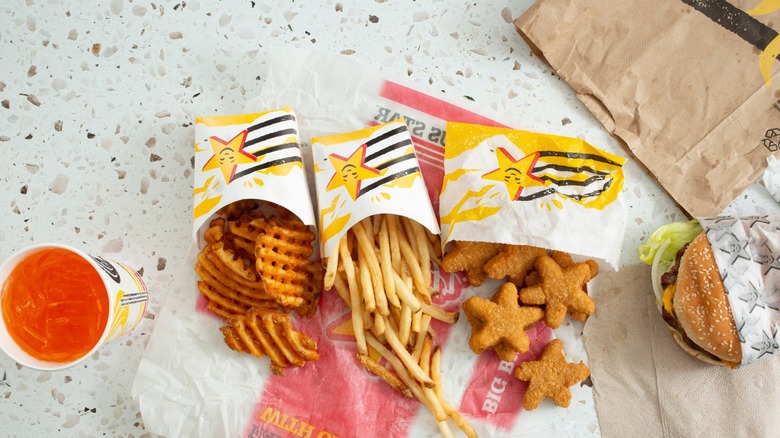
By the 1960s there were 24 Carl's Jr. locations, and Carl Karcher had started his own fast-food empire. In 1977, there were 200 locations throughout California, and by 1979 the company expanded out of state. Hot dogs and chili dogs, which the business was originally founded on, remained on the menu alongside the hamburgers until the 1990s, when they were phased out.
Although hot dog carts can still be found across the country, most restaurants don't specialize in hot dogs, save for the likes of Los Angeles' beloved Pink's Hot Dogs, of course. There has never been a major hot dog chain in the way there have been burger chains. Part of that is because hot dogs are actually harder to cook properly than hamburgers. To cook them evenly and present them well takes more work. Also, unlike hamburgers, they don't hold nearly as well, and diners tend to want to customize them more. So Carl's Jr. shifting focus from hot dogs to hamburgers as the business expanded made sense. It's easier to build a fast-food empire on hamburgers than on hot dogs.
Kercher tried to spin off a new concept again in the 1970s with a Mexican restaurant franchise called Taco de Carlos, but managed to open only 17 locations before selling them off. The company expanded again in the 1990s when it bought Hardee's, which operated in a different region, and merged the two chains. Their menus are nearly identical, but there are a few differences between a Carl's Jr. and a Hardee's – including the fact Hardee's offers a chili dog.