

Frozen Orange Juice Used To Be Everywhere. Why Did We Stop Buying It?
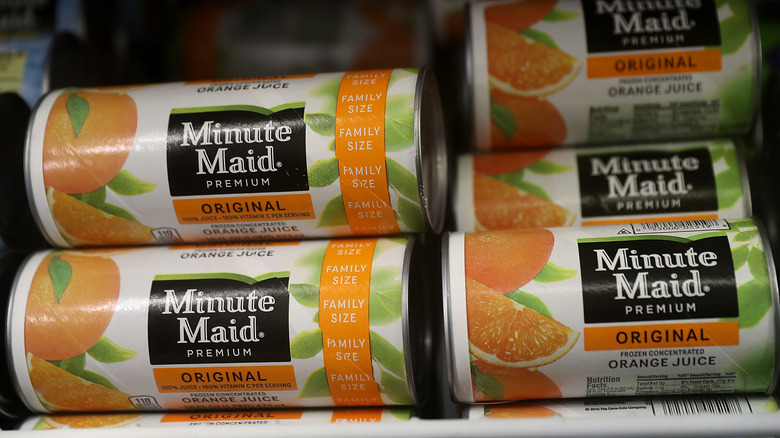
For decades frozen orange juice was the very image of American abundance. Frozen orange juice was born in the aftermath of World War II, a symbol of the good life and a drink full of vitamins that was seen as part of a healthy breakfast for Baby Boomer families. But walk through a grocery store now, and you might not catch sight of one of the signature juice cylinders at all. They've been almost fully replaced by the "fresh" not-from-concentrate orange juice you get in cartons (more on those quotation marks later). While it might seem natural that fresh-squeezed juice would be more popular than frozen, that overlooks just how much of a breakthrough frozen O.J. was and how strange its displacement in our kitchens is.
Orange juice's popularity was on the rise in the early half of the century, driven by health claims about orange's vitamins and health benefits. But with technology of the time, fresh juice was expensive and hard to source outside of growing regions like Florida and California. This is because even frozen orange juice would degrade quickly, turning into discolored flavorless goop. It took a government effort in World War II to change things. The country needed a way to supply troops with vitamin C to ward off scurvy on the front lines, and it invested in finding ways to make frozen orange juice more palatable. Scientists did just that, inventing a new low-temperature evaporation process that made an orange juice concentrate that survived freezing far better.
Frozen orange juice was attacked as less fresh than not-from-concentrate orange juice
The then-new frozen orange juice concentrates were a sensation and became the primary way Americans enjoyed the juice until the 1980s. It was then that another new process for preserving orange juice allowed not-from-concentrate orange juice to hit shelves. Concern over less natural convenience foods like frozen orange juice was growing, and the versions were ready-to-serve instead of frozen, with labeling like Tropicana's famous straw in an orange, implying that you were drinking truly fresh squeezed juice. Ads emphasized the "not-from-concentrate" label as an attack on frozen juice concentrates and touted ready-to-serve orange juice as fresher and higher quality. It worked, with the new cartons of juice doubling in sales in just five years. By the 2010s, the frozen versions made up just 5% of orange juice sales in the U.S., according to the Wall Street Journal.
The problem is that "not-from-concentrate" orange juice isn't really that "fresh." That juice is pasteurized, which is fine, but in order to preserve it as well as freezing, it undergoes a process that removes all the oxygen from the juice, too, which allows it to be stored for over a year. This has the side-effect of striping the juice of its fresh flavor. To fix this, companies have to add flavor back using "flavor packs" made of up chemicals from orange essence and oils. Each orange juice brand like Minute Made and Tropicana have signature formulations that are engineered for consistency in taste.
Plant diseases and growing concerns about juice have limited orange juice's appeal
It was not-from-concentrate juice that killed frozen orange juice, but recent trends have hurt any chance of a revival. Concerns over the sugar content of all juices and how preserved they are has destroyed the healthy reputation that it once had. By the late 2010s, consumption of fruit juice had fallen to its lowest levels in 50 years. Just over the last 15 years, a Statista report shows orange juice consumption alone has fallen by 40%.
During that same time period, American orange juice production has also been devastated by disease and natural disasters. A bacterial infection known as "citrus greening," which kills trees and causes them to produce bitter fruit, has spread through Florida since 2005. Combined with recent Hurricanes that have also damaged citrus groves, Florida's orange production has fallen by 92% in the last 20 years, according to the USDA. Meanwhile, California (which unlike Florida's juicing oranges, mostly makes them for eating) has only seen flat production. So despite falling demand for juice, orange juice prices have continued to rise, with the cost of frozen O.J. jumping more than 50% since 2014.
Between falling demand and not-from-concentrate's domination of the remaining market, frozen orange juice's future is looking bleaker by the year. One hope is that growing awareness of "fresh" orange juice's lack of actual freshness, and the many great uses of orange juice concentrate, may renew appreciation for this product that was once considered a miracle.