

How To Decide Where You Want Your Kitchen Backsplash To End

A backsplash is a decorative element (i.e. its chief function is to look good), and as such, it should follow the existing parameters laid out by your kitchen. The first and foremost rule for deciding how far the covering should extend is to keep the lines simple.
In general, the wall space between the countertops and the cabinets is considered backsplash territory. The latter two fixtures provide natural borders for adorning that section of wall with a crisp, clearly-defined aesthetic pop. Here, the backsplash should align flush with the far edges of the counter and upper cabinets. If your countertop extends beyond your upper cabinets, stop the wall covering so that it aligns with the edge of your upper cabinets. A backsplash can also be arranged as a subtler 6-inch to 1-foot-thick strip lining the space directly above the countertops. This can be a good look for walls without upper cabinets.
If you're working with a pricey tile or material, and a full-wall backsplash isn't in the budget, consider hanging two or three free-floating shelves. Affixed to the wall, these floating shelves will form an open strip (or multiple strips) of wall space with defined borders. That pricey, eye-catching tile can be mounted in the open spaces between the shelves for a pop of personality that doesn't break the bank.
Backsplashes should align with existing cabinet and countertop edges, or engulf them entirely
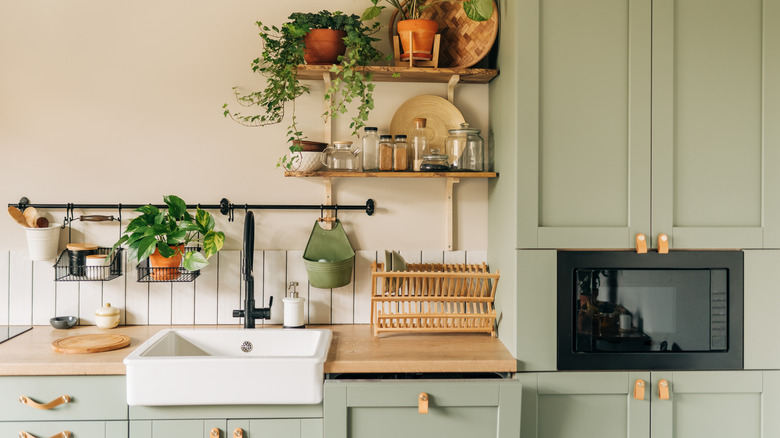
Beauty is in the eye of the beholder, and ultimately, determining where to end a kitchen backsplash is mostly about how bold or subtle you want the desired effect to appear. For a more dramatic look, a wall-to-wall, countertop-to-ceiling installation might be the move. It will provide an opportunity to showcase a fabulous, eye-catching kitchen backsplash material such as deep emerald or cerulean tiles, hammered copper, or vintage pictorial Delft tiles. This look is especially impactful in otherwise minimal kitchens. If you want a sleek, modern aesthetic or an understated design, then a large backsplash can deliver a kick of character without overpowering the space. Full-wall coverage could also be a terrific way to define the space in a smaller kitchen — especially if it's situated in a studio apartment with a decided lack of spatial definition between areas.
Alternatively, for a subtler look, a smaller backsplash with well-defined borders can zhuzh up a kitchen's overall feel without being dominating. The space between the oven and the range hood or the rectangular area above the sink both provide smaller organic boundaries for framing tiles. If you're rocking a maximalist kitchen stocked with colorful spices and boutique appliances displayed in plain sight, keep in mind that a physically smaller backsplash might serve as a more fitting complement to a busy space. Sometimes, less really can be more.