

6 Popular Sweet Snacks Made With Unusual Ingredients
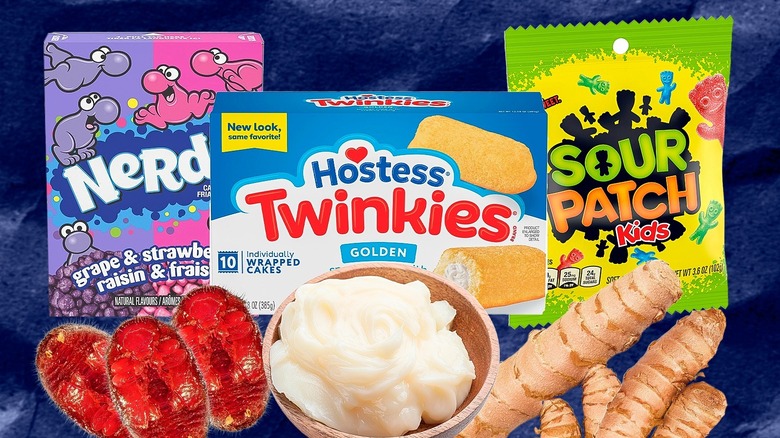
Most of us aren't fooling ourselves — that long, incomprehensible ingredient list on the back of your favorite candy's packaging doesn't include many "natural" ingredients. When we grab a box of candy, we acknowledge that we are not opting for an unprocessed food option. But that doesn't mean there aren't still some surprising ingredients hiding inside it. From classic Halloween candy to sugary snacks, there are some, shall we say, inventive add-ins.
A few are just unexpected, while others are a little eyebrow-raising. A handful of them serve as a lesson in how "all-natural" is not always a good thing, and how meatless foods are not necessarily vegetarian. Your favorite chewing gum, jelly bean flavor, or sour gummy might just have more than one trick up its sleeve. After all, knowledge is power, so it's time to pull back the curtain and see exactly what goes into your favorite sweets. Hopefully, they still taste as good once you know.
Twinkies include beef tallow
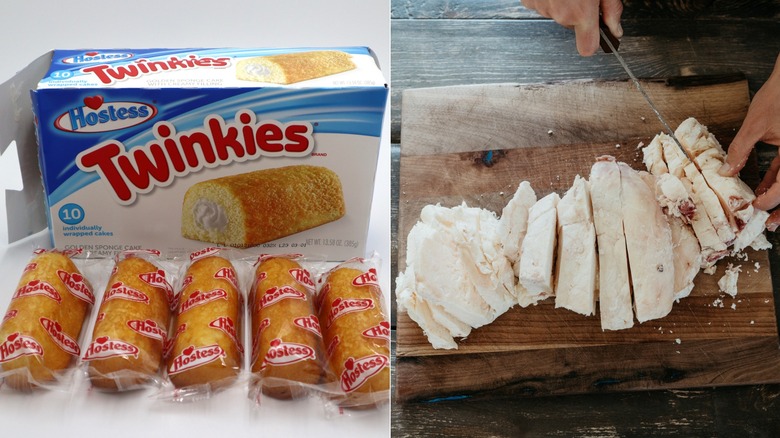
Twinkies are one of the most iconic sweet treats in America. They've been around for almost 100 years and have been referenced in countless movies, TV shows, and books. There are countless rumors about their durability, and kids have been telling each other about how Twinkies would survive anything, even a nuclear bomb, for a long time. Deep-fried Twinkies have even appeared on the state fair circuit. Needless to say, for all the snack's fame, it's not known for having the most "natural" ingredients. The truth is, however, it actually does feature some non-synthetic components. You just might not be pleased to learn that one of them is beef tallow.
Beef tallow, which is really just rendered beef fat, is used as a nearly tasteless preservative in shelf-stable snacks like Twinkies. That means that Twinkies are not vegetarian. When Twinkies first arrived on the scene in 1930, they were mostly made with ingredients you have at home, like eggs, milk, and flour.
Nerds Gummy Clusters have boiled bugs in them
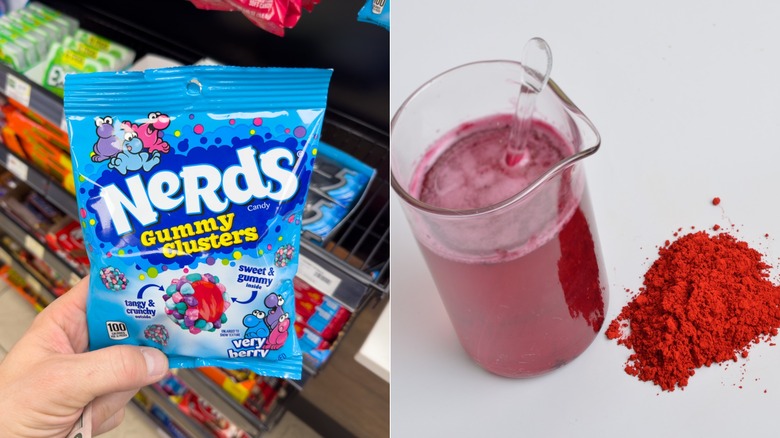
Crushed-up bugs have been used to create colorful pigment for thousands of years; from makeup to clothing, we have insects to thank for some of our richest and most beautiful dyes. It's not necessarily pleasant to think about their involvement, but it's something most of us can eventually accept. However, as it turns out, bugs aren't just used to add color to the things we wear; they're also added to the things we eat, particularly candies, like the extremely popular Nerds Rope and Nerds Gummy Clusters. That's a little harder to swallow (pun intended).
Widely used across multiple industries, carmine is a colorant that lends a vivid red color to whatever it is added to, so that's the product that's used as a red dye in the above-mentioned Nerds candies. Carmine is a natural dye, but it's not necessarily an appetizing one. It's made from the dried and crushed bodies of female cochineal insects (the bugs themselves use it as a deterrent against predators). The bodies of the bugs are boiled, then dried and ground for commercial use. While insects have a long history of being used as ingredients, carmine's inclusion in certain candies is now considered controversial due to a lack of transparency from the industry.
Jelly beans are often covered in insect resin
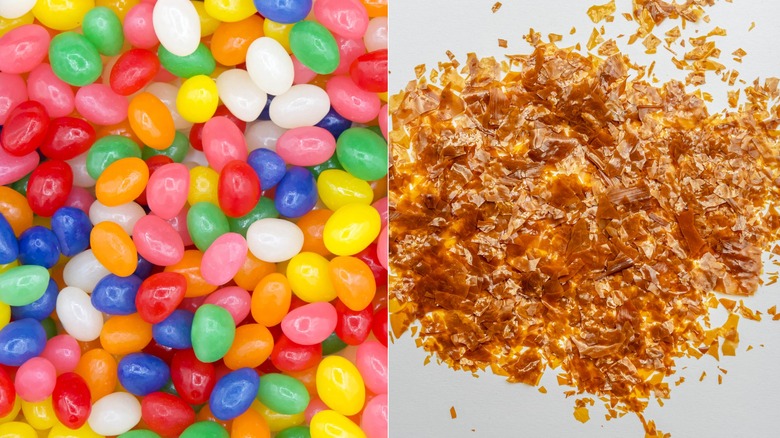
We aren't done with bug stuff quite yet. Perhaps you have heard of shellac, a kind of resin used to make varnish and various other shiny coatings. Referred to as a "natural plastic," it's often used in woodworking, as well as nail polish and glue. What you may not know is that there is a food-grade variety of shellac (often referred to as confectioner's glaze) that's commonly used to give candies like jelly beans the same kind of sheen. Shellac is also used in some cases as a food dye. You also might not know what shellac is made from: bugs.
In fact, shellac gets its name from its buggy origins. It is derived from the secretions of the lac insect, which naturally uses these secretions to create cocoons. For commercial use, this waxy substance is taken from tree branches, dried, and broken into pieces to be used in various products. If this natural resin is to be used as a dye, it's not just the substance itself that is used — the insects are left in the wax to create the pigment.
Kit Kats' secret ingredient is more Kit Kats
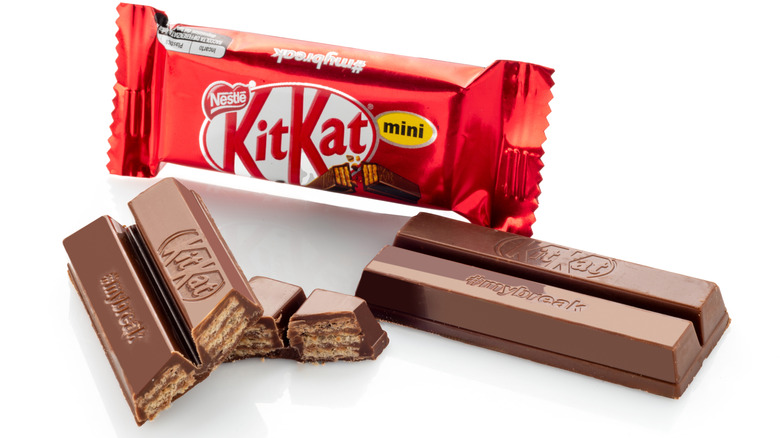
Kit Kats are a lesson in simplicity. Unlike many chocolate candies that are chock-full of add-ins meant to entice consumers in a crowded field, a Kit Kat bar's straightforward chocolate-covered wafer is uncomplicated. All the better to appreciate the satisfying crunch of the wafer contrasted with the rich, creamy chocolate. Kit Kats have even found enormous success abroad; there are more than 300 Kit Kat varieties in Japan alone, from wasabi to sake. While American Kit Kat products keep things more classic, the filling that binds the wafers is surprisingly interesting.
When Kit Kat fingers (yes, the Kit Kat pieces have a name) break during one of the various stages of production, they are crushed and repurposed into the filling of new, intact fingers. You can breathe a sigh of relief that this ingredient isn't beetles or beef fat, but it's a bit of a brain teaser. It's the confectionary version of the chicken or the egg — which came first, the Kit Kat bar or the broken wafer?
Sour Patch Kids Glow Ups include turmeric
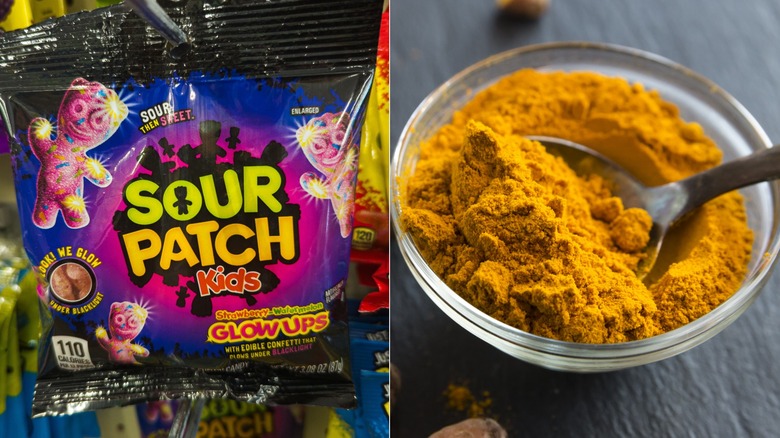
In March 2025, the Sour Patch Kids brand announced a brand-new variety: Sour Patch Kids Glow Ups, which it claims is the first candy to glow under a blacklight. An edible confetti is the source of the glow for these tart gummies. However, this candy product raises a few questions. First, how many people have a blacklight? Second of all, what on Earth is edible confetti, and why does it glow? This luminous property may conjure images of snap-activated glow sticks and creepy-crawly glowworms. But the novelty feature of the candy is derived from a surprisingly pleasant organic source: turmeric root.
Turmeric has a long history of culinary usage, and in the case of candies, it's often used as a dye. After all, anyone who has attempted to remove turmeric stains knows it imparts a very stubborn, vivid yellow hue. In the case of Sour Patch Kids Glow Ups, it's a pleasant surprise for a fluorescent feature to come from a popular, all-natural ingredient like turmeric extract. But even regular Sour Patch Kids have a few surprises; they are actually a plant-based candy.
Some chewing gum features sheep grease
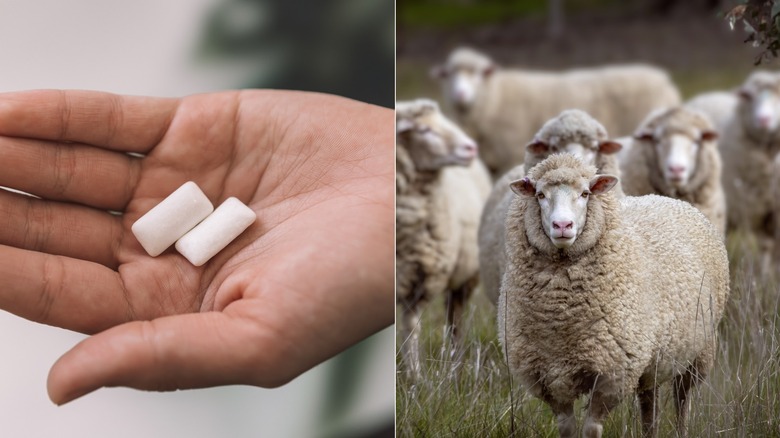
Chewing gum actually has some of the most natural origins you can find in any novelty food product. Thousands of years ago, people were chewing on byproducts of the natural environment around them. Ancient Europeans chewed on birch bark tar, Mayans opted for the sapodilla tree's chicle, and indigenous North Americans partook in spruce tree resin. We've come a long way from chewing gum's ancient origins; modern chewing gum is largely composed of synthetic ingredients. But chewing gum commonly continues to have one specific naturally derived ingredient ... it's just not quite an appetizing one.
While vegan-friendly gum options do exist, many chewing gums include lanolin, which is a secretion from the sebaceous glands of sheep. That's the same gland that makes our skin and hair greasy. For sheep, lanolin is helpful for keeping their thick wool waterproof. For many chewing gum companies, it provides the pleasantly soft texture that the product is known for. You may not even be able to find it in the ingredient list, as it is often disguised under the name "gum base."