

Don't Hesitate To Purchase This Valuable Mason Jar Variety At The Thrift Store

If you're a lover of vintage odds and ends to personalize your kitchen, or if you're a longtime fan of the endless uses of the mighty Mason jar — or both of the above — get ready to hit the local flea markets and secondhand stores with a mission. If you come across an Atlas Mason jar in particular, grab it. They're special, historic, a bit more rare, and — depending on age and a few other factors — can be worth up to or even over $100.
One of our favorite kitchen design trends this year is creating a more eclectic, cozy, and artful look by incorporating antique and thrifted items. There are so many gorgeous items with unique stories and aesthetics, just waiting on thrift shop shelves for another home where they can contribute real personality. These items can be appealingly affordable as they're secondhand and offer a thrill of the hunt. Atlas Mason jars are one of the valuable vintage kitchen items you need to start searching for now.
Atlas Mason jars began being made in 1902 by Hazel-Atlas in Pennsylvania. The jars have a distinct vintage look and haven't been made since the 1960s, making them a special find. They evolved over the years, with different logos, tones, and closures, so it's important to know each era's Atlas Mason jar distinguishers to make sure you're getting the real deal.
How to identify Atlas Mason jars
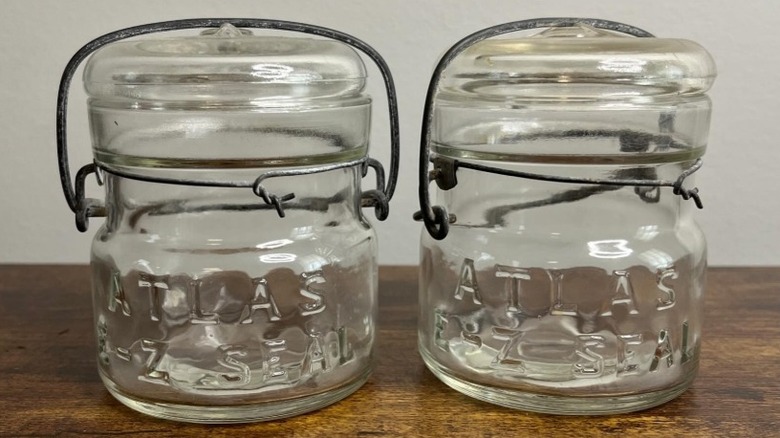
Mason jars were crucial for food preservation pre-refrigeration. Looking to simplify the canning process so people could more easily keep foods safe for longer periods of time, New Jersey tinsmith John Landis Mason developed a glass jar with a screw-top metal lid, the game-changer being a rubber ring underneath the lid that provided an airtight seal. It was a revolutionary invention, but unfortunately, Mason didn't patent his creation upon its debut in the 1850s. Companies like Ball began making their own versions. This included Hazel-Atlas, also famous for "Depression glass," which was inexpensive with bold colors and patterns.
From 1902 until the 1950s, one line of Atlas Mason jars featured a hinged locking system for the lid; they're stamped with "Atlas" over a line reading "E-Z Seal." From the 1920s to 1940s, another line boasted a "strong shoulder" to prevent breaks; these jars read "Atlas Strong Shoulder Mason." In the 1950s and 1960s, other Hazel-Atlas Mason jars featured an "H-over-A" logo between "Atlas" and "Mason." These jars all came in clear as well as shades of blue, green, and amber. Clear is worth about $5 to $15, aqua $10 to $25, green $20 to $60, and amber $50 to $100. Other colors signal inauthentic Atlas Mason jars, as do logos that look off. Vintage Mason-jar hunters know to look for particular numbers; similarly, make sure your Atlas Mason jar has a number on its base referring to its mold and production run.