

For Balanced Kitchen Cabinets And Drawers, Follow This Measuring Rule

Whether they're serving a family-style meal (Bobby Flay's favorite dinner hack) or brewing a cup of coffee (even using a single-serve coffee maker), many people will spend a significant amount of time in a kitchen throughout their lives. Because it's an integral part of your home, planning and designing a kitchen with balanced measurements can ensure plenty of room for movement and a polished aesthetic.
When you're measuring your kitchen cabinets and drawers, for example, you'll want to follow the rule of thirds — an interior design concept that involves splitting a room or surface you're designing into three parts (typically left, right, and center). Using the rule of thirds in a kitchen is a simple task that requires some precision in your measurements and visual trial and error.
For your cabinet and drawer pulls especially, you should test out your ideal placement to make sure you like the way it looks, that it feels balanced, and that nothing will obstruct the function of the cabinets or drawers. You can hold the pulls up and have someone stand a distance away so they can get a visual preview of how things may look when you fix them to the cabinets, or even use a temporary tool like removable glue dots to stick the pulls onto the drawers and play around with the placement before you officially measure.
The rule of thirds can lead to a more harmonious kitchen design
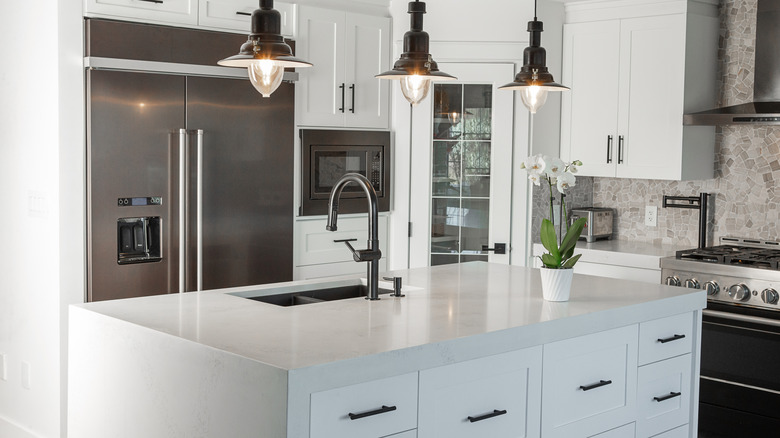
There are plenty of common kitchen design mistakes to consider when you're planning out this important room, and smaller details like cabinet pulls often get overlooked or given less priority. Even these seemingly minor elements can make or break the overall look and symmetry of your kitchen, however, so using the rule of thirds can help you install your drawer and cabinet pulls with confidence.
Using this measuring rule is just about as simple as it sounds, even when applied to kitchen pulls; when you're choosing your pulls, check to see if the length measures to about one-third of the cabinet door or drawer's width. For example, if your kitchen drawer is 12 inches wide, you'll want to look for a drawer pull that is 4 inches in length. Doing so can help you pick pulls that are both functional — easy to grip, for example — while remaining proportional to the cabinet or drawer so that they don't overwhelm the surface or appear too small.
One important tip to note: If your kitchen pulls have a certain design in which the center point is not perfectly aligned with the rest of the pull (aka not in one straight line), you want to measure the entire length of the pull rather than just measuring from the center. This can prevent you from installing it to the cabinet door or drawer with misaligned measurements.