

What Happens If You Add Oil To Your Vinaigrette Too Quickly

What brings a salad dressing together is the magic of sauce emulsification, a culinary sleight of hand where oil and acid, sworn opposites, somehow become perfect in their unlikely union. It's the Romeo and Juliet moment of the kitchen. The elements swirl, then finally merge into an unperturbed gloss, perfectly combined into a secret third thing that adheres to the greens like the star-crossed lovers meeting on the balcony. However, if the oil is added too quickly, all is lost, and the emulsification will break.
Watching vinaigrette come together as you whisk makes you feel like a wizard at work, but when the magic trick fails, it's a disruption in what should be a seamless, alchemical process. The oil globules float stubbornly on top or streak through the vinegar in broken, greasy islands. Instead of a creamy, balanced, and flavorful salad dressing, you get a bowl full of unruly, uncooperative elements, just puddles of acid and oil that would slide right off the lettuce. Beyond aesthetic concerns, a broken vinaigrette results in uneven taste, lost texture, and a salad that doesn't quite work.
The difference between success and disaster in vinaigrette comes down to science and timing. Oil and vinegar resist one another. Vinegar is water-based, oil is fat-based, and they repel each other at a molecular level. Emulsification works when oil is broken into tiny droplets and suspended in the vinegar, something that happens only with physical agitation and mental patience. Pour in the oil too quickly, and those droplets never form; the emulsion breaks before it begins. The key is to add the oil very slowly, whisking or shaking vigorously as you go.
The timely science of mixing oil and vinegar
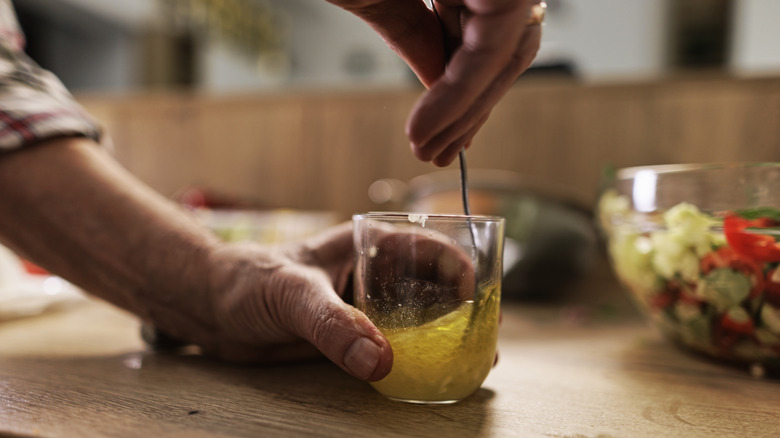
Making vinaigrette is a direct, instantly observable application of kitchen chemistry. Oil and vinegar are immiscible liquids that never truly combine at a molecular level, meaning vinaigrette is a heterogeneous mixture. So even when whisked or shaken, each element remains separate. This state is what scientists define as an emulsion: A mixture where one liquid is dispersed throughout another in small, visible particles.
The stability of this emulsion is temporary and entirely dependent on the energy you put into the mixing process. When you use the right type of whisk and add oil slowly, you break the fat into countless droplets that scatter throughout the vinegar. For a while, the vinaigrette looks unified, with a consistency that coats salad leaves and carries flavors evenly. However, if the bowl remains undisturbed, the droplets begin to find each other, merging and rising until the oil floats back to the top, and separation returns.
To extend this harmony, cooks often add emulsifying agents, like mustard, honey, or egg yolk. These ingredients contain molecules with one end attracted to water and the other to fat, acting as a bridge between the oil and vinegar. By surrounding each droplet, emulsifiers make it harder for the oil to separate, keeping the mixture stable for longer. Professional kitchens rely on these tricks to create vinaigrettes that hold up through service, staying glossy and well-blended. But no matter how skillfully you whisk or what agents you add, oil and vinegar remain two households, willing to share the bowl for a time, but always fated to drift apart.
Tips and tricks for making intact vinaigrette
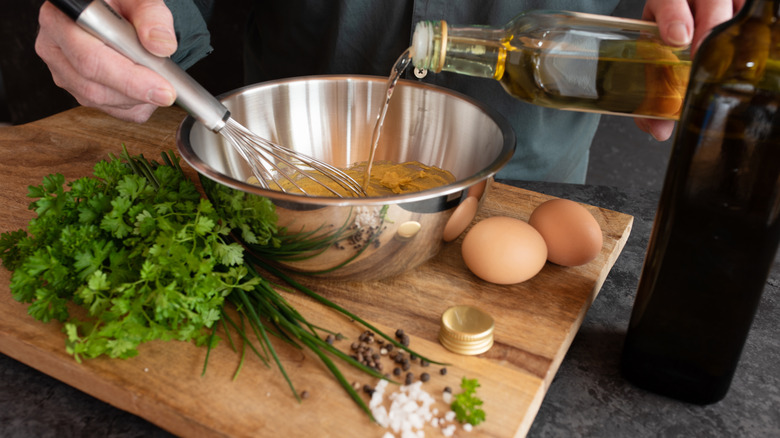
Yet, with all these techniques, every vinaigrette remains a delicate alliance. Sometimes, even a slow pour can leave you with a dressing that stubbornly separates. Usually, a quick whisk can reunite the two opposites when the vinaigrette breaks. Start by adding a small spoonful of mustard or honey, then whisk or shake vigorously to help the emulsion reform — an immersion blender can also work wonders in this process. If the dressing remains oily, try adding a splash of warm water or vinegar to give the mixture more volume to work with.
For home cooks ready to experiment further, there are more chemistry tricks to play with. Professional kitchens sometimes use ingredients like xanthan gum or lecithin, which are powerful emulsifiers that keep dressings stable for days, not just minutes. While not essential, these additions make vinaigrettes almost indestructible, ensuring a lasting, cohesive dressing.
Storage matters, too. Either make a single-serving batch or keep the vinaigrette in a sealed container and shake or whisk it again before serving if you notice any signs of separation. Cold temperatures can cause oil to solidify, so letting the dressing come to room temperature before serving helps revive its texture. Like any fragile peace, a good vinaigrette invites you to enjoy its unity before the spell breaks and each element returns to its nature.