

7 Popular Dishes That Originated In Ancient Greece

Without the ancient Greeks, our world would look completely different. They invented modern mathematics and were among the first to live in a democracy (although it was a male-only democracy, it's worth pointing out). Of course, they were also the ones to give us the Olympic Games, and they have been credited with influencing everything from philosophy to medicine to poetry. Without them, we may not even have alarm clocks or central heating. And, it turns out, on top of all of this, the ancient Greeks may have also influenced what we eat, too.
The ancient Greeks invented everything from kebabs to pea soup to cheesecake. Yes, that's right, without this ancient civilization, The Cheesecake Factory might not exist. Ancient Greeks also probably made the first energy bar, which makes sense, given their love for athletics. Keep reading to find out more about some of the most popular dishes still eaten around the world today that likely originated in the days of ancient Greece.
Cheesecake
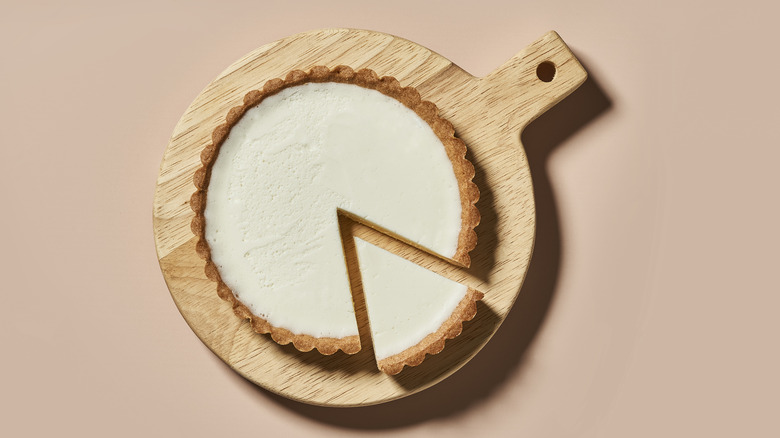
Cheesecake is one of America's most popular desserts. The creamy, sweet, rich, and indulgent treat is served in households and restaurants all over the country, but it's particularly loved in New York, where it has a long history. More than a century ago, restaurateur Arnold Reuben was believed to be the first to put New York-style cheesecake on the menu.
But cheesecake's roots date back even further than the 1920s. In fact, this dessert can be traced all the way to ancient Greece. Research suggests that in the 5th century B.C., people on the Greek island of Samos made cheesecake by baking fresh cheese patties with flour and honey. The dish would then be served at celebrations such as weddings and athletic events. Cheesecake was even on the menu at the very first Olympic Games, which was held in Olympia in 776 B.C.
The ancient Romans also ate a cheesecake-style dish, called savillum. It was made with goat's milk ricotta and sprinkled with poppy seeds. Some experts believe that even if the Greeks came up with cheesecake, it was this Roman version that ultimately made the dish popular around the world.
Kebab skewers (souvlaki)
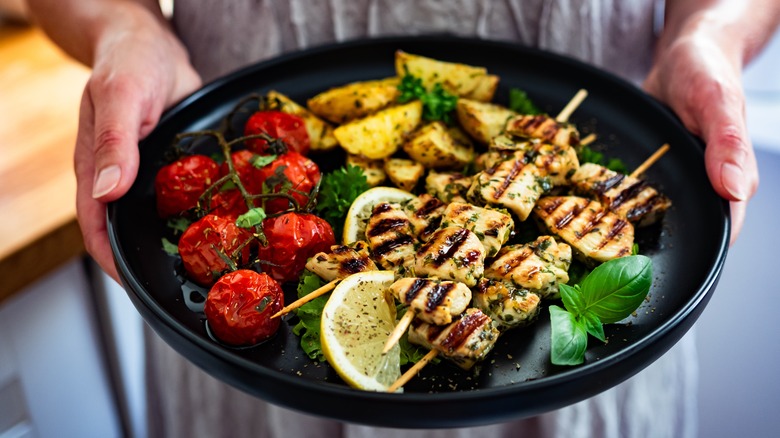
If you visit Greece today, you'll likely come across a type of street food called souvlaki. It's a simple dish that consists of skewer-cooked meat (or plant-based ingredients, depending on where you buy it from), usually served in a pita with salad, french fries, and tzatziki.
But while it's a modern-day favorite, souvlaki is nothing new. Greeks have been cooking meat on skewers for thousands of years. In fact, research suggests that ancient Greek philosophers like Aristophanes and Aristotle enjoyed souvlaki. Back then, they knew it as obeliskos, which comes from the ancient Greek word "obelos," which means "spit." To them, it was probably kind of like how we see McDonald's burgers today: fast and easily accessible when a craving hits.
Souvlaki hasn't evolved much over the years. In ancient Greece, it was served in a very similar way to today; the meat was removed from the skewer and then eaten with bread. While souvlaki dates back to ancient Greece, research also suggests that the ancient Romans and Turkish likely cooked and ate similar dishes.
Roast lamb

Roast lamb is a popular dish all over the world. In the U.K., Brits often eat it for Sunday lunch with gravy and vegetables. In Turkey, Kuzu Tandır Kebab is often made with roast lamb, while in Italy, Tuscan-style roast lamb leg is a favorite.
But research suggests that the Greeks may have been among the first to roast lamb. This was likely because in ancient civilization lambs were sacrificed every spring to honor the Gods. The meat from that sacrifice, as with many animal sacrifices, would then usually be eaten by the poor. The ancient Romans likely also roasted lamb. However, they may have learned this from the Greeks, as one of the oldest Roman cookbook recipes for roast lamb features specific quantities for each of the ingredients. Research suggests that Romans were not particularly big on attention to detail in their own recipes.
Roast lamb, called ovelias, is still eaten across Greece, usually at Easter time. Unlike with the street food souvlaki, which involves chunks of meat on a skewer, ovelias features a lamb that has been roasted in its entirety on a spit.
Pancakes

Every year, Americans eat around 75 billion pancakes, according to The PM Group. So it's safe to say they're a firm favorite, especially when drizzled with bourbon syrup or filled with berries. But pancakes likely didn't originate in the U.S. You guessed it: This morning treat probably has roots in ancient Greece.
The first written records of pancakes date back to Greece in 500 B.C. Back then, the Greeks were making pancakes with a simple mix of wheat, honey, and sour milk. They were called teganitai, which comes from the Greek word "tigani," which means frying pan. Today, Greek pancakes are called tiganites. Just like modern Americans, the ancient Greeks probably ate their pancakes for breakfast. There are also records of pancake-style recipes in ancient Roman cookbooks, too.
There is some evidence to suggest that even before the ancient Greeks, people were making pancakes. However, these were pretty different from anything we would make today. Stone Age civilizations likely used ground cattails and ferns, which were mixed with water and baked to create a kind of fried flat cake, for example.
Energy bars
Thanks to Athenaeus, a third century Greek author, we know a fair amount about what people were eating in the ancient era. In his book "Deipnosophistai," he wrote about banquets, recipes for dishes like grilled fish, and even how much a goat from Spain would cost you. We also know people were eating a dish called pasteli because the book references it multiple times.
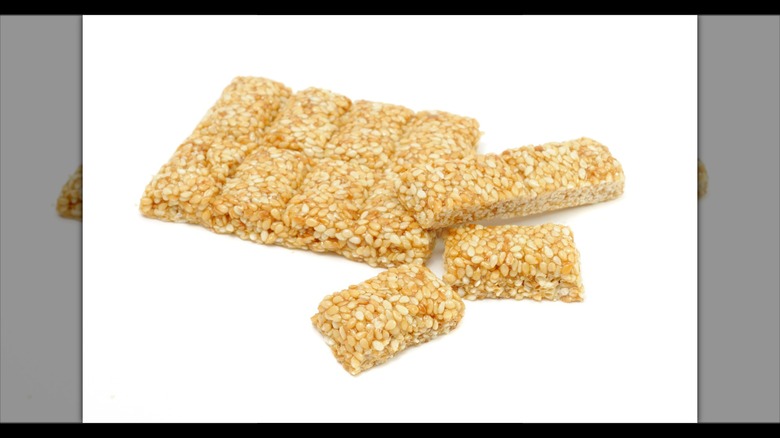
Pasteli was a sort of energy bar-type snack. It was a rectangular shape, made with a mix of sesame seeds and honey. It was likely eaten long before Athenaeus started writing books. In fact, some believe it was given to Greek warriors for energy during the Trojan War. However, it's worth noting that there is still some debate over whether this legendary war actually took place.
Regardless of whether or not it really was eaten by Greek warriors, the truth remains that pasteli has been eaten across Greece for centuries. And it's still eaten today, although recipes vary from region to region. In the north, for example, sugar is added to make pasteli bars even crispier, while on the island of Rhodes, orange peel is added for a fruitier taste.
Dolmades

Across the Mediterranean and the Middle East, dolmades are a staple on restaurant menus. The mezze dish is simple; it's just a vegetable (usually vine leaves or peppers) stuffed with ingredients like rice, herbs, nuts, and more vegetables. But this humble food has an incredibly long and rich history.
Dolmades were actually popularized during the Ottoman period. They were particularly loved by the sultans of the era, but people all over the empire enjoyed them. But the Ottomans didn't invent dolmades. Research suggests that this dish was first eaten by ancient Greeks. Again, it was probably enjoyed by royalty, as it was served at Knossos in Crete, in the Minoan palace.
Today, dolmades recipes vary from country to country. In Turkey, they're often stuffed with meat, for example, while in Greece, the dish is usually vegetarian. In Lebanon, it's made with spiced rice and beef and simmered in a lemon broth.
Split pea soup
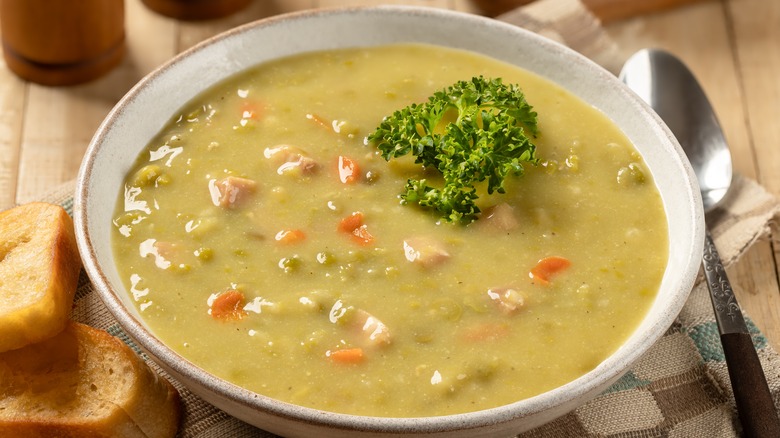
Soup has been eaten across civilizations for thousands of years. In fact, there is some research to suggest it was even eaten by our Stone Age ancestors. Back then, soup was probably made with boiled bones or grains. But over the years, people started turning many different ingredients into soup. Split pea soup, for example, has ancient origins and was sold beginning in the 4th or 5th century.
Split pea soup was likely also popular in Rome, where, much like in Athens, it was sold by street vendors. In fact, the ancient Greeks and Romans may have popped out for a bowl of soup for lunch in the middle of their day, just like we would head out from the office to grab a sandwich today.
Split pea soup hasn't fallen out of favor since the ancient era. It's eaten all over the world, and different cultures enjoy it in different ways. In Poland, for example, it's usually made with ham bone and marjoram, while in Finland, it's often served with a spicy mustard.