

10 Coffee Brewing Methods And The History Behind Them
When did coffee brewing become so complicated? The first documentation of humans consuming this bitter bean dates back to the 10th century, though not in the way we do these days. Initially, the berries were eaten whole. Later, they were fermented, ground into a pulp, and turned into wine. By the 1400s, Muslim pilgrims had spread their enthusiasm for the energy-boosting plant across the Middle East and North Africa. When it reached the cities of Europe, it became a sensation, with coffee houses springing up in Venice, Oxford, and Vienna.
Nowadays, according to the National Coffee Association, Americans consume nearly 1.7 million tonnes of coffee every year. 66% of us drink at least one cup per day, and of those people, the average is three cups per day. There are those who are happy to stir some instant coffee into a mug of hot water before dashing to work and those who set their alarms 15 minutes early to weigh and grind recently roasted coffee beans and pour them into the waiting funnel of a Chemex.
At upscale coffee shops, you might find that you have the option to watch your barista pour hot water from a gooseneck kettle into a Hario V60, work their magic with a mystically shaped siphon, or simply plant themselves behind the hissing and steaming La Marzocco espresso machine. Some of these methods might sound like shorthand for bougie 21st-century gentrification, but many of them have extensive histories that reach far beyond the last decade in Williamsburg and East Austin.
1. AeroPress

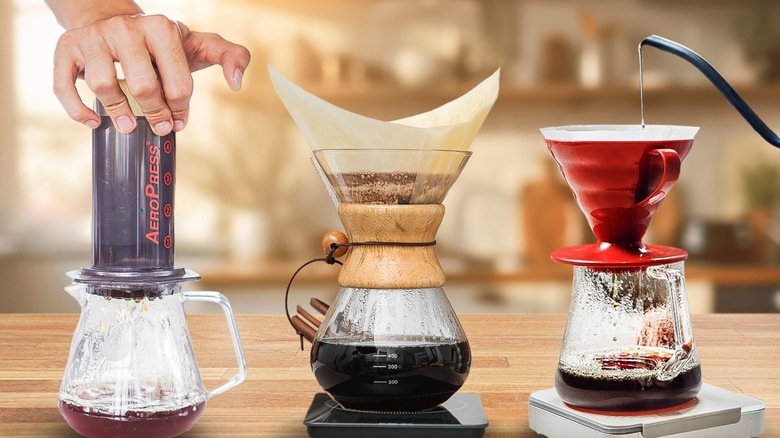
The AeroPress is a relatively recent invention that has proven to be remarkably popular considering how many other options there are. In 2005, engineer Alan Adler introduced the device at Coffee Fest Seattle. Displeased with the bitterness of other home brewing methods, he had come up with an idea that involved using pressure and immersion to produce the perfect brew.
Made of a cylindrical chamber with a filter on the bottom and a cylindrical plunger, the AeroPress draws on the principles of the pour-over brewing method and the French press. First, coffee grounds are placed in the chamber and covered with hot water. As the coffee drips through the filter and into your cup, you press lightly on the plunger, like you do with a French press.
Some people prefer to use the inverted method, in which the AeroPress is flipped over so that none of the liquid can filter into the cup before the steeping period is up, making it more similar to French press coffee than pour-over coffee. The result is a stronger brew because there is more time for extraction, but it is clearer and lighter-bodied than French press coffee because the filter removes some of the unappetizing oils that a French press plunger does not. Regardless of which method you use, the air pressure produced by the plunger speeds the brewing process, cutting back on the acidity and bitterness that you often get with brewing methods that require more time.
2. Pour-over
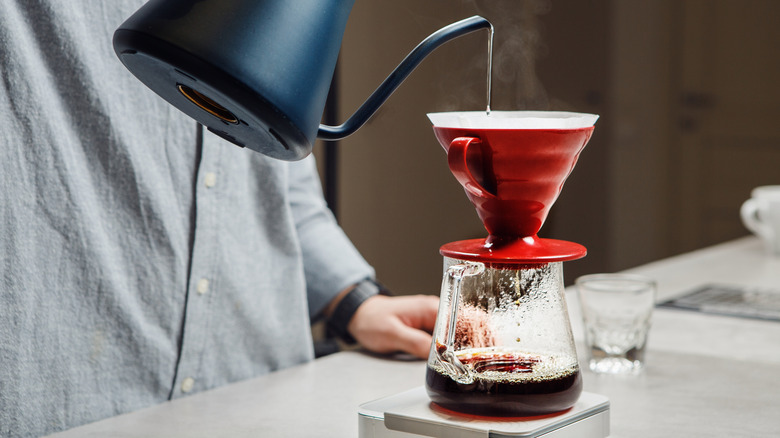
On the face of it, pour-over coffee is one of the most low-tech, no fuss methods of brewing there is, but people who use it can get remarkably precise about the particulars. The grind size, coffee to water ratio, amount of bloom time, water temperature, and even the pattern that you make as you pour the water are all subject to strong opinions. At its core, though, the pour-over method involves passing hot water through coffee grounds and a filter.
It was invented by Melitta Bentz, a German housewife who was dissatisfied with the coffee brewing methods at her disposal. Specifically, she couldn't stand the taste of the murky brew made from a stovetop pot and found the whole process of cleaning grounds off the sides tedious. So, she set about trying to make a disposable filter. Punching holes in a metal pot, she topped it with a piece of blotting paper from her son's school book, filled it with coffee grounds, and poured hot water over it. Coffee dripped through the paper and perforated pot into a mug, and the disposable coffee filter was born. In 1908, she patented her creation, and more than a century later, Melitta is a multi-billion-dollar company.
Whether you're using a Hario V60 or a Chemex, you have Bentz to thank for that light, clean flavor and lack of icky sediment, not to mention those extra moments of meditative pouring to buffer you from the start of your day.
3. Turkish coffee
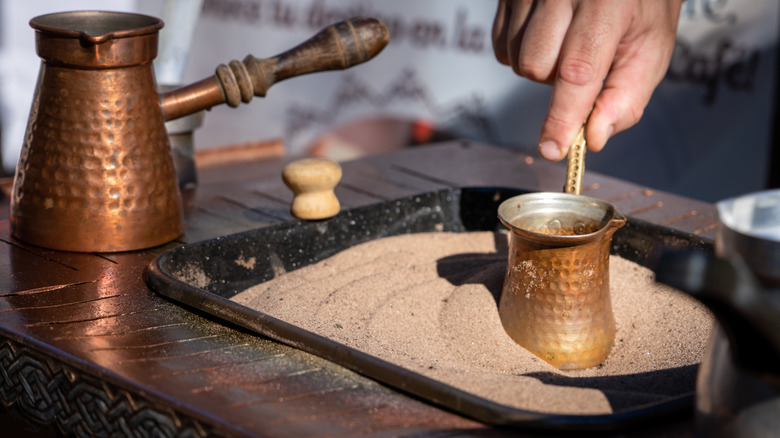
Coffee filtration has been a pretty consistent source of innovation over the decades, whether it's the kind that Melitta Bentz invented in the early 20th century or the one that Alan Adler invented in the early 2000s with the AeroPress. But Turkish coffee, a tradition that dates back nearly five centuries, doesn't use filtration at all. Instead, the beans are ground so fine that there is no need to filter them. Like hot chocolate, the powder is left in the drink.
That's not the only thing that makes Turkish coffee special. It's brewed in a copper pot called cezve and heated in a large bowl of sand over a fire. The sand allows for more evenly distributed heat. Instead of increasing the temperature of the coffee from the bottom or the top, you submerge the cezve in the sand to surround it on nearly every side. Sugar is sometimes added during this process, but unlike with other brewing methods, Turkish coffee doesn't involve dairy or creamer of any kind. Once the liquid begins to foam, it is distributed into small cups and served piping hot.
This brewing method has been integral to Turkish culture since the 16th century and has a ceremonial quality. It features heavily in holidays and wedding festivities, as well as in daily social life. The coffee grounds left in the bottom of the cup are also used to tell fortunes. Not surprisingly it appears on UNESCO's list of Intangible Cultural Heritage.
4. Moka pot

The moka pot is one of the easiest ways to brew coffee, and it has many passionate users. It is made of three main elements – a bottom chamber filled with water, a metal filter in the middle with a tube extending into the bottom chamber, and a top chamber that collects the brewed coffee. When put over heat, the water in the bottom chamber creates steam, which in turn creates so much pressure that the water is displaced through the tube, filtered upward through the coffee grounds, and pushed into the top chamber. All of that pressure creates a powerful brew that is a passable approximation of an espresso.
The handy contraption was invented in 1933 by Luigi di Ponti and perfected and distributed by aluminum manufacturer Alfonso Bialetti. It came at a turning point in kitchen implements. Its angular, octagonal shape was a bold novelty for the modernist era, and aluminum was just becoming the material of choice for kitchen wares. You might not find coffee shops that offer to make you a fancy brew in a moka pot these days, but in the 1930s, it was a revelation, allowing coffee enthusiasts to have a strong and not overly bitter cup of almost-espresso from home rather than having to go to the nearest café. It's stood the test of time, too. Even after the popularization of pour-over devices, the invention of the AeroPress and Nespresso, moka pots are still a ubiquitous kitchen device.
5. Percolator
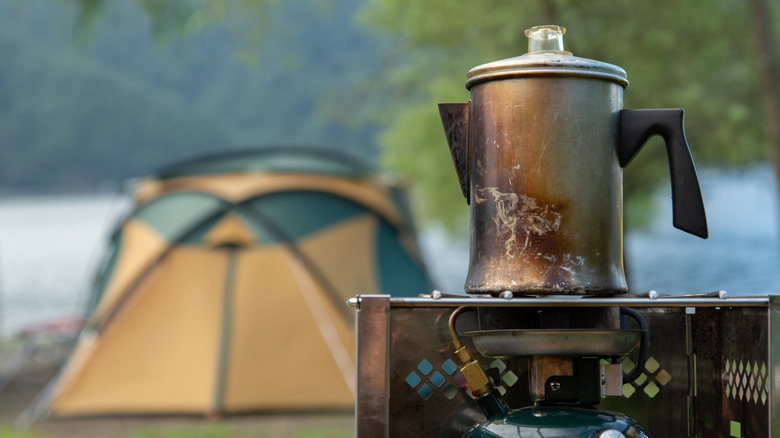
Ah, the percolator, the most dismissed coffee brewer of them all. It's made up of a water chamber at the bottom, a metal filter at the top that holds the coffee grounds, and a center chamber that holds the brewed coffee. When the percolator is put over a heat source, the water starts to steam, creating enough pressure to be pushed through a tube and deposited over the coffee grounds before draining into the main chamber.
It's a similar mechanism to the moka pot, but with one crucial difference: instead of collecting the brewed coffee in its own chamber, percolators continue to circulate the liquid back through the grounds until you remove it from the heat source. As a result, this method is notorious for producing bitter, over-extracted results that would make a coffee snob shudder. That said, it's hard to beat the convenience.
The contraption dates back to 1889 when Hanson Goodrich, the son of an Illinois farmer, took out a patent for his design. He boasted that it produced coffee free of grounds, and while Melitta Bentz would surely have disagreed, it was a relative statement. Before the percolator, the most common method for making coffee was similar to brewing tea without a tea bag. You would simply boil coffee grounds in water and do your best to separate them when they made it to your cup. The percolator might not have many fans in the barista community, but it remains the go-to device for many.
6. Espresso machine
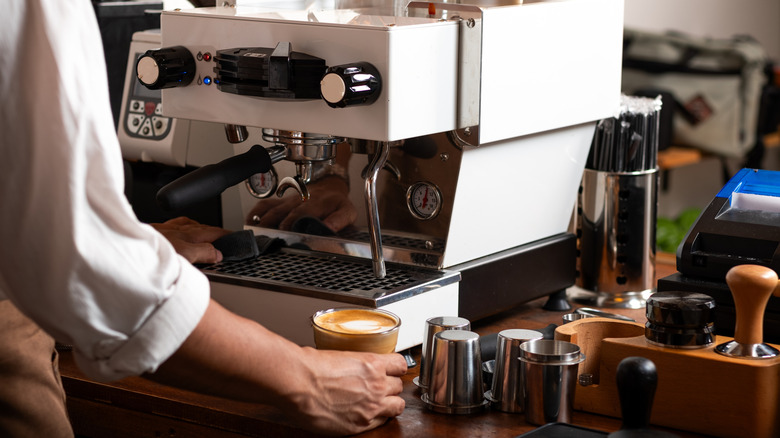
Have you ever been to a coffee shop and watched in awe as the baristas operate the bulky espresso machine and wondered how on Earth the thing works? You can make coffee with a funnel and a kettle, in the compact moka pot, and in a stove-top percolator. How could you possibly need such a large apparatus to produce those tiny shots of espresso? The answer, at least partly, is pressure. Where a moka pot might produce pressure as high as 2 bars, espresso machines operate at about 9 bars. A pump pushes the water into a heating chamber before it forces its way through a compact cake of ground coffee. There is also a steam wand connected to the heating chamber that is used to steam milk for drinks like cappuccinos.
The espresso machine was born out of a need for efficiency. In the 19th century, Europeans were wild about coffee, but there was a bottleneck at cafés because it took upwards of five minutes to brew. In 1884, Italian inventor Angelo Moriondo invented a steam-only espresso machine that managed to quickly produce coffees with a pressure of 1.5 bars. Other inventors tinkered with and improved upon his design, but it wasn't until after World War II that Milanese café owner Achille Gaggia managed to exceed 2 bars when he invented a hand pump component. In 1961, Ernesto Valenti invented an electric pump that could reach 9 bars, and the rest, as they say, is history.
7. French press
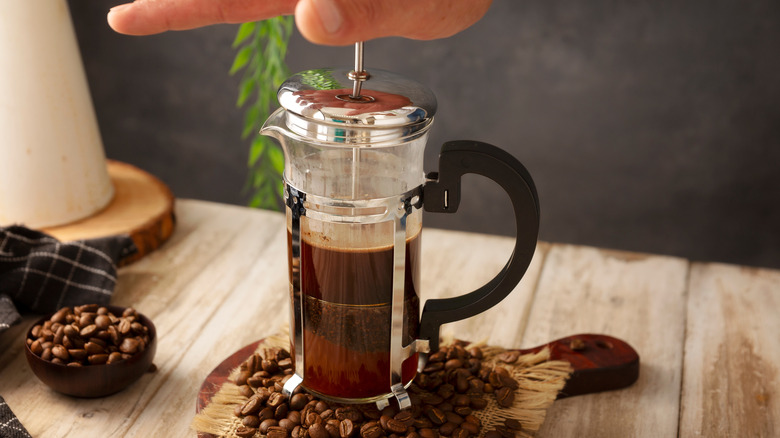
There is something deliciously simple and refined about a French press. Unlike an AeroPress, you don't have to read a manual to use it, and unlike a moka pot, you don't have to turn on your stove. All you have to do is put coffee grounds into the vessel, pour hot water over them, and depress the plunger after a few minutes. The filter on the plunger separates the grounds from the brewed coffee, producing your cup of joe in only a few steps.
There are documents showing that the French press (also known as the cafetière) was invented sometime around the 1850s by two Frenchmen, but it wasn't until 1928 that Italians Attilio Calimani and Giulio Moneta took out a patent on the device. Despite being such a simple mechanism, the French press has seen multiple design improvements over the years, including moving from a cheesecloth filter to a metal screen and adding a spring around the edge of the plunger to get the tightest fit. Swiss designer Faliero Bondanini created the version that we know today, with the glass vessel, short spout, and steel lid and frame.
French press coffee fills a perfect middle ground. Easy to use but less susceptible to over-extraction, it also has an edge over pour-overs by leaving in some of the oils instead of filtering them out. This isn't ideal if you're wanting to get the purest flavor, but it creates a smooth richness that many people prefer.
8. Cold brew
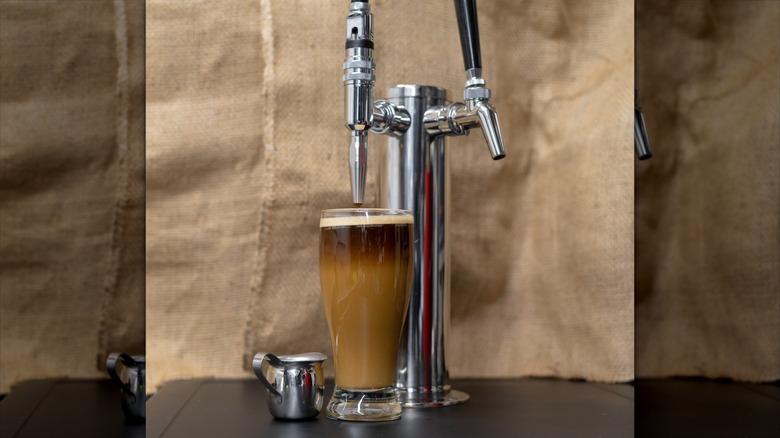
Perhaps you've seen cans of nitro cold brew coffee popping up in grocery store fridges and wondered how that very technical sounding beverage compares to your humble morning latte. Cold brew has risen in popularity in recent years, but its origins go all the way back to the 1600s. The method is in the name. Instead of brewing the coffee grounds with hot water, cold brewing involves steeping the grounds in cold water. This takes significantly longer, between 12 and 24 hours, but it produces a smoother, less acidic flavor than hot brewing. There are some types of coffee that are celebrated for their acidity, but if you prefer a sweeter, more rounded flavor, cold brew is tough to beat.
The process was pioneered in the 1600s by Japanese brewers. They had already been steeping tea in cold water, but Dutch traders inspired them to try it with coffee, too. Various styles of cold brewing cropped up over the following three centuries, including the famous Kyoto-style slow-drip cold brew, but it wasn't until the late 1990s and early 2000s that it began to catch on in the U.S. Things took another turn in the early 2010s when coffee brewers in Austin and Portland began to experiment with adding gas to the proceedings. Nitro cold brew is made by infusing the coffee with nitrogen through a draft tap. The result is black coffee that is so smooth and buttery it may as well be 90% cream.
9. Coffee pod machines
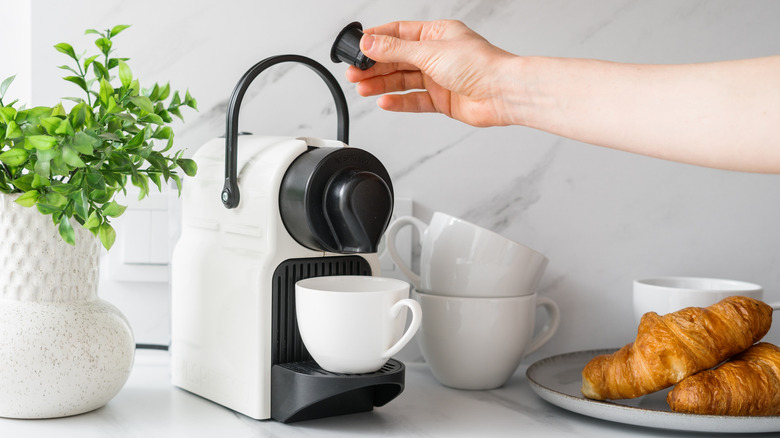
Even if you don't own one, you've probably resorted to a coffee pod machine at some point, whether it was in an office or at a fancy hotel. Nespressos, Keurigs, and other machines that fit this category are based on classic espresso machines. A pump pushes hot water through tightly packed coffee grounds, which in this case includes the plastic and foil casing that they come in. From there, the brewed coffee flows straight into your waiting mug.
Pod machines are probably the easiest brewing method out there. All you have to do is pop a capsule in the machine and hit a button or two. Because of this, coffee snobs often look down on it. You can't use freshly ground coffee and have very little control over the grind size, heat, pressure, and timing. However, the results are pretty close in strength to café-level espresso, though they will never top the expertly made brews that an experienced barista can achieve.
Nestlé engineer Eric Favre began tinkering with the idea of a rapid, easy to use, single-serve coffee machine in the mid-1970s, but it wasn't until 1986 that the Nespresso machine was patented and introduced to consumers. It wasn't an immediate success, but once the marketing department changed its target demographic from office workers to people at home, it took off. These days, nearly 60 billion coffee pods are used every year.
10. Siphon
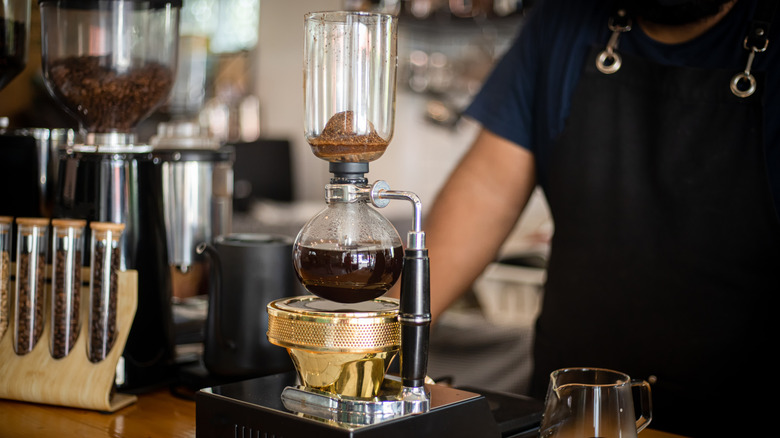
Nothing will inspire you to fork over a 75% tip for your barista like watching them work a siphon. This is not a method for those who want a quick morning brew or would rather not expend precious mental energy. However, if you've ever gazed wistfully at photos of scientists hovering over beakers and wished it could be you, it might be the perfect fit. A siphon brewer is made of two chambers, a lower one for water and a top one with a filter for the coffee grounds. When heated, the water creates vapor pressure and is pushed through a tube to the coffee grounds in the top chamber. When you remove the heat source, it creates a vacuum that sucks the brewed coffee down into the lower chamber.
The first siphon (also called vacuum) brewers appeared in Germany in the 1830s as an antidote to the bitter, astringent flavor of boiled coffee. Like the moka pot, the method separates the coffee grounds and does not over extract them as long as you carefully control the temperature. The resulting brew is clean and smooth. Within a decade, the design had been improved to be as decorative as it was functional, comprising two glass orbs with a metal crown on top which highlighted the esteem in which coffee held at the time. These days, siphons are more of a novelty than an everyday at-home brewing method, but they still produce excellent results when operated by someone with experience.