

Why Linoleum Floors Fell Out Of Favor And Why They Might Be Worth Reconsidering
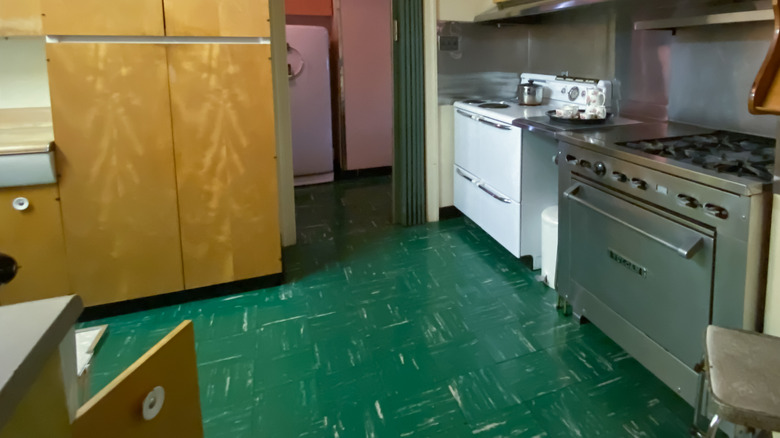
When you want to design a kitchen that doesn't soon look dated – less than ideal considering how pricy kitchen renovations can be — there are some materials you might instinctively avoid. For flooring, that likely includes linoleum. But have you ever stopped to wonder why that is, and whether the lack of linoleum love is actually warranted?
Linoleum was invented in England in the 1860s by Frederick Walton, who developed a formula of wood flour, linseed oil, cork dust, and other natural materials to create a more durable flooring material than was previously available. It quickly became popular because it was affordable, easy to clean and keep free of dust, long-lasting, and could come in different colors and patterns. In the mid-20th century, though, linoleum began to fall out of favor as other alternatives came to market. Vinyl flooring, for example, was appealingly cheap, easy to install, and also especially waterproof. Over the decades, design trends have pointed people in the direction of natural looks like hardwood flooring or luxurious choices like patterned tile. Just as with anything from a certain era that gets pushed aside by newer inventions and trends, linoleum came to be seen as outdated.
Similarly, though, trends tend to be cyclical, and things come back in style. Many people now, for example, are looking for ways to create a retro-chic kitchen. That includes reconsidering materials from the past, including linoleum. As it happens, linoleum is a sustainable choice and still more affordable than other options.
Linoleum is sustainable, affordable, and stylish
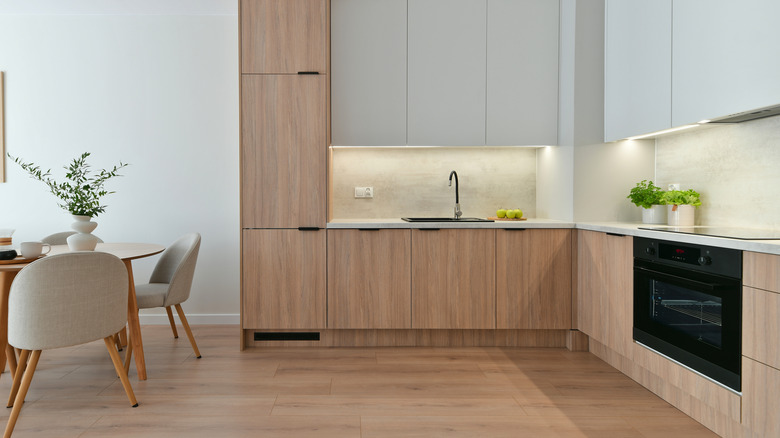
Many of us are now factoring in environmental consciousness when we do home renovations. Under this light, linoleum is an attractive option. While vinyl flooring is made from synthetic materials and is non-biodegradable, linoleum is a mix of natural materials, biodegradable, and free of chemicals that may impact air quality. Linoleum's materials, from the aforementioned cork dust to other elements like pine resin, are renewable resources that can be responsibly sourced. Its linseed oil even boasts antimicrobial properties, helpful for preventing bacterial growth in the kitchen.
Linoleum is also affordable, and if you can get a sustainable material in the color and pattern you want for your kitchen design at a lower price than that of other materials, it's hard to argue against the material. There are different types — it can come as "sheet linoleum" in a roll, "tile linoleum," and "plank linoleum" that interlocks rather than adheres. Depending on which you choose, linoleum ranges from about $250 to $600 per 100 square feet plus $140 to $350 for installation. Vinyl, comparatively, runs closer to $400 to $500 for 100 square feet, plus about $2 to $15 per square foot for installation. Aesthetically, linoleum flooring is a great way to mix modern and vintage elements in your kitchen, creating a uniquely stylish and ultimately timeless space. The low cost, durability, and sustainability all sweeten the deal, making it hard to imagine how this material was so uncool for so many years.