

Who Really Makes Mason Jars? The Brands — And History — Behind The Name

Walk into any American kitchen and you'll probably spot at least one Mason jar lined up on a pantry shelf or holding a handful of wildflowers on the table. It's easy to take these kitchen workhorses for granted because of their sturdy ubiquity, but the simple jar with a two-part lid helped change how people store food and organize their homes. Patented by John Landis Mason in 1858, the original Mason jar introduced a threaded neck and a two-piece metal lid that, together, made it possible to reliably preserve the harvest at home.
Before this innovation, home canning was risky business. More delicate wax seals and corks often failed, ruining entire batches of food or making those who consumed the contents ill. Mason's invention gave home kitchens a way to safely store fruits and vegetables, stretching pantry staples through the winter at a time before a globalized food system or commonplace indoor refrigeration.
Modern Mason jars are still made from thick, heat-resistant glass, designed to survive boiling water baths and pressure canning. Common sizes (half-pint, pint, quart, and half-gallon) fit every need from jam to soup. The wide mouth makes filling and cleaning simple, while measurement markings and interchangeable lids keep things easy and efficient. But who makes these jars today? The two most recognized names in the Mason jar world these days are Ball and Kerr.
Ball, Kerr, and the Mason jar legacy
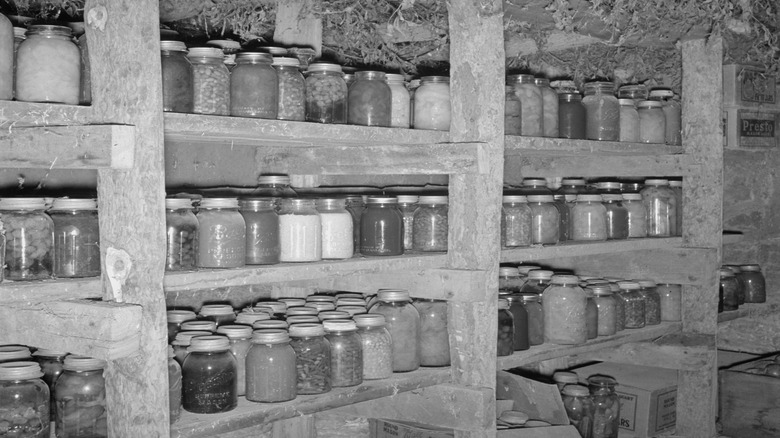
Despite being named for John Landis Mason, the Mason jars most use today rarely come from a company bearing his name. After Mason's patent expired in the 1870s, hundreds of manufacturers began producing similar jars, leading to a flood of variations and brand names. The Ball brothers, based in Buffalo, New York, began making glass jars in the 1880s and quickly became the most popular producer in the United States. Their name is now so synonymous with Mason jars that some use "Ball jar" and "Mason jar" interchangeably. Soon after, the Kerr Glass Manufacturing Corporation, founded in 1903, brought further innovations, like the modern one-piece, self-sealing lid that made home canning even easier.
Since 2016, Ball and Kerr are now brands under the umbrella of Newell Brands, a large American consumer goods company that owns other familiar names like Rubbermaid and Sharpie. Most Mason jars found in stores today, whether they're marked "Ball" or "Kerr," are produced by Newell in factories located across the United States. While a handful of smaller companies (like Bernardin in Canada) also make Mason-style jars, Ball and Kerr dominate the U.S. market. Despite decades of changing ownership and manufacturing methods, the design and reliability of these jars have remained largely unchanged.
The many modern uses of Mason jars
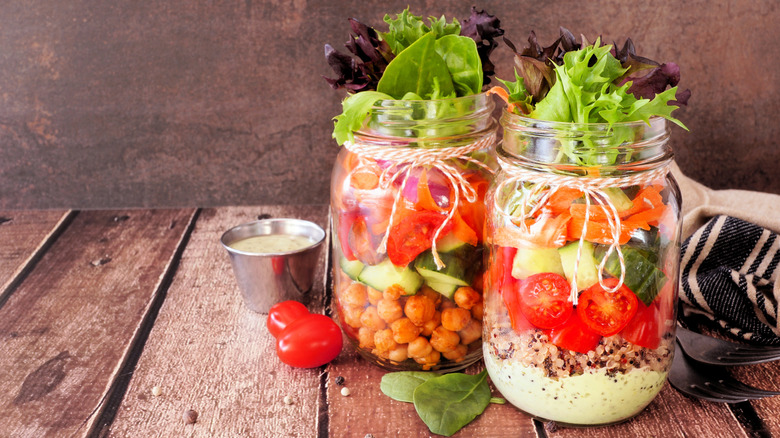
While the original purpose of the Mason jar was food preservation, today its uses have expanded far beyond canning. Because of their reusability, leak-proof design, and thick glass walls, Mason jars are ideal for storing leftovers and bringing meal-prepped lunches on the go. Because Mason jars can withstand both freezing and (careful) reheating, they're also useful for batch cooking and storing soups or stews. Additionally, they can even be used to keep batched martinis frozen or to store leftover wine.
Mason jars are widely used in the restaurant industry, where pint-sized jars are repurposed as rustic drinking glasses. They're also a favorite for homemade cold brew coffee, iced tea, or cocktails, as the jar's wide mouths make them easy to fill and clean. More than that, they're sturdy enough for daily use.
Outside the kitchen, Mason jars have become a go-to choice for countless DIY projects. They serve as vases, candle holders, bathroom organizers, and even as light fixtures when fitted with inexpensive lids and hardware. Because of their homespun aesthetic, Mason jars are also frequently chosen for homemade gifts, filled with layered brownie mixes or bath products. Their timeless design and practicality have made them an emblem of creativity and self-sufficiency.