

Things To Look Out For On The Label When Buying Canned Soup
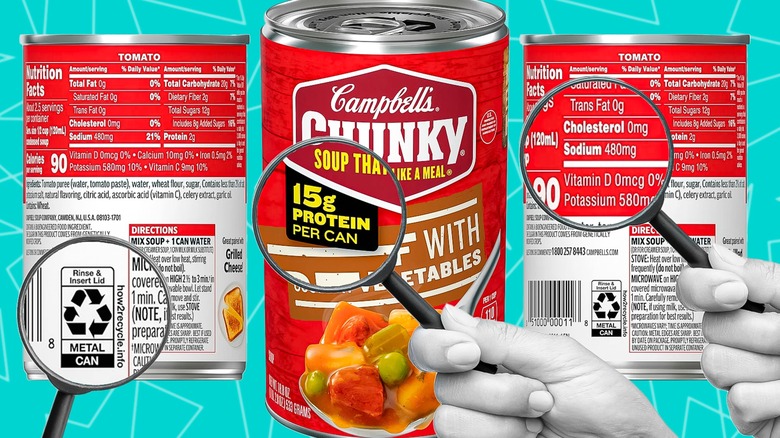
We may receive a commission on purchases made from links.
Nothing hits the spot quite like a hot bowl of soup. It might be the best when you make it yourself, but if you don't have the time or ingredients on hand to whip up your own hearty minestrone or easy chicken noodle soup, there are plenty of great canned options out there. It's arguably one of the best canned foods to keep on hand in the pantry. It lasts a long time; it's effortless to heat up, and there are easy ways to improve store-bought soup. Unfortunately, not all of those cans are created equal. Once you start reading labels, it'll quickly become clear that some are ultra-processed foods that might look healthy in the picture, but in truth, are anything but.
You may have heard that many canned soups contain a ton of sodium, but that's not the only thing you should be looking out for. Reading labels is key to making healthier choices at the grocery store, so let's take a good, hard look at soup labels. There are some things you don't want to see, and others will indicate that a particular canned good or brand is a healthier option. And don't worry, once you know what you're looking for, you just might find yourself checking out other ingredient labels with similar guidelines in mind.
Sodium content

One of the biggest problems with canned soup is its high sodium content, and that's something you may have heard before. Let's discuss specifics. We'll start by emphasizing that too much sodium has been associated with many health issues, including high blood pressure, heart disease, and a higher risk of developing certain types of cancers. According to the American Heart Association (AHA), the average American diet contains 3,500 milligrams of sodium per day, a long way from the recommended 2,300 milligrams and the ideal 1,500 milligrams.
Keep those numbers in mind, because we're going to take just a few examples. Snow's New England Style Clam Chowder contains 3,020 milligrams of sodium per can, and it's far from the only canned soup that's astronomically high in sodium. Campbell's Cream of Chicken Soup contains 2,175 milligrams per can, while the brand's Chunky Spicy Sausage Mac contains 1,720 milligrams per can. Even plant-based soups can surprise you: Gardein's Be'f & Vegetable Soup has 1,130 milligrams of sodium.
The good news is that there are low-sodium options out there. Health Valley Organic No Salt Added Minestrone, for example, has about 100 milligrams per can. That's the exception rather than the rule, though. Here's an easy guideline to keep in mind: To be considered truly low-sodium, the American Heart Association recommends a serving contain 140 milligrams or less.
Know the different names used to describe hidden sodium

If you're keeping an eye on your sodium intake, things can get pretty tricky quickly. Even canned soups labeled 'reduced-sodium' can still have high levels of salt. This is because sodium, while used to improve taste, also acts as a preservative. Checking a label for the word "sodium" is a great start, but other ingredients that are essentially salt might be written differently.
This includes additives like monosodium glutamate (MSG), which is typically added to enhance flavors. Another is disodium phosphate, which is commonly found in highly processed foods and usually stabilizes pH and acidity. There's also sodium phosphate, which is a thickener that prolongs shelf life. Furthermore, be on the lookout for sodium citrate, sodium nitrate or nitrite, sodium benzoate, sodium caseinate, and other sodium-related words. When these are added, they might be listed in the soup's ingredients. Look out for these, as well as reviewing the numbers indicating sodium content, and you might be surprised at how much salt a can of soup contains.
Check out the protein content
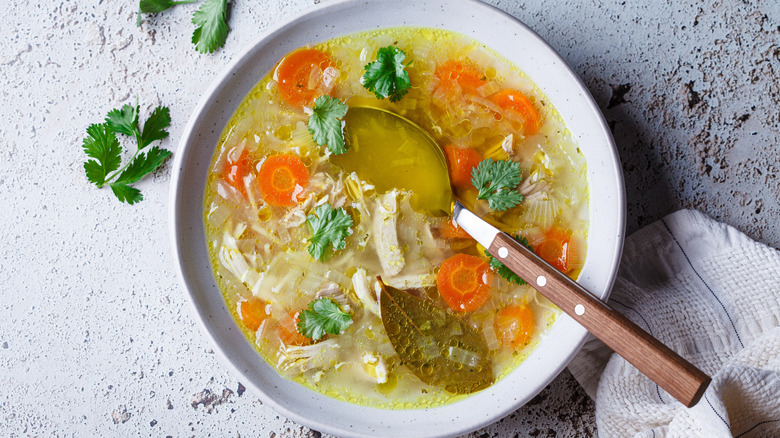
There's nothing worse than taking a lunch break, eating soup, then realizing immediately — or in an hour or two — that you're still hungry. Protein plays a large role in helping to ensure that meals leave us feeling satisfied, and there are a ton of other reasons to look for high-protein soups, too. Protein is crucial for building muscle tissue and maintaining bone health, as it helps the body to recover from minor and major injuries. It's also been associated with heart health. Guidelines for protein intake vary from individual to individual. However, between 46 and 56 grams per day is a good guideline. High-protein soups can be a great way to make sure you're getting enough, and some brands offer great options.
Progresso, for example, has a line of one-serving, high-protein soups. These include the Tomato Sausage & Lentil soup (23 grams of protein per can) and the Mediterranean-style Meatball & Chicken soup (20 grams of protein per can). That said, not all high-protein soups are an immediate and unconditional win. Campbell's Chunky Hearty Beef and Barley Soup has 20 grams of protein per can. However, read the fine print, and you'll see that it contains two servings, which means it also comprises 1,580 milligrams of sodium. On the other hand, Progresso's Tomato Sausage & Lentil comprises 680 milligrams, so you can see it gets tricky.
Thickening agents can be a sneaky source of saturated fat
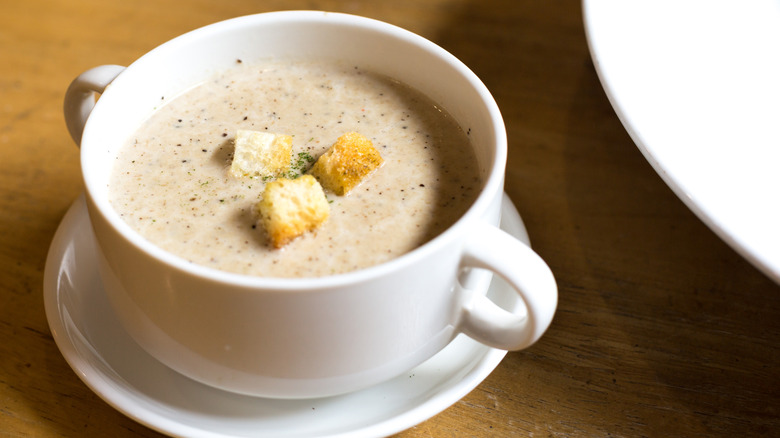
Some chilly afternoons or evenings are just made for a thick, creamy soup. When you make your own New England clam chowder using our recipe, you might use a bit of half-and-half and butter to thicken it. But when it comes to canned soups, thickening agents and ingredients often make up a large percentage of what goes into them. That might mean ingredients like cream, full-fat milk, and cheese, which can add high amounts of saturated fats.
There's still a lot of research being done on just how this particular kind of fat impacts the body. At the time of writing, there's some debate over whether saturated fats are as bad as popular science has long claimed. However, the key here is that, like many things, it all boils down to balance and moderation.
Saturated fats have long been linked to medical issues like high cholesterol and heart disease, and there's also a difference between the saturated fats found in fresh versus processed ingredients. What does that mean for canned soups? Creamy soups are of the biggest concern, and experts recommend looking for those that have less than 4 grams of fat per serving. It's that "per serving" footnote that's surprisingly important.
Double-check the serving sizes
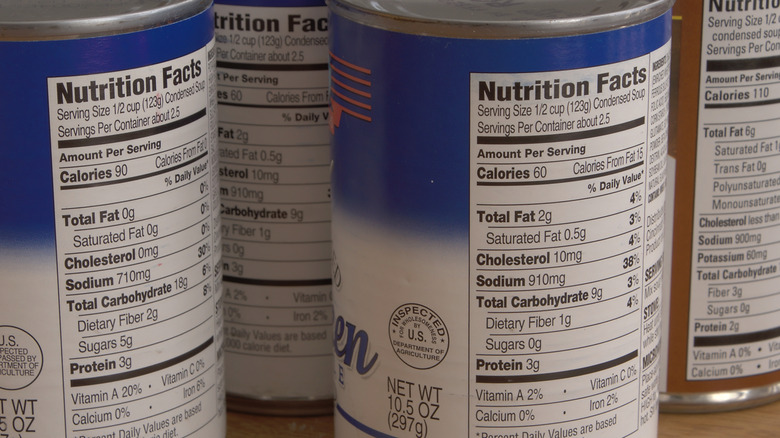
Serving sizes have long been a source of major frustration for anyone trying to monitor what they consume. This is especially true when foods get divided into serving sizes in a non-standard way. For instance, did you know that Crumbl describes one serving size of its cookies as a fourth or even a fifth of a cookie? Canned soup often does the same thing, and that can be incredibly frustrating. If you grab a can of soup on your way out the door to eat at your desk for lunch, you probably aren't planning on saving half for the next day. That one can of Campbell's Tomato Soup is actually 2.5 servings.
You'll sometimes see serving sizes described as about 2 or 2.5 per can. However, when you compare the weight of the can of soup to the serving size, you'll find that there's more than that number in each can. Serving sizes have long been problematic and hard to judge, especially when it seems intuitive that one can of soup should equal one serving. Sometimes, it does: Progresso's high-protein soups are described as having a serving size "as packaged." There are Reddit threads dedicated to discovering and understanding serving sizes for soups, as well as how they impact additives like sodium.
Look at the fiber content

Fiber is crucial to a healthy, well-balanced diet, and soups in general can be a great source. Some of the most popular, high-fiber foods, including beans and vegetables, make for tasty soups. Even though processed foods can be lower in fiber and other nutrients, we get that you might not have time to whip up your own herby ham and bean soup. So, check labels on cans, and a good guideline is to look for soups with at least 3 grams of fiber per serving.
There are plenty of options out there, with some passing that 3-gram minimum guideline. Pacific Foods Organic Vegetable Lentil Soup has 4 grams per can, and it makes sense — the second ingredient listed is lentils. Some of Amy's Soups are up there, too, with Amy's Vegan Split Pea Soup bringing 12 grams per container, while the Vegan Red Bean and Vegetable Soup has 9 grams per can.
There are a ton of benefits to adding this good fiber to your diet, with the most notable being that it keeps the latter half of the digestion process moving along smoothly. It has also been linked to regulating blood sugar and lowering cholesterol. Furthermore, fiber will help keep you feeling fuller for a longer period. This means your soup will be much more satisfying, and that's a win.
Look for added sugars

When Tasting Table ranked store-bought tomato soups, Campbell's Tomato Bisque came in last. Our reviewer found it was too sweet to an unsettling degree, and there's a good reason for that. Take a look at the label, and you'll find that it has 37.5 grams of sugar per can of soup. Alone, that number might not mean a whole lot, but let's compare. Six regular Oreos have 27 grams of sugar. If you're wondering what else has around 37 grams of sugar, that would be a single serving of Ben & Jerry's Cherry Garcia, which is about a third of a pint.
And that's the problem. You expect Oreos and ice cream to have that kind of sugar, but soup? Not so much. That can make soup an extra-sneaky source of sugar. It's worth mentioning that the American Heart Association notes that most Americans consume more sugar than they think, precisely for these kinds of reasons. AHA guidelines recommend limiting added sugar intake to 36 grams for men and 25 grams for women. That one can of tomato bisque is more than what's recommended for anyone's daily intake. Who would have thought tomato soup would come with so much sugar?
Judge a can's safety by BPA labeling and recycle codes
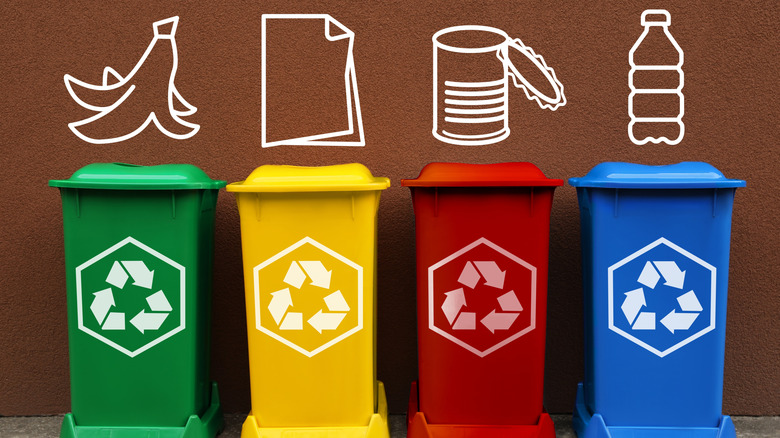
There's a good chance you've heard a lot about BPA in cans, and you probably know it's a bad thing. In a nutshell, it's a toxic chemical that has been used in lining cans for a long time. While a certain amount is deemed safe for food, high levels have been linked to health issues like high blood pressure, heart disease, as well as behavioral abnormalities and growth defects in children and infants. BPA is being phased out of many areas of the food industry, but it's still used in lining cans.
If that's something you're worried about, there's a sneaky way to determine the kind of linings and resins employed in sealing your soup cans: Look at the recycling codes. And yes, this works with all cans, bottles, and other product packaging. Recycling codes are used so centers know what materials are in a product, how it can be recycled, and what processes need to be employed. The numbers refer to resins. If you see the can labeled with a three or a seven, that's a pretty good indication that there's something in the can that can't be easily recycled. This could indicate that BPA or associated chemicals were used. It's not a guarantee (seven is frequently utilized as a sort of catch-all for compounds), but it is food for thought.
Bone broth can be a valuable source of added nutrients
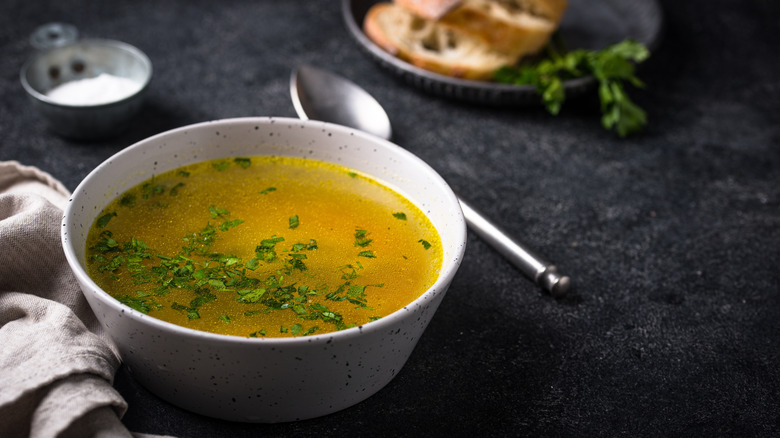
It's a well-known fact that chicken soup is a great pick-me-up when you're under the weather, and we're not being facetious here. There's a scientific reason chicken soup helps you feel better when you have a cold or the flu, and it has to do (in part) with the soup's ability to reduce inflammation. Broth, it turns out, is kind of magical. If you take the time to read labels and find soup with bone broth, you'll be getting even more benefits.
As the name suggests, bone broth is made from simmering bones in a broth. It's a process that leaves you with a liquid that's full of vitamins, nutrients, and minerals. Bone broth has been linked to maintaining a healthy digestive system, lessening inflammation, and contributing to joint mobility. Some studies even suggest that it could help with memory, relaxation, and sleep.
Stocks, broths, and bone broths aren't the same, so be sure to check the labels. Some bone broths — like Swanson's Sipping Chicken Bone Broth with Ginger and Turmeric — comprise ingredients like cabbage, celery, onions, and seasonings. It's meant to be heated and sipped from the container. It really doesn't get much easier than that.
Look at the kind of oil that's used

There are different types of cooking oils, from the ideal oils for salad dressings and the best finishing oils to those that add nuttiness and depth to dishes. When it comes to canned soup, you should definitely check the labels to see what kind of oil it contains. This is because, in some cases, you'll see hydrogenated (or partially hydrogenated) oil showing up in the list of ingredients. It's commonly used as a stabilizer, preservative, and to achieve a desired texture, but you may choose to avoid it.
Hydrogenated oils have been linked to increasing the risk of health issues like type 2 diabetes, chronic inflammation, as well as strokes and heart disease. Seeing hydrogenated oils on an ingredients list should be a red flag, but there are plenty of canned soups that use healthier kinds of oils. Progresso, for example, has statements asserting that it does not use partially hydrogenated oils or high fructose corn syrup in its soups. A quick look at the Creamy Mushroom Soup shows it's made with soybean oil.
Those with allergies should be familiar with hidden allergens
Although the purpose of food labels is to inform you about the contents of the product, it's worth mentioning that not all allergens may be plainly written. That's the case with canned soup as well as other products. Here's what's going on. We'll take Campbell's as our example, since it's a widely popular brand. On its website, Campbell's notes that it labels allergens "... present in any quantity ..." but also adds that at the end of the day, customers with allergies should check the ingredient lists. That's because there's always the possibility of hidden allergens, which has been a concern for a long time. Allergens might be contained in a product or labeled in a way that's not entirely clear.
Gluten is one of those ingredients that can show up in canned soups. Anyone with a gluten allergy might look for wheat or pasta, but labels that use couscous or malt also contain gluten. Arachis oil might trigger a peanut allergy, for instance, and others might react negatively to the seasoning or flavoring, which might not be clearly labeled. If you — or someone you're shopping for — has an allergy, do your research and become familiar with the sneaky ingredients to look out for.