

Ina Garten's Gardening Tip For Growing Mint Couldn't Be More Practical

Fresh herbs can completely transform a meal. Sometimes a sprinkle of chopped leaves might add a subtle fragrance, while at other times it may supply a sharp punch of flavor, but it always adds freshness and a pop of color. Still, buying fresh herbs at the store can be a pain. They are expensive, they spoil fairly quickly, and what you find on the shelves can be hit or miss for the dish you are hoping to concoct. All of these problems are solved, of course, by planting a garden filled with all the herbs you commonly use. Some herbs need a bit more care than others in the garden, as Ina Garten well knows. For her, mint is an herb of particular concern — though maybe not for the reason you think.
Mint is actually one of the easiest herbs to grow. It is so easy, in fact, that if you aren't careful, it can become rampant. "Unlike other herbs, I plant mint in big pots," Garten suggests on Barefoot Contessa, "otherwise, it would invade the entire garden!" Tucked away in a planter, your mint will be perfectly happy. Mint is, by nature, a hardy, or even rugged, plant. Even ignored, it often grows like a weed, giving you more fresh leaves than you know what to do with. So long as you keep it locked away with a physical barrier — like the walls of a pot or planter — it can't threaten the rest of your garden.
How to keep mint from taking over your garden
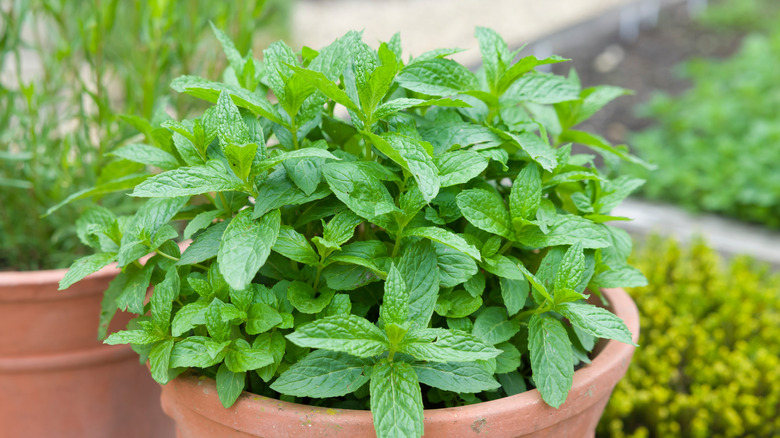
The problem with mint is that it primarily spreads not by seed, but by runner and rhizome. As soon as mint takes hold in your garden, it begins sending out runners in all directions, spreading above ground, rooting as they go, and sending up new stems. The rhizomes store nutrients and disperse underground, sending up another wave of new plants. Pretty quickly, a single mint plant can transform into a dense patch of the fragrant herb. In addition to allowing mint to spread quickly, these runners and rhizomes also make it difficult to eradicate — or even slow. Just like you can often regrow store-bought herbs from just a stem, each bit of mint rhizome left in the soil can quickly become a healthy plant, eager to begin spreading once again.
Mint is a great herb to have on hand. It has many culinary uses and can even help repel ants and moths from your garden. But careful planting is important. You can stick to Ina Garten's method, planting mint in aboveground containers, or you can limit its spread in other ways. If you don't like the look of large pots for growing mint, try sinking the pot into the ground with only the very top poking out. The mint will look like it is planted directly in the soil, but the pot walls will prevent it from spreading outward. The other option is simply to pick an area that is already contained. For example, if you have a space outside your house that is surrounded by a walkway, this will also keep the mint penned in.
What to do with all that mint

The aggressive spreading potential of mint is a definite downside when it comes to planting it in your garden. But the upside to mint's vigor is that once you have some in the ground, you will never find the herb in short supply. Once that mint patch really takes root, you're going to need all the tips you can get for cooking with mint. Fortunately, there is no shortage of uses for this robust perennial.
The cooling nature of mint is most often paired with sweet flavors — and there's really no arguing with it. Mint chip ice cream is a top flavor, but it really doesn't hold a candle to the elegance of a mint and pear sorbet. For something simpler, try this mint and melon fruit salad. Mint often shines in drinks, too. Little is better on a hot day than a refreshing mojito cocktail, and its alcohol-free cousin, mint limeade, isn't bad either. You can also fall back on classics like mint juleps and mint tea to work your way through all that roughage.
Of course, one of the lovely things about mint is that it is also at home in savory settings. Whether you are using it to whip up a quick mint and almond pesto, stirring it into a fragrant and cooling yogurt sauce, or blitzing it with ginger for this baked ginger and mint cod recipe, it clearly is an herb that can adapt to many settings, both in the kitchen and the garden.