

12 Discontinued Candy Bars Fans Miss The Most

Picking a favorite candy bar can be harder than picking a favorite band or movie. Maybe yours was the one you always grabbed at the checkout counter or the first thing you dug out of your Halloween bag. Unfortunately, some of those favorites have disappeared from candy shelves for good.
Some of these candy bars were beloved by generations. Others hit it big in their first few years only to fizzle out quickly. All of them have been permanently discontinued — and a lot of people still have big feelings about it.
As a note, we are focusing primarily on candy bars that were specifically popular in the United States (that doesn't mean they weren't also available and popular elsewhere). Further to that point, we only considered candy bars that have been discontinued globally, not those that are no longer for sale in the States but are available in other countries.
Butterfinger Crisp
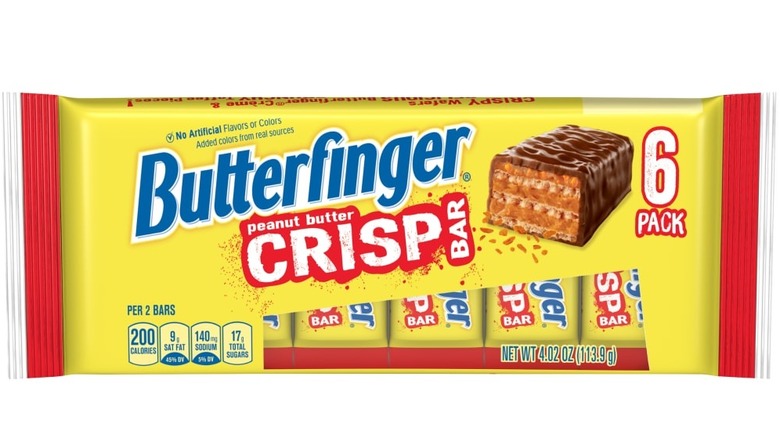
Despite being one of the most iconic American candies, Butterfinger has struggled to become an entire family of treats in the same way, say, M&M's have. Butterfinger BBs were discontinued in 2006, and the Butterfinger Crisp met the same fate by 2015. It has proven difficult to recreate that crispety, crunchety, peanut buttery flavor outside the OG.
To be fair, Butterfinger BBs weren't without their issues — they were notoriously prone to getting melty and messy. Actually, Butterfingers themselves aren't perfect, and Butterfinger Crisps managed to improve upon their parent candy's biggest issue. "Butterfinger crisp was superior because it wouldn't stick to your stinkin' teeth," a Redditor noted. And that sentiment was echoed by several others on Reddit, who all complained about the way the center of a Butterfinger would cement itself to your teeth and loved that Butterfinger Crisp solved that problem.
Elsewhere on Reddit, someone compared Butterfinger Crisp to Reese's Sticks, which were likewise a Reese's Cup turned into a Kit Kat dupe, and noted the former's superiority. "Agree with someone else saying the next best thing is Reese's sticks — good but still not in the same league as Butterfinger Crisp, the GOAT candy bar."
Milkshake Malted Milk Bar
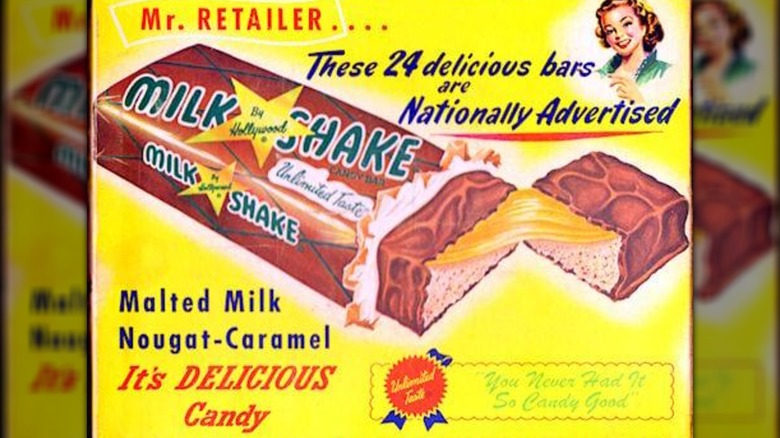
Unfortunately, malted milkshakes just haven't maintained the popularity that they enjoyed in the first half of the 20th century. Likewise, chocolate malt-flavored candies also fell off the map as newer generations didn't have that built-in affection for or awareness of the flavor. And one of the casualties of that cultural shift was the Milkshake Malted Milk candy bar.
With a history that goes all the way back to 1927, the Milkshake bar attempted to replicate a malted milkshake with its fluffy nougat center coated in chocolate. Later versions would also have caramel, making it very similar to a Milky Way, but that wasn't true of the initial recipe — the whole thing was supposed to remind you of just a chocolate malt milkshake specifically, hence the name.
The Milkshake bar was quite popular, surviving well into the '90s before ultimately being discontinued in 1996 after its parent company was acquired by Hershey. Given the Milkshake bar's long history, it's somewhat surprising that Hershey didn't keep it around after the acquisition. But sometimes there is only room for one specific configuration of a candy bar in the candy aisle.
Summit Cookie Bar
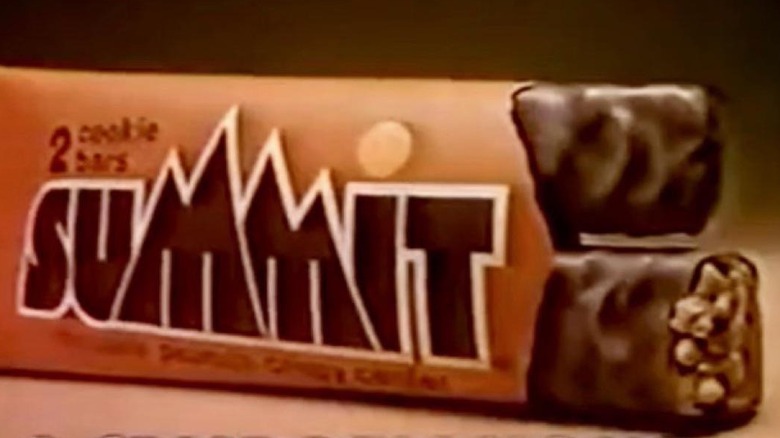
Here's another loose attempt to beat Kit Kat at its own game. But at least the Summit Cookie Bar brought a fairly unique twist to this goal, taking the chocolate-coated wafer of a Kit Kat and combining it with the cookie-stick approach of Twix, while also adding peanuts to the mix.
Introduced in the late 1970s, Summit immediately faced a pretty significant flaw. While you'd think a major corporation like Mars would make sure to test something like this before sending a product to market, Summit bars were incredibly prone to melting. A person interviewed by a newspaper in 1983 claimed that storing Summit bars in a refrigerator was the only way to prevent the issue. Mars also made a recipe tweak shortly into the Summit bar's life by upping the amount of chocolate, but it did little to help. The Summit never made a huge splash and was gone by 1991.
Even so, plenty of people have fond memories of Summit bars. "Summits came out when I was in middle school and I absolutely loved them. I would pay some darn good money for a box of those," wrote one Redditor. "That was a great candy bar," enthused another.
Nestlé Alpine White Bar
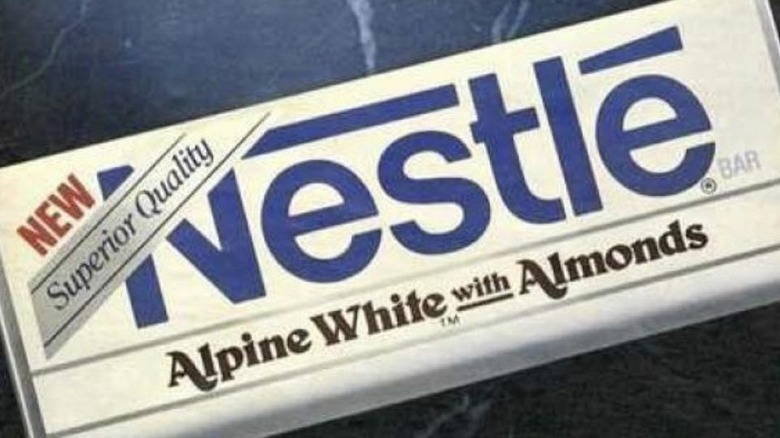
Anyone who lived through the '80s knows exactly what it means to say Nestlé Alpine White bars still give fans sweet dreams. Sure, some of it is because the bar was a luxurious combination of white chocolate, chopped almonds, and a hint of vanilla. But it's also because of that charmingly ridiculous commercial with its overly dramatic song, feeling more like an ad for designer French perfume than a candy bar. If that commercial aired now, it would be intended as intentionally campy and "ironic," but this was the '80s — it was 100% earnest, we assure you.
The marketing for Nestlé Alpine White bars felt very much aimed at adults. This differed from a lot of candy bar marketing at the time, typically full of catchy jingles, cartoon mascots, and tie-ins with family movies and TV shows. Nestle was so committed to the campaign, and its intended grown-up demographic, that singer Sophie B. Hawkins eventually sang the aforementioned song herself in another ad a few years later.
In a post about the candy bar on Reddit, it's clear a lot of people loved it. "THESE WERE SO GOOD!" reads one comment, and "Oh baby — this one was my favorite [...] No other white chocolate bar has compared since," writes another. Even so, the Nestlé Alpine White — and those amazing commercials – were gone by 1993.
Caravelle
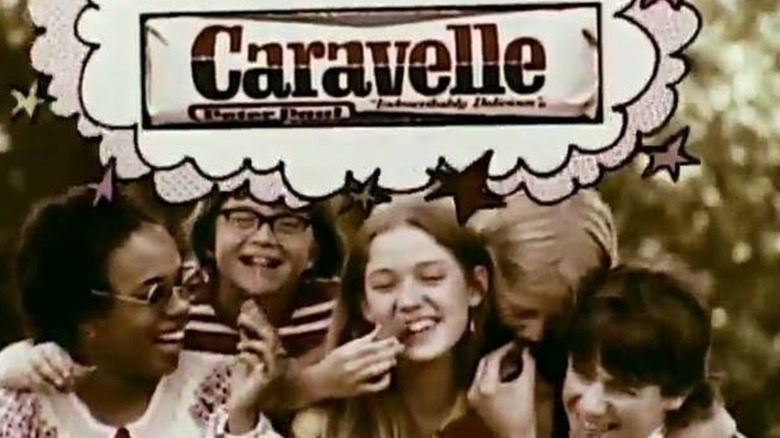
As we said before, sometimes the candy aisle isn't big enough for multiple specific types of candy bars. And that is apparently the case for candy bars containing crisped rice and gooey caramel coated in milk chocolate, as 100 Grand Bars live on while Caravelle Bars didn't survive beyond the end of the 1970s. As for why the latter was pulled, you can thank Cadbury, as the candy bar became one of the casualties of the company's acquisition of Caravelle maker Peter Paul.
In comparing Caravelle with 100 Grand, some say Caravelle's caramel was softer and creamier. The downside was that Caravelles had a bit of a shelf-life problem similar to the Summit Bar, which might also be part of why Cadbury didn't keep Caravelle in its portfolio. But fans of Caravelle didn't seem to notice or care about its structural integrity or lack thereof, as that doesn't tend to get mentioned when people are reminiscing about the candy bar.
In a post in the Facebook group Vintage Candy, someone said simply, "My favorite candy bar was the Caravelle." And the replies were equally enthusiastic and to the point: "I loved these," "fantastic," "they were really good," and "loved Caravelle," to name a few. There was also further confirmation that people preferred Caravelle to its rival, with one person commenting, "Better than the 100,000 bar."
PB Max
Now this is a strange one. To this day, '90s kids mourn this snack, one that was a huge commercial success immediately following its 1989 launch. So, if PB Max sold well and people liked it, why was it pulled after just five years on sale? Apparently, it all came down to its parent company just not particularly caring for peanut butter.
As explained by the book "The Emperors of Chocolate: Inside the Secret World of Hershey and Mars," the Mars family simply weren't fans of peanut butter, owing to the generation of Marses that were in charge at the time growing up in England, where peanut butter isn't nearly as beloved as it is in the U.S. They kept peanut butter out of almost every one of their candies, with a particularly notable exception being Peanut Butter M&Ms — but not before those spent a decade being pitched before the Marses finally signed off on them.
And so, even with PB Max doing extremely well out of the gate, the Mars family's aversion to peanut butter ultimately overruled how their own customers felt about the candy bar. To this day, people consider PB Max one of the best discontinued candy bars of all time, and many call out the Mars family in their mourning of it. "The Mars family killing it over peanut butter still hurts. PB Max was genuinely the perfect candy bar," wrote one user on Reddit.
Hershey's S'mores Bar
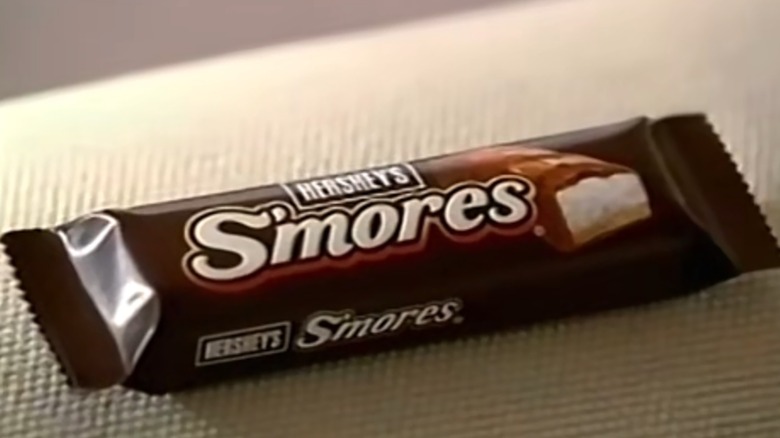
It's difficult to pin down a definitive origin for the s'more, but the general consensus is that a Boy Scout handbook released in the 1910s marked one of the earliest printed recipes for the iconic treat. Hershey also helped popularize affordable chocolate bars around that time, making its chocolate a natural choice for s'mores. With all that in mind, it's shocking that it took all the way until 2003 before Hershey finally released a straight-up S'mores candy bar.
To achieve the flavor profile of its titular campfire dessert, Hershey's S'mores bar contained marshmallow creme nougat and a layer of compacted graham cracker bits, all coated in that trademark Hershey chocolate. Unfortunately, Hershey decided that this would be the perfect time to also do a marketing blitz for traditional s'mores, advertising the use of the classic Hershey Bar along with graham crackers and marshmallows and even selling a machine that let you make them without a campfire. The S'mores candy bar got lost in the shuffle but still managed to remain in stores until 2012.
With s'mores-flavored treats and candies having a moment right now, it seems like a great time to revive the Hershey's S'mores bar, especially with so much ongoing online chatter from folks who miss it greatly.
Powerhouse
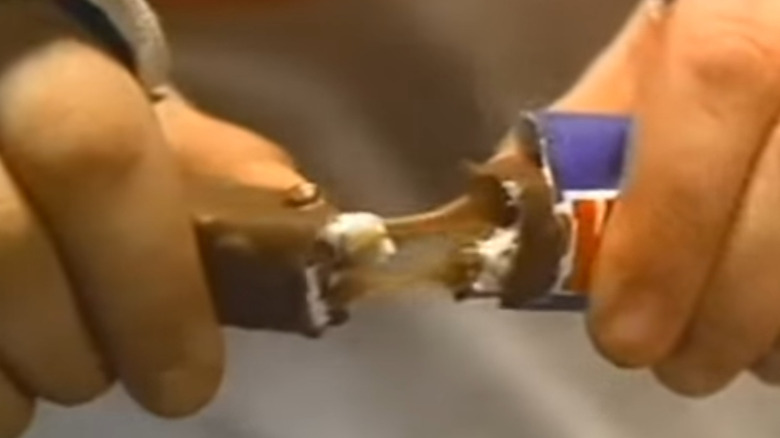
Before actual protein and energy bars first started hitting the market in the mid 1980s, candy companies would push mostly regular candy bars with just the tiniest bit of extra protein to athletes. Such was the case with the Powerhouse Bar, which first debuted in 1935 and was marketed as being more filling than the typical candy bar. Containing fudge, caramel, and peanuts all coated in chocolate, it seemed pretty much like any other candy bar with the exception of how dense the fudge was.
Going into the late '70s and early '80s, Powerhouse's advertising further drilled down on it being something that athletes would want to munch on as a satisfying, energy-boosting snack. One 1982 ad showed a football player and a boxer talking up the Powerhouse Bar as something they eat to fuel up before a big game or match. Despite all the effort, the Powerhouse Bar was discontinued just six years later.
A candy bar that was around for over 50 years clearly had its fans, but do any of them still remember it? Indeed, several replies to a post in the Vintage Candy Facebook group do: "That was one of my favorites, why do they always discontinue the good ones," asked one, and "I loved that candy bar. Sure miss it," plus a sad emoji, relayed another.
Willy Wonka's Super Skrunch
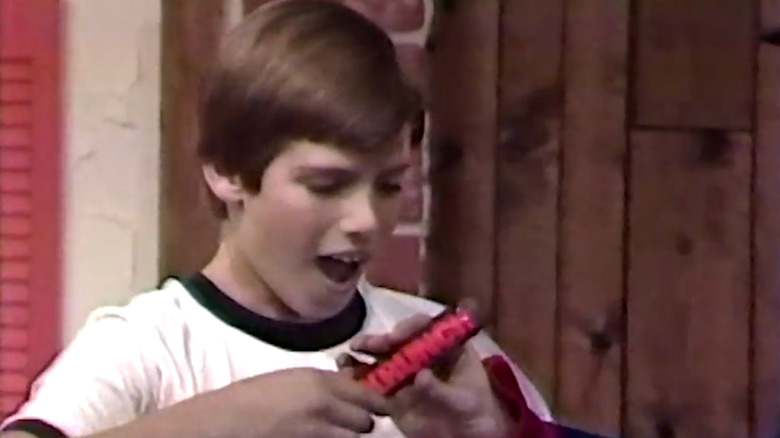
Life imitated art alongside the release of 1971's "Willy Wonka and the Chocolate Factory," with a number of iconic movie-inspired chocolate bars and candies hitting stores with Wonka branding. Interestingly, real life versions of actual candies from the film — like the Everlasting Gobstopper and the Wonka Bar itself — wouldn't come until later, with the initial batch consisting of entirely new creations that weren't present in the film. And the first traditional candy bar in that line was the Super Skrunch.
The original Super Skrunch was creamy peanut butter and crisped rice coated in chocolate. The bar would subsequently see multiple tweaks to its ingredients (actual peanuts were added later), its size (it was eventually made almost 50% bigger), even its name (from "Super Skrunch" to "Skrunch" to "Willy Wonka's Peanut Butter Bar") — in spite of only lasting until around 1982. This perhaps suggests that it was never a huge seller, but people certainly remember it, and fondly.
In a post in the nostalgia Facebook group 1970s Memories about the Super Skrunch, the original poster raved, "There should've been a law against somethin tasting so GREAT." Multiple people agreed, calling Super Skrunch bars "delicious" and "so, so good."
Seven Up
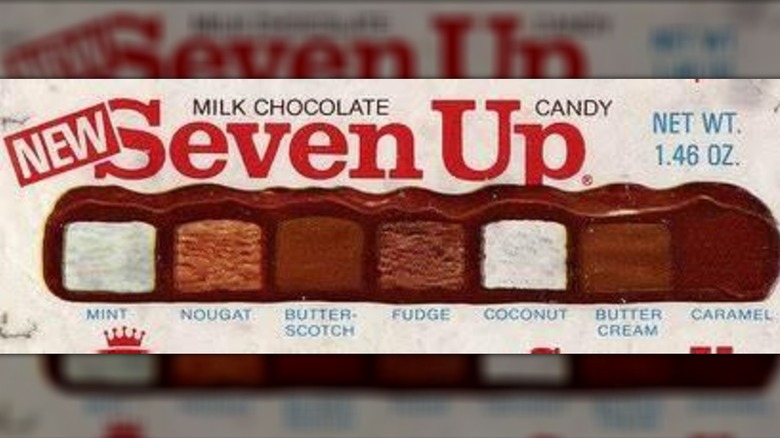
Most people know that the original 3 Musketeers candy was way different, originally coming as three smaller bars that each had a different flavored nougat. It's not hard to figure out why they would've wanted to simplify things and just have one big, single-flavored bar instead. But when it came to the Seven Up bar, which was a single bar divided up into seven separate compartments that each had a distinct filling, there was no such streamlining effort made in later years. Instead, the candy bar was just nixed entirely in 1979. It also didn't help that Seven Up bars shared a name with a certain lemon-lime soda, which left the candy bar in a trademark dispute with the company behind 7UP soda during the 1970s.
In a post in the Facebook group ChinDeep, someone posted about missing the Seven Up bar. "I miss these sooooo much, was always my favorite," one person replied. "Was my fav! As they bring vintage candy back I keep checking if Seven Up is one of them. Not yet," lamented another.
Marathon
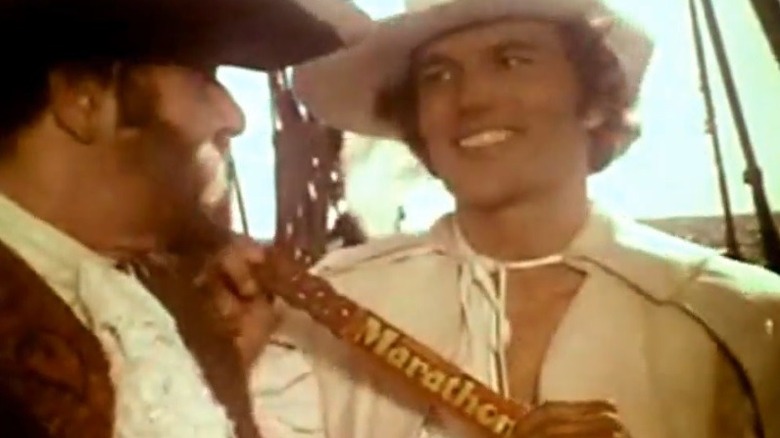
You have to give the Marathon Bar props for trying to be something truly unique, and not just honing in on some existing candy's gimmick and trying to either outright copy it or put some spin on it. There aren't many candy bars that are instantly identifiable on sight, but you knew a Marathon Bar when you saw it — it was long, thin, and full of holes. At eight inches, it was also a fair bit longer than most candy bars, and its wrapper was made to look like a ruler to reinforce this fact.
Marathon Bar's individuality didn't stop at its looks, however. Its slogan was "The candy bar you can't eat quickly," owing to it being filled with incredibly chewy latticed caramel. That's where the candy got its name, in case you haven't already pieced that together. Unfortunately, the Marathon Bar wouldn't live up to its promise of longevity in terms of its actual lifespan. It was introduced in 1973 but was gone just eight years later.
In addition to being a favorite of actor Adam Sandler, who was still talking about them as recently as 2024, it seems that the Marathon Bar earned a lot of fans despite it not being around for a particularly long time. "I think from the ages of 7-10 I had one of those every day," one person on Reddit said. If only all kids in the '70s were as enthusiastic about Marathon Bars, maybe they could've stuck around, pun intended.
Choco'Lite
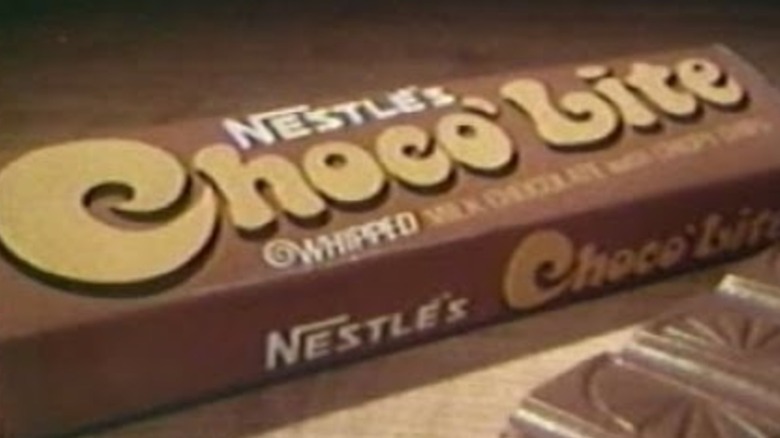
Aerated candy bars are all the rage in Europe. In fact, some of the best Cadbury chocolate bars are made with aerated chocolate. Every now and then, there is an attempt to bring an aerated candy bar to the U.S., but they never seem to catch on in the same way on this side of the pond. Case in point: Nestlé's Choco'Lite Bar, which made its debut in 1971 but only stuck around for about a decade.
In a post in the Vintage Candy Facebook group, a lot of people not only remembered having the Choco'Lite Bar but talked about how great it was. Replies include "Oh yes my favorite," "loved them," "they were so good," and "my little kid self was obsessed!" A few people mentioned wishing they could still buy them — and of course, aerated candy bars are certainly readily available through online ordering or U.S. stores that sell imported candy. But given that you can expect to pay upwards of $30 just for a 12-pack of Aero bars – by contrast, that's about the cost of a 20-pack of a typical American candy bar — it's not the most affordable proposition.