

Low-Fat Vs Skim Milk: Which Is Actually Healthier?
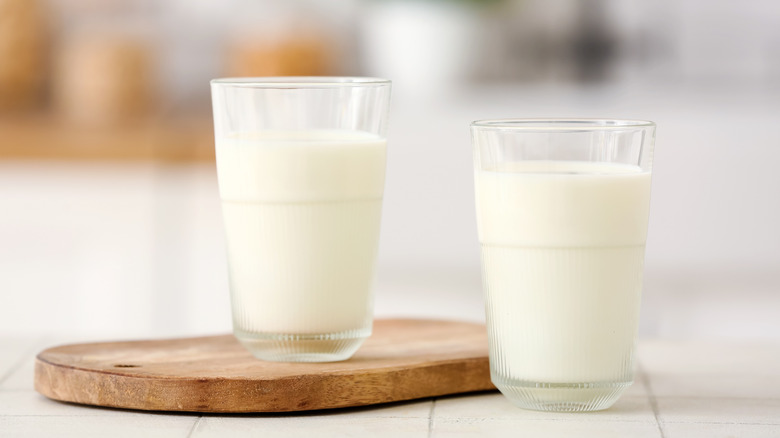
Back in 1980, the first Dietary Guidelines for the Americans were released, with a key pillar of avoiding fat, saturated fat, and cholesterol. By the next update in 1985, the guidelines had expanded to specifically recommend low-fat and skim milk over whole milk — a recommendation that remained in place until 2026.
So, is lower fat milk still the healthier choice? To answer that, you need to consider the full nutritional composition of these two options. Low-fat milk and skim milk are made by removing some of the fat from whole milk, with the remaining fat content indicated by the percentages on the milk carton. Low fat milk has just 1% fat, while skim milk is fat free, compared to 3.25% in whole milk.
Low fat milk is not watered down, despite some rumors to the contrary, so apart from the fat content, the nutritional composition is much the same as whole milk. And likewise for skim milk. In fact, skim contains slightly higher levels of beneficial nutrients.
An 8-ounce glass of skim milk contains 8.4 grams of protein, a little more than the 8.3 grams in low fat milk. Skim milk also contains 411 milligrams of potassium, 157 micrograms vitamin A, and 2.71 micrograms Vitamin D. Compare this with low fat milk which offers 391 milligrams of potassium, 143 micrograms vitamin A, and 2.6 micrograms Vitamin D in the same 8-ounce serve.
Skim milk remains the healthier choice

When comparing the nutritional value of two similar foods, it's often a case of weighing up any trade-offs you might have when trying to avoid unhealthy components such as cholesterol, sodium, or sugar. In this case, however, you're not missing out on anything beneficial.
Low-fat milk is higher in both calories and total fat than skim milk, but this doesn't necessarily make it unhealthier — fat and calories can fit into a balanced diet. What makes the key difference here is the amount of saturated fat, which is linked to increased levels of cholesterol, heart disease, and diabetes. An 8-ounce serving of low-fat milk contains 1.4 grams of saturated fat, while the same amount of skim milk contains less than a tenth of a gram.
Some nutritionists recommend whole milk over lower fat versions, as the fat can help our bodies absorb nutrients such as vitamins A and D. And while this might be true, it's not necessarily a reason to swap your skim for whole milk. Studies have shown that any type of fat aids absorption, so pairing skim milk with a food containing healthier unsaturated fats could be a better choice.