

8 Sodas That Taste Different Now Than They Did In The '80s
Even well-established products can see their taste, flavor, texture, and more change over the years. There are a number of reasons why this happens, from cost-cutting measures to changes in ingredients as health and safety guidelines evolve. Those factors and more have contributed to these sodas tasting noticeably different today than they did back in the 1980s.
The most sweeping change that occurred in the soda industry in the '80s was the industry-wide shift from real sugar to high-fructose corn syrup (HFCS), which is the most obvious reason why '80s sodas stopped tasting the way they did by the time that decade ended. And that certainly plays into a few of these picks. But we didn't want this whole feature to just be a list of sodas that taste different because they switched from sugar to HFCS. So, we found more specific examples, from recipe and formula changes to formerly defunct sodas being relaunched as something different, and other unique reasons.
Oh, and just to get this out of the way — we won't be diving into the whole "New Coke" fiasco. That specific version of Coca-Cola doesn't technically exist anymore, and the Coke we drink today is what was known as "Coca-Cola Classic" until 2009, when the "Classic" branding was dropped. Plus, we've all heard that story a million times by now, and there really isn't much new ground to cover on that front.
Mountain Dew
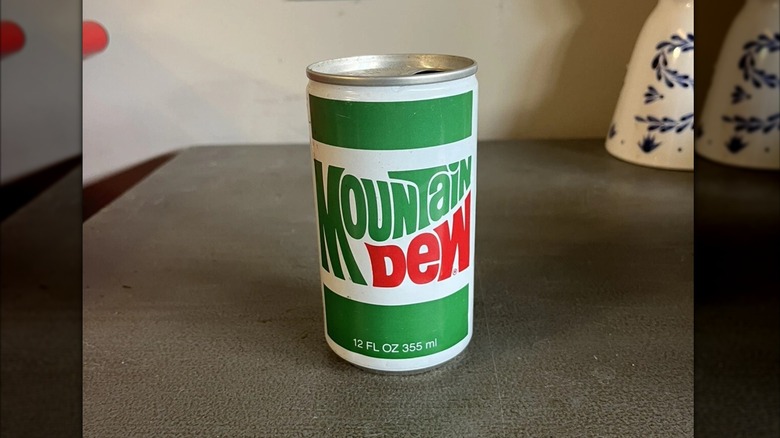
While both Pepsi and Mountain Dew made the HFCS switch, subsequently altering the flavor of both, we are highlighting Mountain Dew here because the change had a much greater effect on the taste of the iconic citrus soda. In an NPR discussion of the throwback versions of each soda released in 2009 — which took out the HFCS and put the cane sugar back in — soda reviewer Steve Tanner said of the respective difference between each current soda and its throwback counterpart, "It's quite a bit more of a dramatic difference in the Mountain Dew Throwback. You're going to find tasty citrus flavor that originally was found in Dew, and not so much the acidic bite that I think has grown into the drink in the last few years."
In fact, some people actually think Pepsi tastes better with HFCS. In a taste test of cane sugar Pepsi and HFCS Pepsi conducted by HuffPost, a little over half the respondents actually preferred the HFCS version. They could indeed taste a difference between the two and assumed that the one that seemed sweeter was the HFCS version and opted for the one with the more subtle sweetness.
If that is also the case with Mountain Dew, it makes sense that the preference would go the other way. Especially since Mountain Dew drinkers — and drinkers of most non-cola soda flavors — are typically looking for a sweeter finish than Pepsi drinkers.
7Up
It probably isn't a huge surprise that modern 7Up tastes different than 1980s 7Up. After all, 7Up has always struggled with confidence in its recipe, and the brand seems to change it every 10-15 years or so. In our August 2026 review of 7Up's latest formula, in which the recipe shifted from being lemon with a twist of lime to lime with a twist of lemon, our reviewer noted that the change resulted in "a slightly robust tanginess that the old formula lacks." But even before that, the flavor of 7Up had gone through changes over the years.
Fans of 1980s-era 7Up recall how different it was from similarly flavored sodas at the time and appreciated that it was its own thing. "It had a unique crisp sweetness and a very unique taste that was nothing at all like Sprite," one Redditor reminisced about 7Up during that decade, before complaining that the soda appeared to subsequently change to be more similar to Sprite and lost what made it special. Replies to that post — and similar ones across social media — also pointed, once again, to 7Up's flavor being made worse after the switch from sugar to HFCS during that era, as the latter sweetener didn't enhance the flavors of the recipe's natural citrus oils as well. Another person also went on to argue, "I think THIS fact and the shift away from pure lime and lemon oils as the sole flavor agents is what changed."
The fact that the 2026 switch was called 7Up's first recipe change in 15 years means that 7Up obviously had yet another recipe change in the early 2010s. So basically, if you've only had 7Up once every decade between the '80s and now, each one would've tasted a bit different than the last.
IBC Root Beer
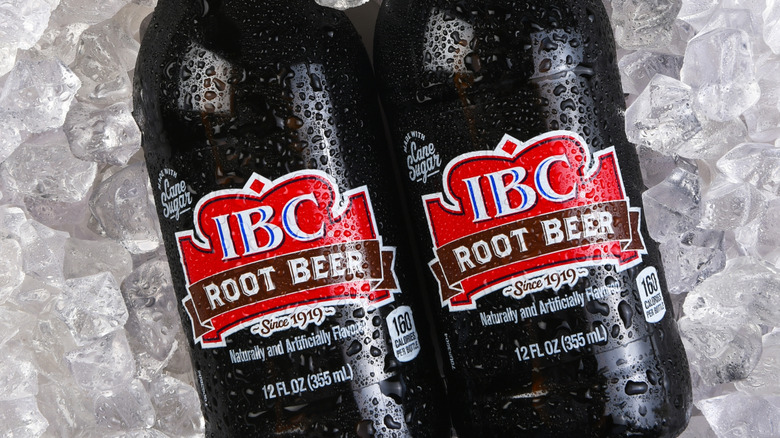
IBC Root Beer finished at a disappointing 14th place in our ranking of the best root beer brands back in 2022. What's interesting about that is the current IBC Root Beer formula actually contains cane sugar instead of HFCS, a permanent change that was made in 2016.
While HFCS is considered the primary offender as to why sodas in general don't taste as good as they used to, it seems like the opposite happened with IBC. IBC had already switched to HFCS when its parent company, The 7Up Company, merged with The Dr Pepper Company in 1986, which is when it became a much more widely distributed beverage. So, the people that fell in love with IBC in the '80s, fell in love with that version.
A Reddit post from 2025 asked whether anyone else had noticed a decline in the taste of IBC, saying that it actually tastes like it contains an artificial sugar substitute despite promising otherwise. And most people agreed that modern day IBC is worse than it used to be. "Man I don't what they have done to the recipe but they have made a huge mistake!" one reply read. Another Redditor made note of the sweetener switch in their complaint of current IBC Root Beer, claiming, "Not only does it taste foul it smells bad too. Like it's got a weird chemical or even bacteria in it.... IDK, can switching to cane sugar do that?"
Slice
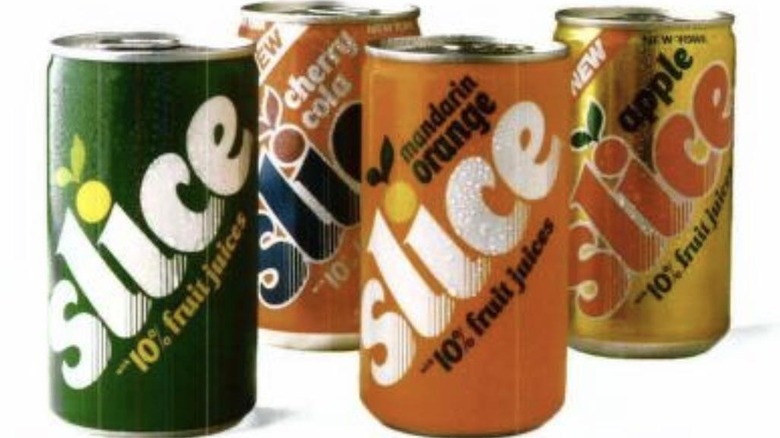
Slice was introduced in 1984, when lemon-lime sodas were all the rage. Despite being a crowded market, it was a hit, and multiple flavors followed. But for as much as '80s kids likely have fond memories of Slice, its popularity had actually already started to wane before the decade was even over. And even among those who still stuck with Slice going into 1990, the flavor had already changed, as the 10% real fruit juice had been reduced to 0%. So, the taste of '80s Slice disappeared when the '80s itself did. Slice stuck it out until the 2000s, but it was gone by the end of that decade.
Though Slice did make a highly publicized return in 2025, it wasn't at all the same product. Modern-day Slice is a line of prebiotic and probiotic sodas that seems to only be called Slice in an effort to nab the attention of those who have fond memories of the original from its surprisingly brief heyday. While sharing some of Slice's classic flavors, like lemon-lime and orange, it goes without saying that a soda boasting prebiotics and probiotics in the 2020s isn't going to taste all that much like a sugary sweet, fruit-flavored soda from the '80s.
Jolt Cola
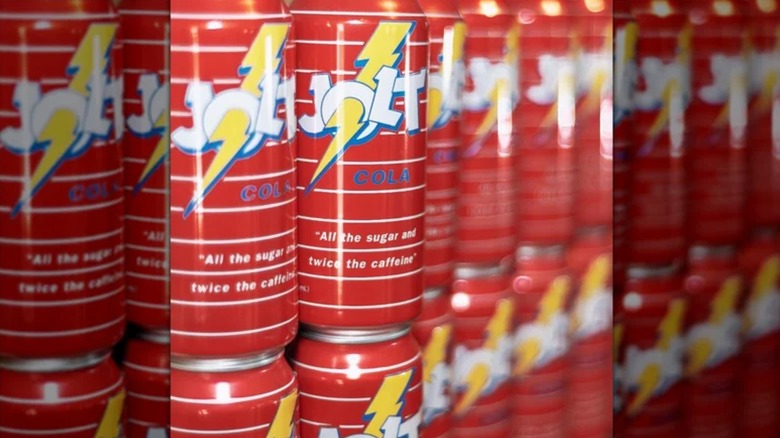
While we proclaimed it a discontinued soda that didn't deserve a comeback, many '80s kids have strong nostalgia for Jolt Cola as the go-to drink for summer camps and slumber parties. Not because it tasted particularly good or anything — in fact, the taste wasn't the point. The point was the marketing and packaging's bold proclamation that Jolt Cola contained "all the sugar and twice the caffeine" as other sodas. Can you imagine a tagline like that even getting past the brainstorming phase of a modern marketing meeting? The person who even suggested it would probably be fired on the spot.
Jolt Cola initially peaked in the mid '80s, saw a brief resurgence in the '90s, and ultimately fell apart in the 2000s, amidst what at that point had become an entire energy drink industry. But with its original fans now hitting that age where they start feeling nostalgic for the stuff they grew up with, Jolt Cola has been revived. Though, like Slice, it's basically by name only.
The relaunch and rebranding of Jolt is now that of an actual energy drink, with a whopping 200 milligrams of caffeine, albeit one that still calls itself a "cola." And like with Slice, the new Jolt Cola — which has zero sugar and is instead sweetened with sucralose — obviously doesn't taste anything like it used to, owing to the fact that it's literally a different product entirely.
Mr. Pibb
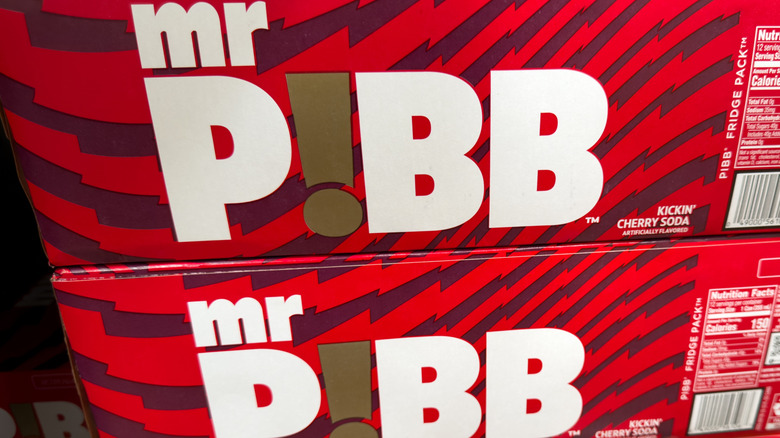
The Mr. Pibb that people had been enjoying in the '80s — though never enough to put even the slightest dent in Dr. Pepper's dominance in the spiced cherry cola market — had already gone away not long after Y2K, when it was reformulated as Pibb Xtra in 2001. Dropping the honorific felt like an attempt to stop trying to position Pibb as a Dr. Pepper competitor and instead have it be its own thing entirely. And it wasn't strictly a name change, either, as the flavor profile was also a bit different, leaning more heavily on the cinnamon spice than the cherry notes that were bolder in Mr. Pibb.
Fast forward another couple of decades, and Pibb was relaunched once again, as Mr. Pibb, in 2025. Calling it a "new-stalgic offering," parent company Coca-Cola was hoping that swinging the flavor pendulum back into cherry territory would both bring back lapsed Mr. Pibb fans as well as hopefully earn the soda some new ones.
The "new" in the "new-stalgic" marketing line should probably clue you into the fact that the current Mr. Pibb, which has 30% more caffeine than the original, isn't attempting to be a straight-up revival of classic Mr. Pibb. Fans of the original say that the new version doesn't taste nearly as flavorful and seems more like a regular cola with just a hint of cherry flavor.
Green River
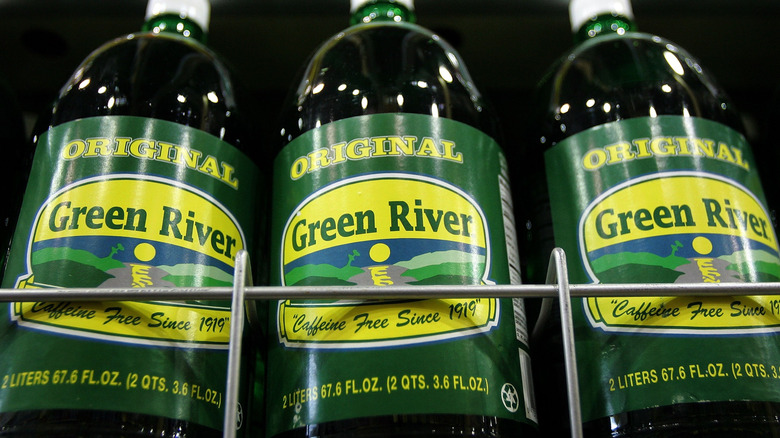
You might not be familiar with Green River if you didn't grow up with the iconic Midwest soft drink, but people from Chicago in particular know the distinctly lime-flavored soda well. In fact, Green River is such a product of its region that it feels disingenuous to refer to it as soda rather than "pop." Even when its overall popularity declined, which happened during the '90s, Green River would still spend a number of years getting an annual sales bump each March, when people would buy it as a seasonal treat for St. Patrick's Day.
To that end, going into the '90s and beyond, Green River would move across several different corporate parents, landing at its current home at Sprecher Brewing Company in 2021. Longtime fans of Green River were happy to know that the pop had returned to its Midwestern roots, as Sprecher is located in Wisconsin.
Unfortunately, it doesn't seem like the classic Green River formula went along for the ride across its various changes in ownership between the '90s and today, with some fans questioning whether there's been a recipe change in recent years. One Reddit user pointed to a shift in Green River's lime profile — which is what makes Green River unique in the first place. "Old stuff straight up tasted like lime jello in the best way," they wrote, adding, "new stuff — idk — more like a disappointing lime candy."
Fanta Orange
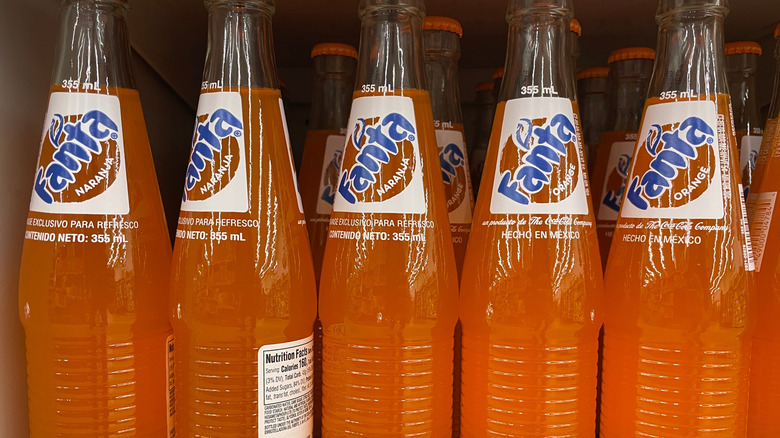
The '80s seemed to be when the fruit-flavored soda wars hit a fever pitch, and Fanta Orange was definitely part of that skirmish. Unfortunately, it would prove to be a casualty of that battle, at least in the U.S., where it quietly went away halfway through the decade after having been much more popular in the '70s. But Fanta survived as a brand because it remained popular worldwide, particularly in Latin American and South American countries. The ubiquitous "Wanna Fanta?" ad campaign in the early 2000s attempted to revive the brand in the U.S., but it didn't end up leading to a huge popularity resurgence for the struggling soda.
Well, Fanta Orange is back once again — with, you guessed it, a new formula. In 2023, Fanta Orange was revived with the promise of it having the strongest orange flavor that it has ever had before. But orange soda fans aren't impressed, with some thinking the new Fanta Orange might actually be too orange (or at least, fake orange) for its own good.
One Redditor said of the change, "It now tastes like intense artificial orange." Meanwhile, YouTuber PapiEats did a review directly comparing the new formula with a bottle of the old recipe that was being phased out. "This one's sweeter; this one tastes faker," he said of the newer recipe, before describing the old formula as tasting better because "it tastes more natural to me."