

The Difference Between McDonald's And Culver's Fish
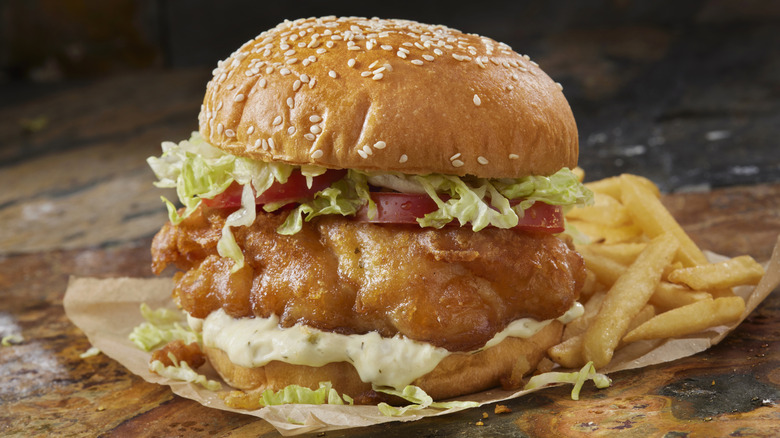
Fish sandwiches often feel like an afterthought at most fast food places, but at McDonald's and Culver's they stand out. The Filet-O-Fish is probably the single most iconic fish sandwich in fast food, becoming McDonald's first non-burger sandwich in 1965. And Culver's emphasizes the quality of its fish and its midwestern connection to the popular fish fry tradition. But the two are interesting comparisons in another way, as each one uses a different fish — pollock at McDonald's and cod at Culver's
In 2013, McDonald's switched to pollock in an attempt at more ethical sourcing. Now it touts the sandwich as being made with 100% sustainably-sourced fish. The wild-caught pollock comes from Alaska, which has the largest sustainable fishery independently verified by the Marine Stewardship Council. Culver's cod is North Atlantic cod sourced from the Barents Sea, above the Arctic Circle. The Barents Sea cod fishery is also considered well-managed and sustainable. It should be noted that Culver's also has a seasonal walleye sandwich, but we're focusing on the sandwich available year-round.
Both are considered mild white fish, and pollock is actually a part of the cod family. If there is any noticeable difference, its that cod is considered a little sweeter. Instead the contrast is more in texture. Both are flaky, but cod tends to have larger, meatier flakes, while pollock is softer and more delicate.
McDonald's pollock and Culver's cod are very similar nutritionally and in flavor
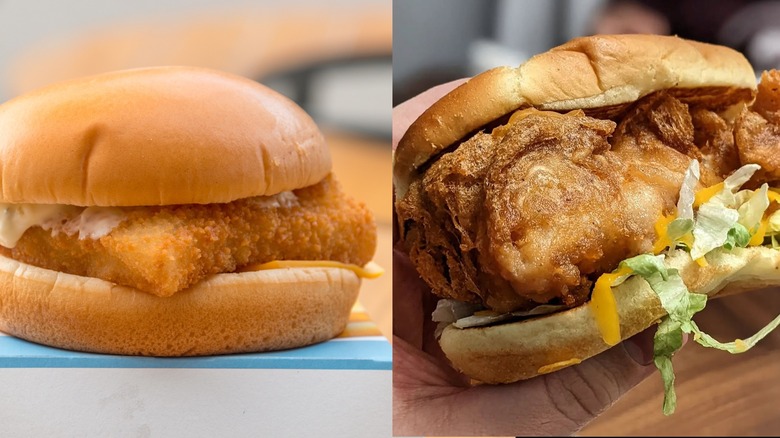
Being relatives the Alaska pollock and Atlantic cod are also very close nutritionally. According to the U.S. Department of Agriculture (USDA), North Atlantic cod has 16.1 grams of protein per 100 grams, with Alaska pollock having 17.3. Both are also very lean, with pollock only having .24 grams of saturated fat, and wild-caught cod having even less at .05 grams. But the numbers are so small for both, it makes little difference.
Interestingly there is a decent difference in sodium levels between the two. Wild North Atlantic cod has 299 milligrams, while Alaska pollock only has 115. Sodium is an essential nutrient, so some is fine, but the FDA recommendation is to stay under 2,300 milligrams per day as a maximum. That means just one 100 gram serving of cod, which is only 3.5 ounces, has 13% of your daily sodium before you add any salt. That's not too much for the nutrition you are getting, but when you add in salt, batter, and toppings for a fish sandwich, you may want to start looking at those sodium levels.
That one concern aside, both pollock and cod are considered nutrient dense, and healthy, lean types of white fish. Both McDonald's and Culver's offer you a fish sandwich with real fish from sources you can actually follow, which isn't always a guarantee in fast food, and both can fit into a balanced diet now and then with no issue.