

What's The Lifespan Of Propane In A Grill Tank? What To Know Before You Put Away The Grill For Winter
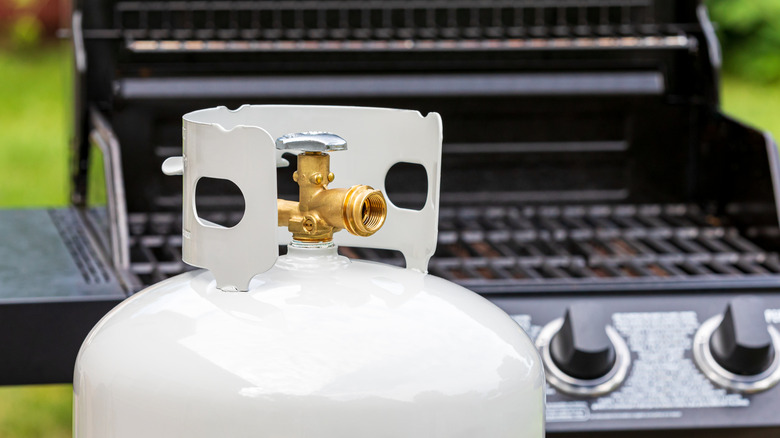
The last burgers of the season are off the grates and the grill's propane tank still has some mystery amount of fuel in it. Before you wrestle the cover onto the grill, you might wonder whether that leftover propane will still be good by spring. Luckily, it will be — and for a long time after that, too.
Unlike gasoline, which can "spoil" over time from evaporation and oxidation, propane is chemically stable. A review in the journal Chemical Synthesis describes it as chemically inert, with bonds that resist breaking down. That's how, in a sealed container, propane can easily last and remain usable for years. A standard 20-pound propane tank gives you around 20 hours of cooking, so there's a good chance you'll head into winter with some left.
The tank, however, doesn't last forever. Steel cylinders can rust, dent, and wear out around the valve — all of which are potential hazards. That's why, under U.S. Department of Transportation rules, a portable propane cylinder has to be requalified within 12 years of the date it was made. Furthermore, you wont' be able to get a refill with a tank that's overdue. To check yours, look for the manufacture date stamped on the metal collar around the valve. A tank marked "10-14" was made in October 2014, so it's due for a checkup.
The only thing in the tank that "goes bad" is the rotten-egg smell. Propane is naturally odorless, so suppliers add ethanethiol — a chemical with a rotten-egg scent to make leaks noticeable. The chemical can fade over time, which is why a soapy-water leak test is more reliable while you're checking an old propane tank.
How tank requalification works, and how to store your tank for winter
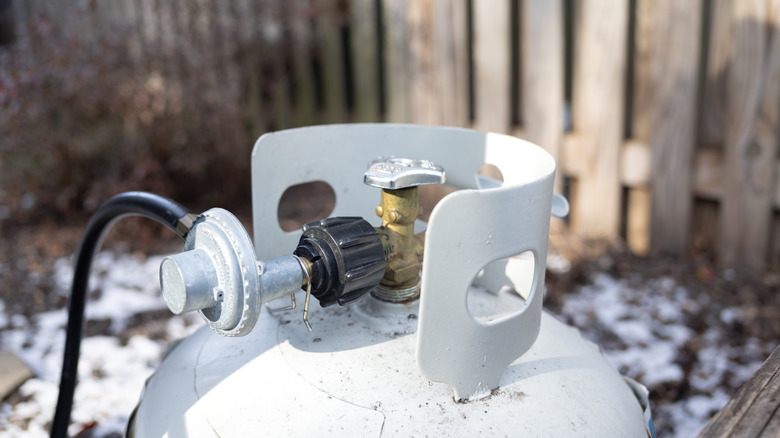
If your tank is coming up on its 12-year mark, requalificationis a fairly quick job. For starters, it has to be done by a facility registered with the DOT, and many propane dealers are. For the cylinders used on grills, the test is an external visual inspection: A technician checks the tank for dents, gouges, bulges, rust, fire damage, and a leaking or damaged valve or pressure-relief device. A tank that passes gets marked with the requalifier's ID number, the month and year, and a letter showing how it was tested. An "E" means the tank is good for five more years, an "S" means 10, and no letter means 12. A tank that fails can't be refilled and will need to be properly disposed of. If you swap tanks at an exchange cage instead of refilling, the exchange company takes care of inspections for you.
As long as it is still in-date, you can store your grill's propane tanks with peace of mind. Close the valve and disconnect the tank from the grill. Brush soapy water around the valve, too — if you see bubbles, that means there's a leak, and the tank should go back to your supplier. Otherwise, it can stay outside for the winter, standing upright in a shady spot.
Before storing your grill for winter, scrape out the grease, scrub the grates and interior with soapy water, and rub a thin coat of cooking oil over the grates to prevent rust. The grill can spend the winter in the garage, but again — and we can't stress this enough — leave the tank outside.