

6 Forgotten Baking Mixes Of The 1960s
We may receive a commission on purchases made from links.
Let's be real: Not everyone has time to whip up extravagant baked goods from scratch. Heck, in this busy, overstimulating world, not many people have time to whip up any baked goods from scratch. Thank goodness for cake mix, then, which is just as popular as ever. Per Fortune Business Insights, the cake mix market was valued at more than $2.8 billion in 2026, and is set to exceed $3.7 billion by 2034. This obsession with baking mix isn't unique to the 2020s, though. It has roots that go back decades; for instance, during the 1960s, baking mixes were all the rage.
Invented in the early 1900s, pre-made baking mixes started to pick up in popularity during the 1950s, and were everywhere by the 1960s. Quite frankly, the market was saturated with options, some of which stood the test of time — looking at you, Betty Crocker Angel Food Cake Mix – and some of which, well, didn't. In honor of our fallen frosted soldiers, we're stepping down baking mix memory lane, and taking a closer look at some of the products that, rightly or wrongly, didn't make it into the 21st century.
Betty Crocker Country Kitchen Cake
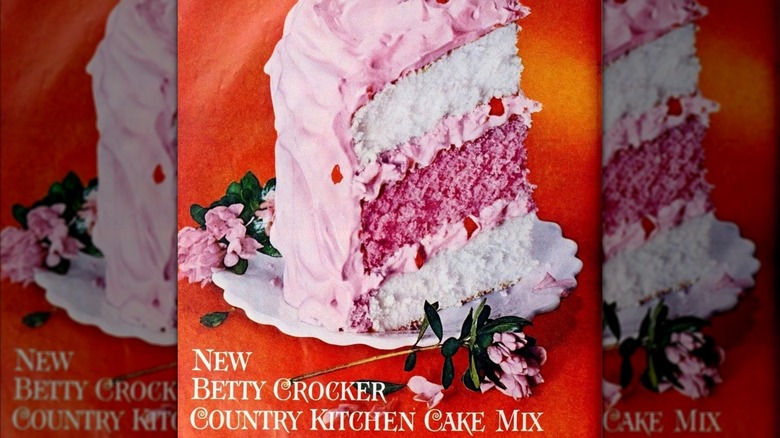
Brands knew that to stay relevant in the competitive cake mix world of the 1960s, they really had to crank things up a notch. General Mills' solution was to create a cake mix that outperformed its predecessors on moist, creamy, fluffy goodness. So, in 1960, Betty Crocker Country Kitchen Recipe Cake Mix hit the shelves. "It bakes up Country Kitchen good," Betty Crocker herself declares — or rather, the (spoiler alert) actress playing her does – in the original commercial.
The cake mix line came in eight flavors, including Devils Food, Black Walnut, and White Cake. The latter was often used as a base for Pink Azalea Cake, as well, which is a pink, cherry-flavored cake, and one of Betty Crocker's signature recipes from the 1950 "Betty Crocker's Picture Cook Book." And while it's now discontinued (it's hard to deduce exactly when, but let's say long ago), some say it still looks pretty tasty.
"It looks really good, and I'm not much of a cake guy," said one Redditor in r/vintageads, underneath a 1960s print ad for the Country Kitchen White Cake Mix. "Looks like the inside of a bounty bar with cream on top," another added, "which is my type of thing."
Betty Crocker Dole Pineapple Cake
If you grew up in the 1960s, there's a good chance that Betty Crocker was a big part of your childhood. The fictional cook was omnipresent in American households through her cookbooks, recipe cards, and cake mixes. Through Betty Crocker, General Mills was pretty good at innovating new and interesting flavors for its cake mixes; there was lemon velvet, for example, as well as colorvision cake (which was fruit gelatin combined with Betty Crocker Party Cake Mix). Plus, in the late 1960s, there was Dole Pineapple.
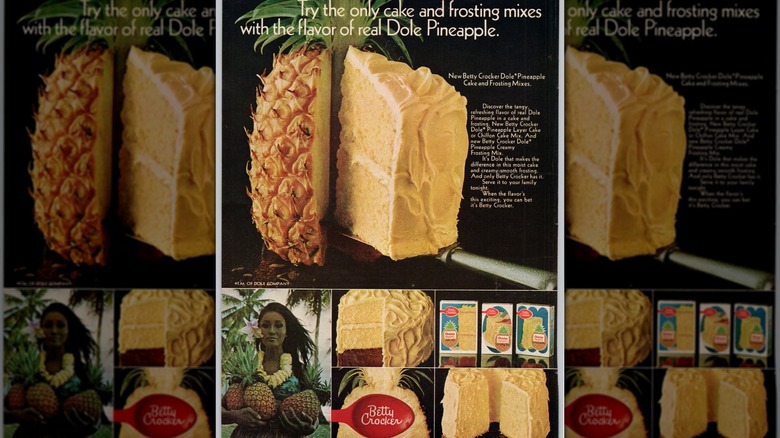
Yep, Dole and Betty Crocker formed a dream team to create Betty Crocker Dole Pineapple Cake Mix, Dole Pineapple Frosting Mix, and Dole Pineapple Chiffon Cake Mix. Not to be confused with Betty Crocker's Pineapple Upside Down Cake Mix, the finished cake was supposed to be fluffy, tangy, moist, and deliciously creamy.
In a bid to transport people away from their kitchens, the print advertisements even featured a woman wearing a lei with a flower in her hair and carrying three fresh pineapples. They're still working, too, despite the fact the Dole Pineapple Cake Mix is one of many boxed cake mixes that isn't around anymore. "I'd buy that pineapple cake mix if they still sold it today," commented one Facebook user in a group for 1960s and 1970s ads. "This looks incredible," added another user.
Pillsbury's pink lemonade angel cake
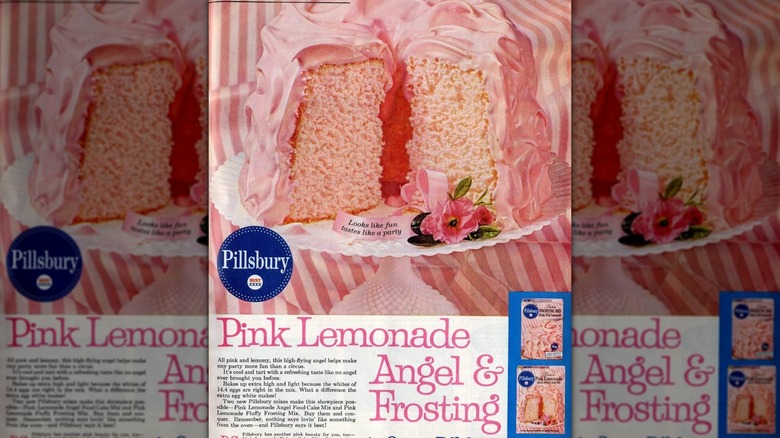
Betty Crocker wasn't alone in the cake mix aisle in the 1960s, of course. Pillsbury was also doing its best to capture the attention of housewives across the nation. It had an abundance of options, including Bavarian Creme, Swiss Style, Lord Baltimore, and even Pink Lemonade Angel Food Cake Mix.
Many of Pillsbury's discontinued mixes deserve a comeback, but, we have to admit, the Pink Lemonade Angel Food Cake Mix is especially eye-catching. Launched in 1961, the cake mix was supposed to be paired with the brand's Fluffy Pink Lemonade Frosting Mix to make a decadent, refreshing, light and lemony showstopping sponge straight from Barbie's Dreamhouse (which, coincidentally, was also launched in the early 1960s). Though one drawback is probably the fact that each box contained the whites of 14.4 eggs. For context, that's more than double what the average cake typically requires.
However, if you're not put off by the egg content, you can still make the Pink Lemonade Angel Cake. The mix isn't around anymore, but the recipe for the original is still floating around, thanks to Pillsbury's "Best of the Bake Off Collection" cookbook, published in 1959. Yes: The cake mix was actually based off of a real recipe (with a marginally more modest 12 eggs).
Pillsbury's Fudge Macaroon mix
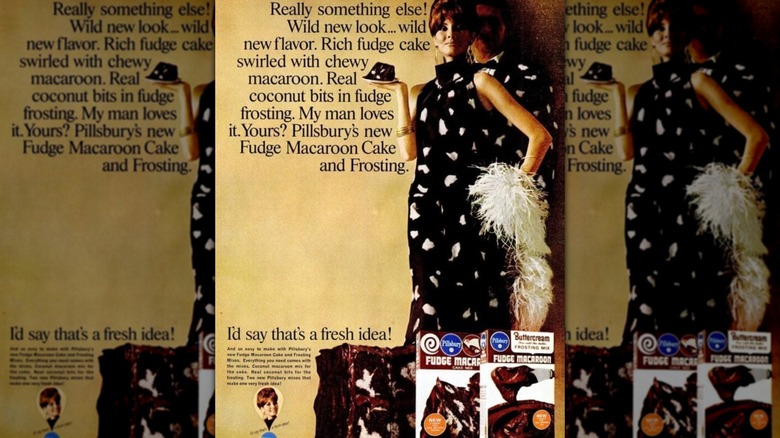
As we've established, innovation was key in the cake mix category. Another example of Pillsbury taking things to the next level? Its Fudge Macaroon mix, which featured real bits of macaroon and coconut pieces in the frosting. Pillsbury clearly wanted to give the impression that this mix wasn't just a new idea, it was a classy one. The print ad features a woman dressed to the nines holding a slice of cake in one hand, with a feather boa wrapped around the other.
Despite the glamorous ads, the mix was still really for families, and it became a favorite of many children across the U.S. during the decade. "This was my favorite birthday cake as a kid," recalls one Facebook user in a group for retro ads. "I remember it so well. My mom made it in one layer and frosted it with Hershey's fudge topping."
Duncan Hines' Dutch Topping Mixes
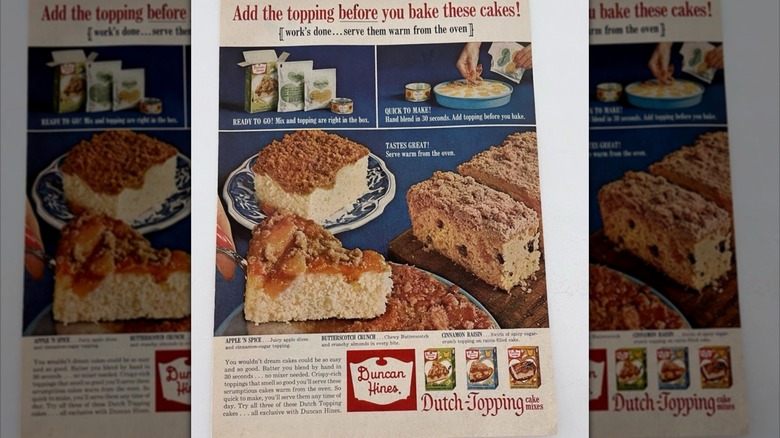
Of course, Duncan Hines has also long been a major cake mix name, too. There are many mixes from the brand that arguably deserve a revival, including its popular Dutch Topping Mixes. First advertised back in the early 1960s, the mixes were unique because they contained both the cake mix and the toppings in the same box. The idea was that bakers would literally add the topping before the whole cake went in the oven (easy peasy).
The Dutch Topping mixes came in three varieties: Apple 'N Spice, Cinnamon Raisin, and Butterscotch Crunch. But while the mixes were exclusive to Duncan Hines, the concept wasn't actually the brand's idea. The inspiration was likely Pennsylvania Dutch Crumb Cake. That's traditionally baked with the topping sprinkled on, and has a signature crumbly, buttery texture. To be fair to Duncan Hines, it did give credit where it was due. One of the print ads described it as "a happy idea from the Pennsylvania Dutch."
Duncan Hines Early American cake mixes
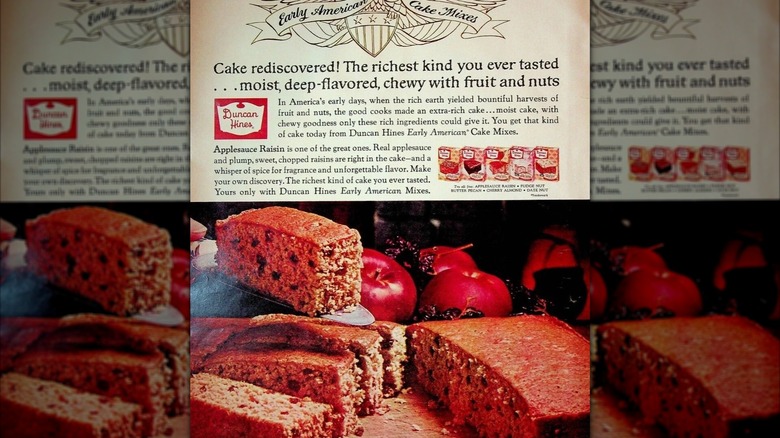
In the 1960s, people were pretty fascinated with the American frontier. Case in point: Around 500 spaghetti westerns were produced between 1964 and 1973. Duncan Hines was willing to bet that people would also be willing to move this obsession into the kitchen. So, in 1961, it released its Early American Cake Mixes, which, of course, were advertised by women in traditional colonial American clothing baking a cake over the fireplace.
In general, the advertising played into nostalgia for the "old days," implying that pioneer-made cakes were better than any of modern recipes. True or not, Duncan Hines was willing to bet it would work, and released five flavors of Early American Cake Mixes: Applesauce Raisin, Fudge Nut, Butter Pecan, Cherry Almond, and Date Nut.
It's hard to figure out exactly when they were last sold, but the Early American cake mixes haven't been around for a while. Still, if you, like a 1960s American, are eager to relive the past, you can still eat many of the same foods that pioneers ate on the Oregon Trail, for example. Although we have to be honest, it was less about indulgent cake and more about making do with dried fruits, cornmeal mush, and pinto beans.